
Your rabi pulse block is a mix this year: chickpea on the upland, lentil on the medium soil, a strip of mustard and some field bean on the border plot. Walking that block in the last week of October, the question is never whether to use biofertilizers. It is which culture goes on which crop, and at what dose per acre. A Rhizobium packet does nothing useful on mustard, and a phosphate culture alone leaves the nitrogen side untouched on a legume.
This guide is a working chart for the rabi pulse group (rabi ki dals) sown from the second half of October through November 2026. It puts each crop against the culture it actually needs, the typical dose range, and the method that suits your sowing setup. Use it as a checklist before you buy, then confirm every number on the product label.
Start With the Crop, Not the Packet
Every pulse in your block fixes nitrogen through a different partnership, or none at all. Chickpea, lentil and field bean (bharta, lobia) host Rhizobium in root nodules and pull atmospheric nitrogen into the plant. Mustard, fenugreek and coriander are not legumes; they take nitrogen from the soil pool and give nothing back, so they need a different microbial partner.
Phosphate and potash are the other half. Band phosphatic fertilizer in cold rabi soil sits close to the row where roots cannot reach it, and a phosphate solubilizing bacteria (PSB) culture works on exactly that fixed phosphorus. Potash mobilizing microorganism (KMB) does the same job for potassium locked in illitic soils, which covers a large part of the Malwa and eastern Rajasthan belt.
So the pairing logic is simple: legume gets Rhizobium plus PSB, non-legume rabi crop gets a free-living nitrogen culture plus PSB, and sandy or potash-deficient soils get KMB on top. For the nodulation side of this, our Biofertilizer seed treatment guide for rabi crops covers the coating method in detail.
What Each Culture Actually Does
Rhizobium. A host-specific bacteria that enters root hairs within the first couple of weeks and forms nodules. One inoculated crop can cover a large share of its nitrogen need, so the top dressing you skip is the real saving. Use the strain matched to your crop: the chickpea group and the lentil group are not always interchangeable.
PSB. Dissolves unavailable phosphorus from fertilizer residue and native rock phosphate through organic acids. Best placed with the seed or in the furrow, because it works within a few centimetres of roots, not across the whole field.
KMB. Mobilises potassium from silicate minerals and improves the plant's water handling, which farmers in our Chittaurgarh and Mandsaur enquiries notice first as better standing through a dry spell.
Azotobacter and Azospirillum. Free-living nitrogen fixers for crops that cannot nodulate. On mustard and coriander they add a modest nitrogen stream and stir up rhizosphere activity around the taproot.
A multi-species blend is convenient, but a blend carries each organism at a fraction of the single-culture count. Where the crop has a clear partner, buy the single culture. Our PSB multiplier and KMB multiplier are used to raise carrier or liquid cultures for growers running their own inoculation.
The Crop-by-Crop Chart
The numbers below are typical published ranges for standard carrier formulations at 10^8 to 10^9 cfu/g, per acre of seed or slurry. Concentrates and liquids run lower per acre, so read your label before you measure.
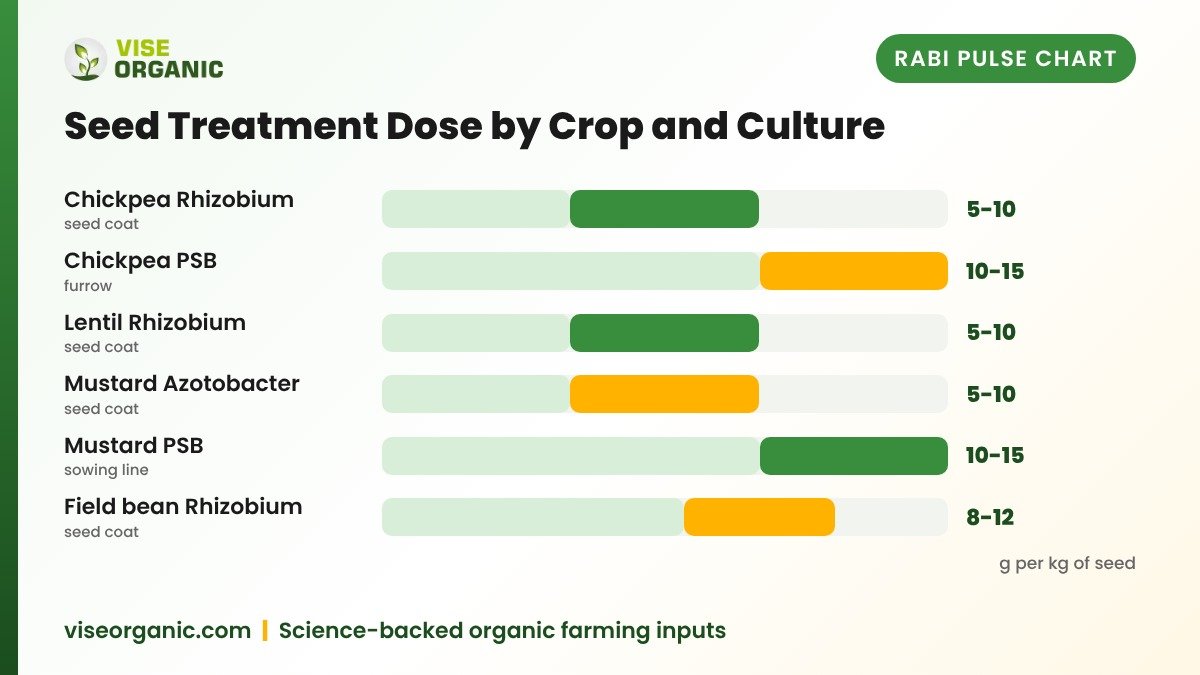
Read that as two lines per crop where the crop needs two partners. Chickpea and lentil usually go out with Rhizobium on the seed and PSB in the furrow or as a slurry drench. Mustard gets Azotobacter on the seed with PSB placed in the sowing line. Field bean takes a slightly heavier Rhizobium rate because the seed is large and the nodule population has to establish in cool soil.
Timing and Method for Late Sowing
Late sowing is the real constraint this season in much of Rajasthan and Madhya Pradesh, where the chickpea went into the ground 10 to 15 days behind normal. Cool soil at 8 to 12 degrees Celsius slows nodule formation badly, so the method you choose matters more than the brand.
- Check the date on the pack. Carrier cultures lose count fast after opening; a packet that sat in a dealer's godown through summer is worth far less than the label says.
- Treat seed in the shade, evening or early morning. Mix the culture into 200-300 ml of clean water with a spoon of jaggery or gum, coat 10 kg of seed, and dry on a gunny sheet away from sunlight for 30-45 minutes.
- Place PSB in the row, not onBroadcast. Broadcasting 2 kg of PSB on the surface of a cold field wastes most of it. Put it with the seed in the furrow or in the 5 cm around the seed line, where roots will pass through it in week two.
- Sow deep enough. In late sowing, 5-7 cm with adequate moisture gives the inoculated seed a better chance than a shallow 3 cm in dry top soil.
- Do not coat fungicide and culture together. Treat the seed with a chemical fungicide first, dry it fully, then apply the culture, or skip the fungicide on inoculated seed and rely on a clean seed lot.
- Keep the seed bed moist for 7-10 days. Nodule infection fails in dry soil more often than it fails from bad culture.
Inoculate the crop that can use it, and place the phosphate where the root will actually go. Those two rules carry most of the benefit.
If you are using liquid cultures instead of carrier, our guide on How to store and handle liquid biofertilizers explains the shelf and dilution points that change the dose.
Where KMB and Organic Carbon Fit
KMB is not a universal add-on. It earns its place on soils testing low in available potassium, on the sandy loams of Saurashtra, and on continuous wheat or mustard rotations where potash removal has outpaced the dose. Typical soil application runs 1000-2000 g per acre worked into the top 5-7 cm at the pre-sowing irrigation. See the KMB potash guide for rabi sugarcane for how it behaves in a long-duration crop.
The second, larger lever is soil organic carbon. Microbial cultures need food. A field at 0.4 percent organic carbon will not respond the way one at 0.7 percent does, no matter how good the packet is. That is where humate and seaweed inputs do their best work alongside the cultures.
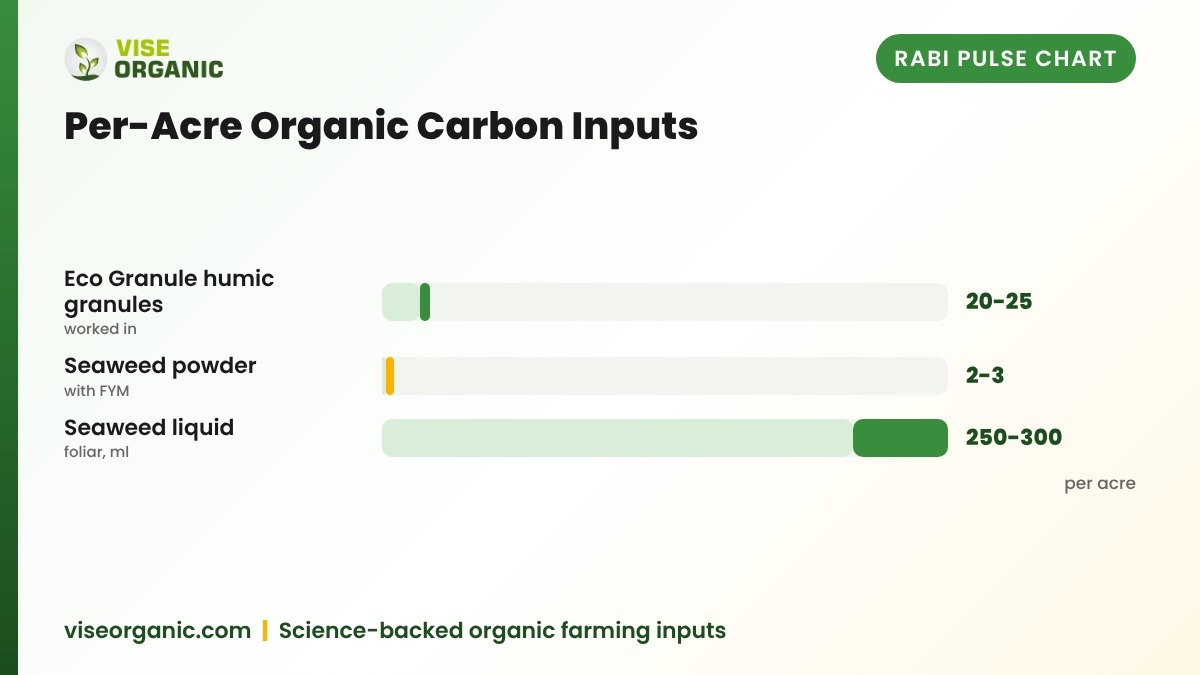
Humates do not replace the nutrient; they improve what the roots and the microbes can hold on to, and they buffer a saline or high-pH seed bed. Our Eco Granule and Secure Power seaweed powder are both granular or powder inputs you can run through the same pass as the sowing fertilizer. For the carbon side of the rabi wheat block, read our Soil organic carbon guide for compost and humate.
Mixing Rules and Field Mistakes
Most failures we hear about in a phone call are handling, not product. Cold soil, hot water and a drum that had phenyl in it account for nearly all of them.
- Never mix cultures with chemical fungicide or bactericide in the same water. Unless the label explicitly allows it, apply them separately and at least 5-7 days apart.
- Use plain water only. Chlorinated tap water, hard water and leftover spray-tank detergent kill the live count on contact; our note on Irrigation water quality and biofertilizers gives the simple bucket test.
- Mix the full dilution in under 2-3 hours. A tank left standing in the sun through the afternoon is a dead tank.
- One culture per crop on the seed. Two Rhizobium strains on the same seed compete; the weaker one is simply wasted money.
- Adjust for your own soil test, not your neighbour's. Where the soil test already shows high available phosphorus, halve the PSB placement and put the money into carbon instead.
Safety and Label
Read the label before you open anything: cfu count, batch date, crop specificity and the storage note. Wear gloves and a mask while mixing powder cultures, and wash hands before eating. Store packets in a cool dark place between 15 and 30 degrees Celsius, away from direct sun, insecticides and the chemical fertilizer pile; a shaded room, not the store room with the fungicides. Never store mixed liquid in a spray tank overnight. Keep all cultures and humate bags away from children and away from wells, hand pumps and ponds. If a packet is bloated, caked hard or smells sour, return it rather than using it.
Frequently Asked Questions
Which biofertilizer is best for chickpea in rabi?
Rhizobium specific to the chickpea group, at 5-10 g per kg of seed as a seed treatment, plus PSB placed in the sowing line at 1000-2000 g per acre. Confirm the strain and dose on the pack label.
Can I use the same Rhizobium packet on lentil and chickpea?
Not reliably. Rhizobium is host-specific, and a chickpea-group strain often nodulates lentil poorly. Buy the culture named for your crop, or a pulse blend that lists both hosts.
Does mustard need a biofertilizer at all?
Mustard is not a legume, so Rhizobium does nothing for it. A free-living culture such as Azotobacter at 5-10 g per kg of seed, with PSB in the row, is the usual pairing, and results depend on your soil's existing fertility.
What is the KMB dose per acre?
Typical soil application is 1000-2000 g per acre, worked into the top 5-7 cm at the pre-sowing irrigation. Use it where the soil test shows low available potassium, and treat the label as the final word.
Can I mix biofertilizer with DAP in the same bucket?
Do not put cultures into a concentrated fertilizer solution. Mixing with dry fertilizer for a furrow application is workable if it goes into the soil within an hour, but never dissolve the culture in a DAP or urea solution.
My sowing is 10 days late. Is seed treatment still worth it?
Yes, and it matters more, not less, because cool soil delays nodulation and a good coating gives the plant a head start. Keep the seed bed moist for the first 7-10 days so infection can happen.
How do I know the culture is still alive?
Check the batch date and the cfu count on the label, and reject packets that are caked, bloated or sour-smelling. For a real check, ask your KVK for a simple viability test before you treat a whole block.
Conclusion
Pick the culture by crop, not by habit: Rhizobium with a phosphate culture on chickpea, lentil and field bean, a free-living nitrogen culture with PSB on mustard and other non-legume rabi rows, KMB only where the potassium test or the soil type asks for it, and organic carbon high enough for the microbes to survive. That is the whole chart for rabi pulse biofertilizer selection. Start from Our product range, check the label dose against the numbers above, and Write to Vise Organic or Request a callback if you want the plan matched to your soil test.
Disclaimer: This article is general agronomic information. Results vary with soil, crop, weather and practices. Always read and follow the product label and consult a local agronomist for advice specific to your field.
Article Topics & Tags:
Vise Agronomy Team
The in-house agronomy and field research team at Vise Organic Biotechnology, publishing applied research on bio-fertilizer protocols, crop protection, and sustainable cultivation practices.