Irrigation Water Quality and Biofertilizers: Farm Guide
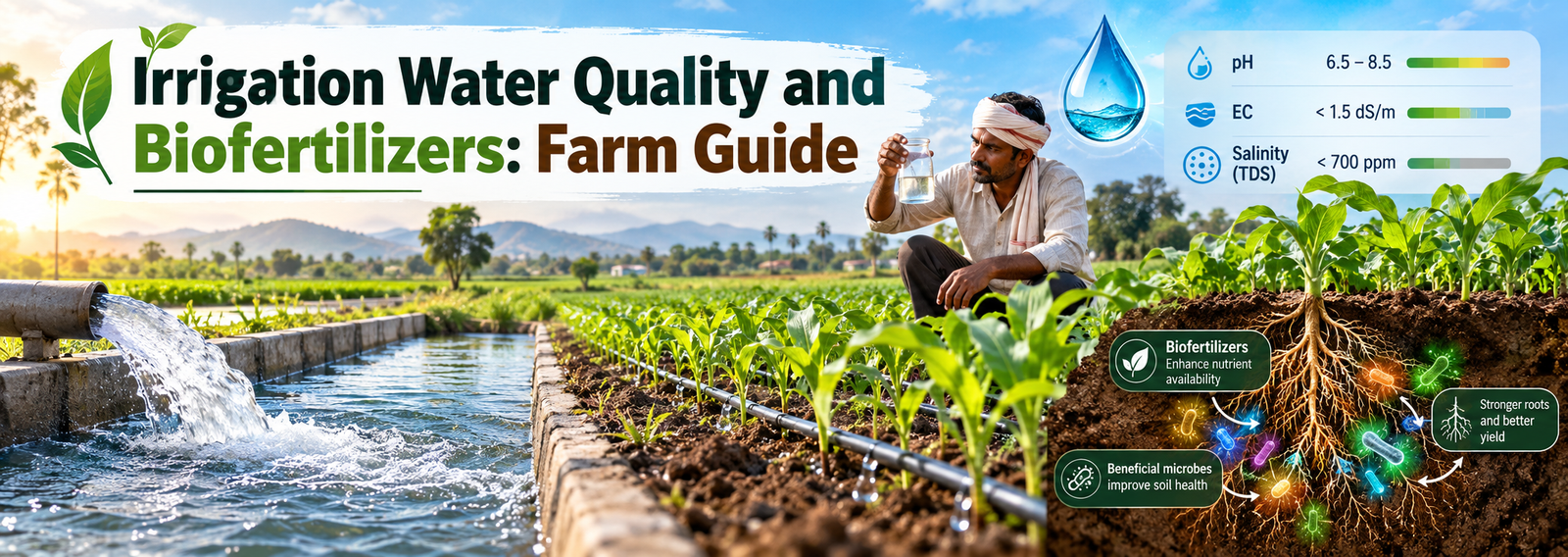
Irrigation water quality and biofertilizers should be considered together when farmers plan a microbial nutrient-management programme. Biofertilizers contain beneficial microorganisms, but those organisms still have to function in the real root-zone environment. If irrigation water contributes excessive salts, sodium or other problematic ions, crop roots and soil biology can face additional stress.
That does not mean a biofertilizer will automatically fail whenever irrigation water is imperfect. It means farmers should understand the water source, soil condition, crop tolerance and product instructions before expecting consistent field results.
Why Irrigation Water Quality Matters
Irrigation water carries dissolved salts and minerals into the field. FAO guidance explains that the effect of irrigation water depends not only on the water itself but also on soil properties, drainage, crop tolerance and management. Salts can accumulate in the root zone when water evaporates or is taken up by plants, especially where drainage or leaching is inadequate.
Salinity affects crop water uptake
As root-zone salinity rises, plants may need to use more energy to take up water. This can reduce growth even when the soil looks moist. Salt-sensitive crops and young seedlings can be particularly vulnerable.
Sodium can affect soil structure and infiltration
High sodium relative to calcium and magnesium can create infiltration and permeability problems in some soils. FAO and USDA guidance therefore evaluates sodium risk together with electrical conductivity rather than using sodium concentration alone.
Specific ions can matter too
Chloride, boron and bicarbonate may create crop or irrigation-system concerns at elevated levels. The practical meaning depends on crop sensitivity, irrigation method and local conditions.
How Water Quality Can Influence Biofertilizer Performance
Biofertilizers are living microbial products. Their value depends on viable organisms reaching a suitable environment near seeds, roots or soil surfaces. Water quality can influence that environment indirectly through soil salinity, osmotic stress, nutrient chemistry and changes in soil physical condition.
Salinity can alter microbial activity
Research on plant-growth-promoting bacteria shows that salinity can affect microbial communities and plant–microbe interactions. Some strains are more salt-tolerant than others, so field performance cannot be predicted from the product category alone.
Root stress can change the crop response
If salinity reduces root growth or water uptake, the crop may respond differently to nutrient inputs. A microbial inoculant may support a specific nutrient process, but it should not be treated as a substitute for correcting serious irrigation-water or drainage problems.
Compatibility depends on the formulation
Do not assume that every biofertilizer can be mixed directly into every irrigation source or tank. Follow the label for dilution, application route, timing and compatibility. When in doubt, use the product's recommended carrier or application method rather than improvising a concentrated mix.
What Farmers Should Test in Irrigation Water
A laboratory water analysis is much more useful than judging quality by taste, colour or visual appearance. The exact testing panel depends on the crop and region, but common irrigation-water indicators include:
FAO's widely used irrigation-water guidelines place water into broad restriction categories, but these values are screening tools rather than universal pass/fail limits. Crop tolerance, soil texture, drainage and climate all influence the final recommendation.
Use Soil and Water Tests Together
A water report shows what is entering the field. A soil report shows what is already happening in the root zone. Using both together provides a stronger basis for biofertilizer planning.
Check soil EC and pH
If irrigation water contains significant salts, soil EC can show whether those salts are accumulating. Soil pH provides additional information about nutrient availability and microbial conditions. For a deeper explanation, read Soil pH and Biofertilizers: A Practical Farmer Guide.
Review drainage and infiltration
Poor drainage can allow salts to accumulate even when irrigation water is only moderately saline. Waterlogging can also reduce root-zone oxygen, creating a different stress for both roots and aerobic microorganisms.
Track the trend, not only one result
Seasonal water quality can change, especially where farmers alternate between groundwater, canal water and stored water. Repeated testing can reveal whether salinity or sodium risk is increasing over time.
Choosing a Biofertilizer Under Challenging Water Conditions
Start with the crop and nutrient objective. Then consider whether the soil and water environment is suitable for the intended microorganism.
For phosphorus management
Phosphate-solubilizing bacteria are used to support phosphorus availability through microbial processes. Farmers considering this category can review Vise Organic's Phosphate Solubilizing Bacteria and follow its current crop-specific instructions.
For biological nitrogen support
Azotobacter-based products are used in selected crops as part of biological nitrogen-management programmes. See Azotobacter Liquid Based for product information and application guidance.
For multi-nutrient microbial programmes
Consortium-type products can combine microorganisms with different nutrient functions. Their use should still be matched to crop need, soil testing and water conditions rather than assumed to overcome salinity or sodicity by themselves.
Practical Steps Before Applying Biofertilizers Through Irrigation
- Test the irrigation source for EC and other locally relevant parameters.
- Review soil EC, pH, texture and drainage condition.
- Confirm the crop's salinity sensitivity and growth stage.
- Select the biofertilizer for a defined nutrient-management purpose.
- Check whether the label allows soil, drip, drench or irrigation-water application.
- Avoid mixing microbial products with unverified chemicals, disinfectants or highly concentrated fertilizers.
- Use clean equipment and follow the recommended dilution and application sequence.
- Apply at the recommended time and maintain suitable root-zone moisture after application.
- Keep records of water EC, soil condition, product batch, application date and crop response.
For additional timing guidance, see When to Apply Biofertilizers for Better Crop Results.
Common Mistakes to Avoid
Assuming clear water is good-quality water
Dissolved salts are invisible. A clear borewell or canal-water sample can still contain enough salinity or sodium to affect crop and soil management.
Using one EC number as a complete diagnosis
EC is useful, but it does not identify which ions are present. Sodium hazard, chloride, boron, bicarbonate and crop sensitivity may require separate interpretation.
Expecting biofertilizers to repair salinity problems alone
Beneficial microbes can support plants under some stress conditions, and research continues on salt-tolerant plant-growth-promoting microorganisms. However, biofertilizers should complement—not replace—appropriate drainage, irrigation scheduling, salt management and crop selection.
Ignoring storage and water temperature
Microbial products should be stored and handled according to the label. Avoid leaving diluted microbial products in hot tanks or direct sunlight longer than recommended.
Frequently Asked Questions
1. Can saline irrigation water reduce biofertilizer performance?
It can influence the root-zone environment and the activity of some microorganisms. The effect depends on the salinity level, microbial strain, crop, soil and overall management.
2. What EC is safe for irrigation water?
There is no single value that is safe for every crop and soil. FAO provides general interpretation ranges, but crop tolerance, drainage, soil texture and climate must be considered before making a field recommendation.
3. Can I mix liquid biofertilizer directly into borewell water?
Only if the product label supports that application method. Test the water where quality is uncertain and avoid unverified chemical or disinfectant residues that could reduce microbial viability.
4. Does high sodium always mean the water cannot be used?
No. Sodium-related infiltration risk is interpreted together with water salinity, soil properties and management. A qualified local adviser can interpret SAR and EC together.
5. Can biofertilizers make saline water safe?
No. A microbial product should not be described as a water-treatment substitute unless that use is specifically validated and labelled. Salinity management requires appropriate irrigation, drainage, crop and soil practices.
6. Should irrigation water be tested every season?
Testing frequency depends on the source. Groundwater and blended sources can change over time, so periodic testing is useful where salinity or sodium is a known risk.
7. Which biofertilizer is best for saline conditions?
There is no universal best product. Salt tolerance is strain-specific, and the correct choice also depends on crop, nutrient objective, soil test and application method.
Conclusion
Irrigation water quality is an important but sometimes overlooked part of biofertilizer planning. Salinity, sodium, drainage and specific ions can affect the conditions in which both crop roots and beneficial microorganisms operate. The strongest approach is to test the water, interpret it alongside the soil report, select a biofertilizer for a clear agronomic purpose and follow the product's approved application method.
Explore Vise Organic's biofertilizer range and share your crop, soil report, irrigation-water analysis and application method with the Vise Organic team for product-specific guidance.