Walk into a tomato block after three days of wet weather and the first thing you notice is not insects. Leaves look scalded, a few tips droop even when the soil is wet, and one plant pulls away when you tug it gently. Most growers blame a fungus or a nutrient problem and reach for a fungicide. Half the time the real trouble is a bacterial pathogen disease in tomato, and no fungicide will slow it down.
This guide covers how to tell the four common bacterial problems apart in the field, what conditions push them, where botanical and microbial biopesticide sprays fit into an IPM plan, and the spray timing that actually matters for a rabi or zaid tomato crop. It is written for growers in places like Bhavnagar, Nashik, Hosur or Guntur who are scouting twice a week and want plain decisions, not theory.
Why Bacterial Trouble Spikes in Tomato
Tomato is a host for several bacterial pathogens, and each enters through a different door. Wounds from wind-driven sand, insect feeding, pruning cuts and tie-up wires let bacteria into stems and petioles. Stomata let them in from the leaf surface when a film of water sits there for hours.
Free water is the trigger. Overhead or flood irrigation on a still morning, dew that stays past 10 am, and dense canopies that never dry keep bacterial populations moving on leaf surfaces. Warm nights between 20 and 28 degrees Celsius with high humidity are the classic setup for bacterial spot in coastal Gujarat and Tamil Nadu zaid plantings.
Inoculum carries over on infected debris, in the soil around old root zones, and on seed. That is why the same block repeats the problem year after year even when the spray schedule looks correct.
Four Bacterial Problems You Will Actually See
Learn these four and you can name most bacterial calls in a tomato field.
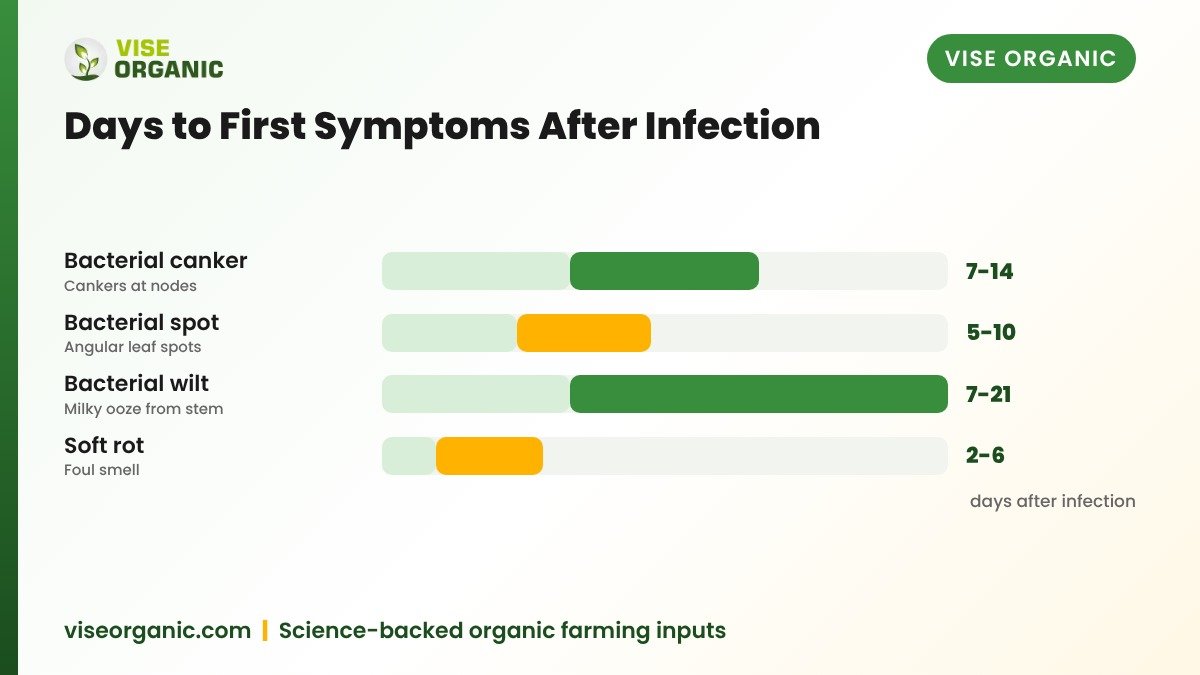
Bacterial canker
Clustering pale spots with a brown corky centre, often called bird's-eye spots, on fruit, plus sunken cankers on petioles and stem nodes. One plant dies while its neighbour looks fine. Canker is a seed-transmitted problem, so clean seed matters more than any spray.
Bacterial spot
Small dark, water-soaked spots on leaves that turn angular as leaf veins box them in, with raised scabby lesions on fruit. It spreads fast through a wet canopy and shows up first where plants touch each other.
Bacterial wilt (bacterial pathogen disease in tomato)
Sudden drooping of the upper leaves in the hottest part of the day, recovery at night for two or three days, then a permanent green wilt. Cut a low stem and press the cut face: a milky to creamy ooze confirms it. There is no rescue spray for a wilted plant; the plan is for the ones still standing.
Soft rot and pith necrosis
Mushy, foul-smelling stems or fruit, usually after a stem borer or fruit borer entry, or a heavy hail bruise. Soft rot is a secondary invader, so the fix is insect control first.
Scouting That Catches It Early
Scouting is the whole game with bacterial problems, because a visible outbreak is already two weeks old. Walk a W pattern through the block twice a week, more during humid spells, and spend time at the windward edge and low spots where water stands.
- Check the lower canopy. Strip a few lower leaves and look at the undersides and petioles, where spotting starts.
- Watch the top leaves at noon. Midday droop that recovers at night points to a vascular problem, not dry soil.
- Count insect entry wounds. Fruit borer and leaf miner holes are bacterial doorways, so note them with the spotting.
- Rogue as you go. Pull suspect plants with roots, carry them out and cover them; do not drop them on the bund.
- Log weather. Note the days with more than 12 hours of leaf wetness; those are the days your next spray was decided by.
Fix the leaf wetness clock first. A spray that lands on a dry leaf beats a perfect product on a wet one.
Spray Timing Rules That Matter
With bacterial disease in tomato, timing beats product choice. A protectant biopesticide film has to be on the leaf before the bacteria arrive; there is no curative spray for a plant that is already infected.
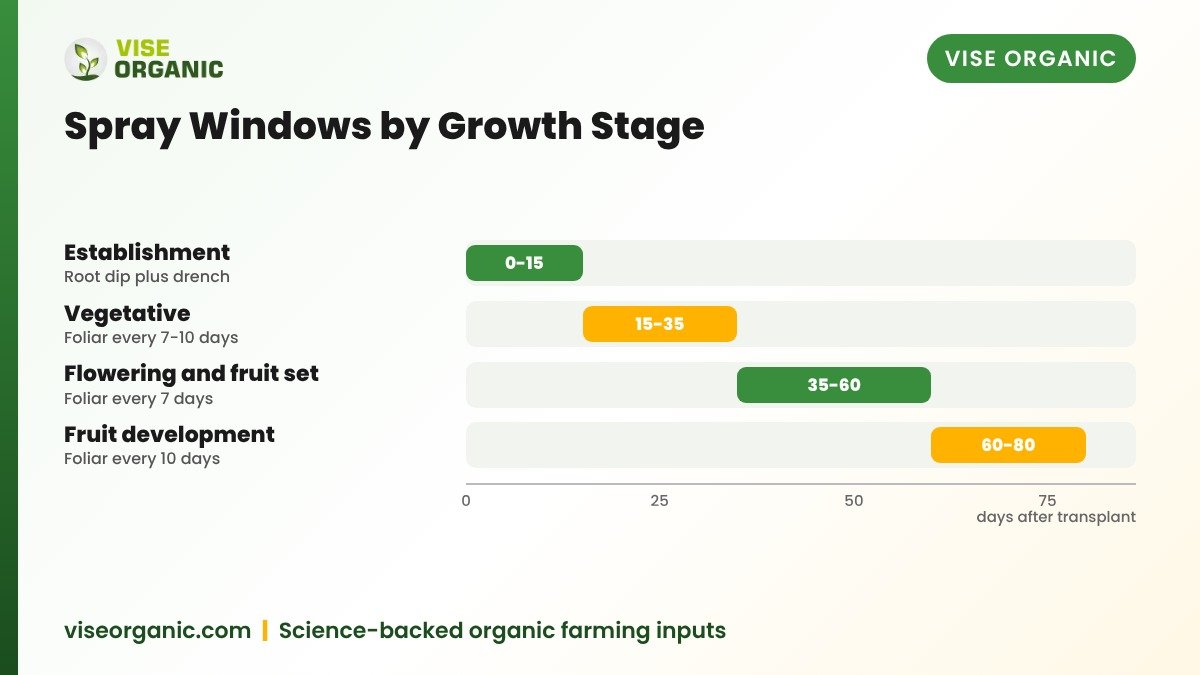
- Start at transplant or early establishment. A root dip or drench with a microbial product at planting builds colonisation before infection pressure starts.
- Begin foliar sprays at first true leaf and flowering. Keep a light protectant film on new growth from this stage onward.
- Spray before the wet spell, not after. Check the outlook and get the tank on 24 to 48 hours ahead of rain or a long dew period.
- Keep 7 to 10 day intervals in humid weather. Stretch to 12 to 15 days only in dry, windy conditions where leaves dry fast.
- Re-cover after heavy rain. Wash-off is the most common reason a schedule fails; re-spray within 2 to 3 days.
- Stop 5 to 7 days before harvest as most labels require, and plan your last spray around the picking date.
Two application details carry most of the result. Use enough water for full coverage of the undersides, which for a staked block usually means 200 to 300 litres per acre, and add a spreader like Plant Stick so the droplet spreads instead of beading. Spray at dawn after dew dries or late evening, never in hot midday sun.
Botanical Sprays in the Programme
Botanicals do two useful jobs here: they suppress surface bacterial and fungal populations, and they keep the insect vectors that carry bacteria from plant to plant.
Neem oil is the workhorse. It smothers soft-bodied insects and disrupts feeding, so fewer wounds on leaves and fruit. Use it on a 7 to 10 day rhythm in the wet season and keep it off high-temperature days to avoid leaf burn. Our Neem and organic farming guide covers rates and tank mixing in detail.
Other botanical options in the same slot include neem-seed kernel extract pressed on farm, and botanical azadirachtin products. For the wider picture of what botanical sprays can and cannot do, read How neem oil helps in farming practices.
Rotate actives rather than repeating one. Neem in week one, a microbial product in week two, keeps insect pressure off a single mode of action.
Microbial Biopesticides: Preventive, Not Rescue
Microbial products such as Bacillus and Pseudomonas strains work by occupying leaf and root surfaces and competing with the pathogen. They are protective and slow-building, so they pay off when started early and continued, and they do very little for a plant that is already wilting.
Apply them as a drench for soil-borne wilt pressure and as a foliar spray for leaf spotting. Keep the tank clean, use plain water without chlorine, and never tank-mix a microbial spray with a chemical bactericide or a strong fungicide unless the label clearly allows it. For the disease-management side of our own range, see How Eco Safe supports pest and disease management in organic farming.
For certified organic blocks, whether a product is allowed is decided by NPOP or your certifier's input list, not by the word organic on a label. Check Our NPOP compliance page before committing a programme.
Cultural Steps That Outperform Any Spray
Where bacterial wilt is established in a block, sprays only slow the loss. The block-level fixes are:
- Grow clean seed and raise seedlings in a soilless media, so canker never enters with the crop.
- Rotate away from solanaceous crops for 2 to 3 seasons and avoid planting into an old tomato or brinjal block.
- Switch to drip with frequent short cycles so the soil surface dries between irrigations, and never irrigate in the evening.
- Stake and prune for airflow, and tie with clean twine; disinfect hands and blades between plants if you prune.
- Keep nitrogen in balance, since soft fast growth and dense canopies make tissue easier to infect.
- Clear all debris and volunteer plants at crop end, and do not compost infected stems.
A balanced nutrition programme helps the crop hold up. Seaweed and humate products such as Seacure Liquid and Eco Green are commonly used for root and canopy vigour; read more in How eco green contributes to soil health and plant growth. For the soil side of a rabi tomato plan, see How eco granules contribute to soil health and crop growth and How biofertilizers contribute to sustainable agriculture.
Safety and Label
Read the full label before the first tank, including the pre-harvest interval and the maximum sprays per season. Wear gloves, a mask and full sleeves while mixing and spraying, and wash hands before eating. Mix in an open area away from drinking water sources and never wash the tank out into a well, pond or canal. Store packs in a cool shaded shed, away from children and animal feed. Microbial products lose viability in heat, so do not leave them in a vehicle or in direct sun. Do not mix microbial sprays with chemical bactericides or copper-heavy tank mixes unless the label permits.
What to Check Before Buying in Bulk
Dealers and FPOs buying a season's protection programme should verify the paperwork before the truck is loaded.
- Content and count on the label, including the microbial count at expiry rather than at manufacture, and the azadirachtin percentage for botanicals.
- Batch or lot certificate with the manufacturing date, since an old microbial stock will not colonise no matter how well you spray.
- Packing integrity, with light-blocking bottles and sealed caps, because light and heat kill live cultures.
- Shelf life with at least 8 to 10 months remaining at the time of delivery.
- Storage conditions at your warehouse, ideally below 35 degrees Celsius and out of sun.
Ask for a small trial on one block before committing a whole taluk's worth of acreage, and keep the label and technical sheet with every batch.
Frequently Asked Questions
How do I tell bacterial wilt from a watering problem?
Wilted plants that recover overnight for two or three days, then stay wilted, plus a milky ooze from a cut stem, point to bacterial wilt. Dry soil gives uniform drooping that fixes within hours of irrigation.
Does a copper spray remove bacterial spot lesions?
Copper and other protectants reduce spread on new leaves. They do not clear lesions already on a leaf or fruit, which is why timing before infection matters.
Can I tank-mix a microbial biopesticide with neem oil?
Some labels allow it, many do not. Do a jar test, spray one test row, and follow the label on both products rather than a neighbour's advice.
How often should I spray in the monsoon or a wet rabi?
In humid weather with long leaf wetness, most programmes call for 7 to 10 day intervals and a re-spray within 2 to 3 days after heavy rain.
Is seed treatment enough to stop bacterial canker?
Clean or treated seed removes the main entry route, but sanitation, insect control and sprays are still needed, since canker also spreads by splashing and tools.
Should I pull a wilting plant out?
Yes. Rogue it with roots, carry it out of the block and cover or bury it. Do not compost it, and avoid walking through that spot when the soil is wet.
Do these sprays work on certified organic tomato?
What is permitted is decided by NPOP or your certifier's input list. Get written approval from your certifier before using any new product on a certified block.
Conclusion
Bacterial pathogen disease in tomato is a timing problem more than a product problem. Name the disease correctly, cut the leaf wetness and insect wounds that let it in, start a protectant programme at establishment, and keep the film on the leaf through every humid spell with 7 to 10 day sprays. Browse Our products for botanical and microbial options, and Contact Vise Organic or Request a callback for a spray calendar for your block.
Disclaimer: This article is general agronomic information. Results vary with soil, crop, weather and practices. Always read and follow the product label and consult a local agronomist for advice specific to your field.
Article Topics & Tags:
Vise Agronomy Team
The in-house agronomy and field research team at Vise Organic Biotechnology, publishing applied research on bio-fertilizer protocols, crop protection, and sustainable cultivation practices.