
Walk into a wheat field in early January and the difference shows up before you touch a leaf. In one plot the soil breaks into small crumbs and earthworms are visible within two spadefuls. In the next plot the top 5 cm is hard, pale and powdery, and water pools at the field channel instead of soaking in. That difference is soil organic carbon, and rabi wheat season is the best window of the year to build it, because you have a long cool growing period, standing residue and time for slow inputs to work.
This guide covers a soil organic carbon rabi wheat plan you can run on 1 to 5 acres: how much compost to budget, where humate fits, how to place biofertilizers so they survive the winter, and how to judge results with your own eyes and a lab report instead of a guess.
What Soil Organic Carbon Actually Does in a Wheat Field
Soil organic carbon (SOC) is the carbon part of the organic matter in the top soil. It is not a nutrient in the way urea is, but it decides how much of the nutrient you apply is kept and used. A rabi wheat crop grows through a cool, dry period when microbial activity is already slow, so low-carbon soil gives up its nitrogen early and holds little water.
In practical terms SOC affects four things you can see in the field:
- Water holding. Organic matter holds several times its own weight in water, so a field at 0.6 percent SOC reaches the crown-root initiation stage with less stress than one at 0.3 percent.
- Nutrient retention. Carbon-rich soil holds ammonium and potassium on its exchange sites instead of losing them to the irrigation that follows a urea dose.
- Aggregate stability. Organic glue binds clay and silt into crumbs, which is why a low-carbon field seals after rain and shows thin, patchy emergence.
- Microbial food. Every biofertilizer you buy needs carbon to survive its first two weeks in soil. Without it, PSB, KMB, Rhizobium and Azotobacter cells die off and the packet money goes with them.
That last point is why this plan puts compost and humate first and the microbial products second. The same logic applies to any Rabi crop biofertilizer plan.
Read Your Soil Before You Spend Anything
Do not buy a single bag before you know the baseline. SOC in the Indo-Gangetic wheat belt commonly sits between 0.3 and 0.8 percent, and in parts of Rajasthan, Bundelkhand and rain-fed Maharashtra it is under 0.3 percent. Ask your KVK or soil health card centre for organic carbon along with pH, texture and the phosphorus and potassium grades.
Take the sample yourself so the number means something:
- Draw a composite. Collect 15 to 20 spots in a zig-zag across the plot, only the top 15 cm, no spots on the bund or under an old dung heap.
- Mix and dry. Combine in a clean plastic tray, break clods, air dry in shade, and send about 500 g in a cloth bag.
- Record the field history. Write down the last three crops, how much straw was burned or removed, and the typical manure dose, because the lab number means nothing without that history.
- Set a target. Aim to move the number up by about 0.1 to 0.2 percentage points over three seasons, not in one.
Say you grow 3 acres of wheat near Bharatpur on flood irrigation, with paddy straw mostly burned and no farmyard manure for two years. Your organic carbon will likely read 0.3 to 0.4 percent, and the plan below starts with straw and compost, not with a spray.
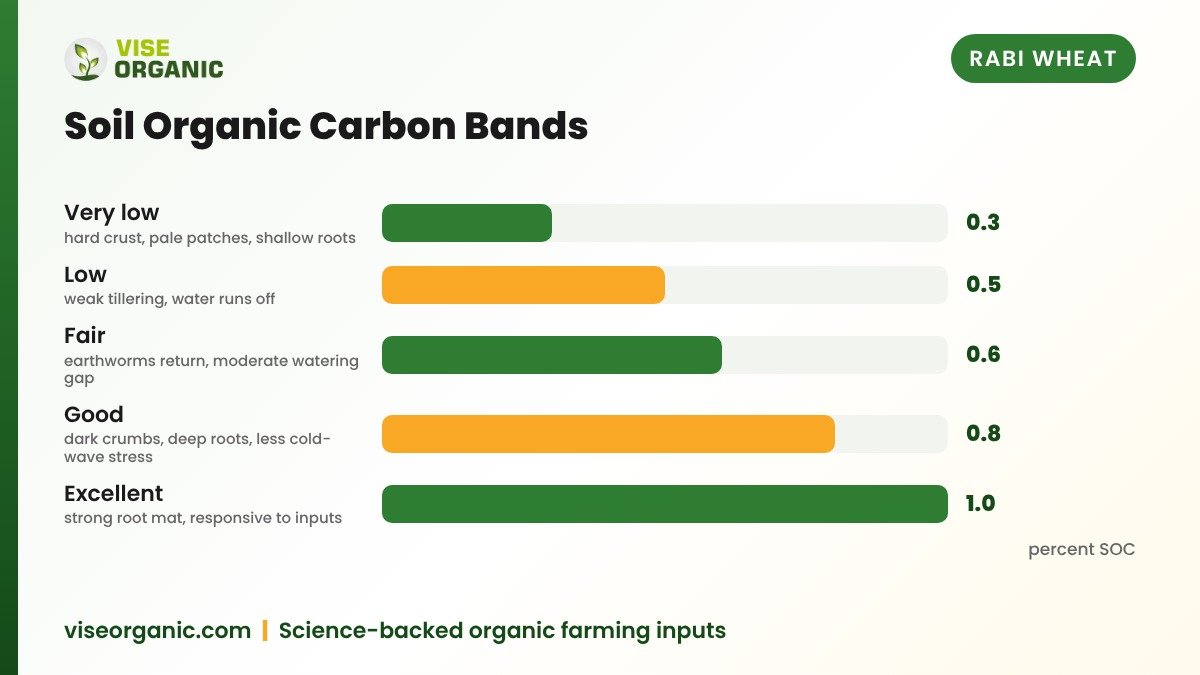
The chart that replaces this table shows the same bands, so keep the numbers in mind: 0.3 percent is the alarm level, 0.6 percent is where most wheat fields respond well, and 0.8 percent and above is what a well-managed farm reaches after several years of residue and organic inputs. If you want the deeper reading on soil conditioning, see What benefits Soil Carbone provides for soil conditioning.
Build the Base With Compost and Crop Residue
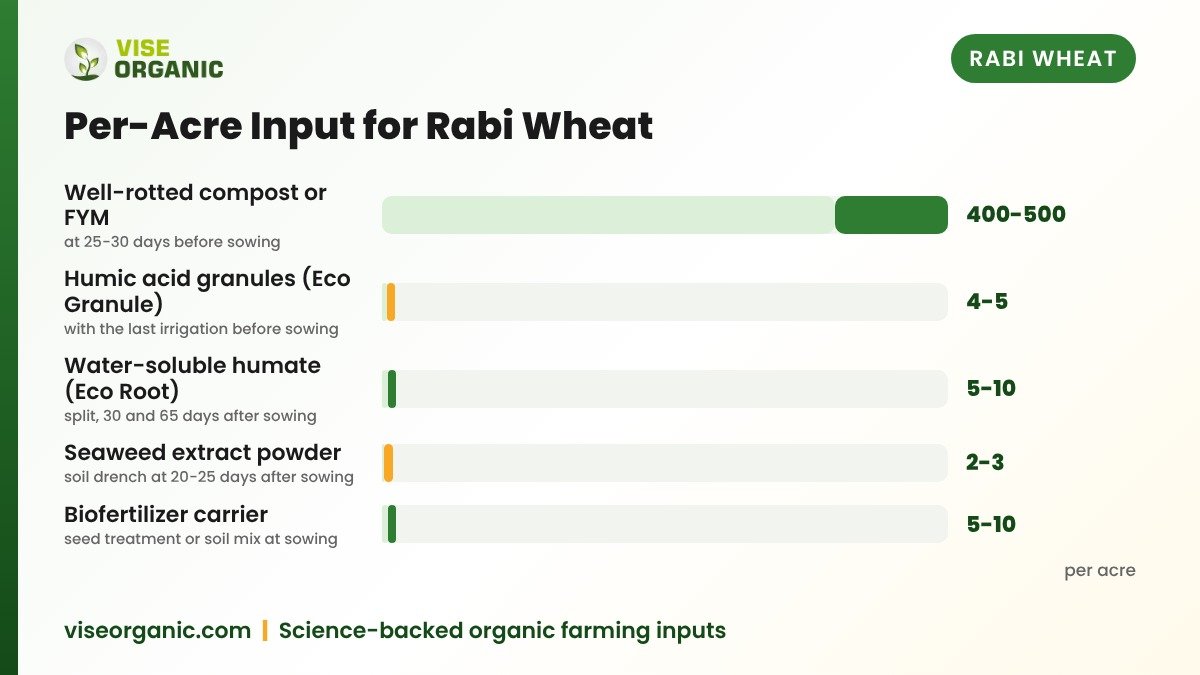
Compost is the only input here that adds carbon in bulk. Humate products feed biology and improve the soil's chemistry, but they do not replace the tonnage that residue and compost supply. Budget 400 to 500 kg of well-rotted compost per acre, or the farm's own FYM at a similar rate, and work it in with the first deep ploughing 25 to 30 days before sowing so it begins to break down before the seed goes in.
How you handle paddy straw decides most of the outcome:
- Chop and mix. Run a straw chopper or paddy straw cutter, then a rotavator, so 2 to 4 cm pieces sit in the top 10 cm instead of lying on the surface.
- Add nitrogen with the straw. A small urea or mustard-cake topping over the straw speeds rot and stops the microbes from robbing the wheat seedling of nitrogen in the first month.
- Never burn. Burning returns almost nothing to the top soil and destroys the surface biology you are paying biofertilizers to rebuild.
- Check the finish. Good compost is dark, crumbly, smells of earth and shows no recognizable straw. Green or raw compost pulls wheat seedlings down.
For a fuller treatment of the materials side, read How to make and use organic compost for vegetables and field crops, and for enriching a heap with microbial culture see Compost enrichment with biofertilizer cultures.
Where Humate Fits in the Plan
Humic and fulvic acid products are concentrated carbon, so a few kilograms do work that 400 kg of compost cannot do quickly: they soften a hard pan's effect on young roots, improve the efficiency of the fertiliser you apply, and give microbes a soluble carbon starter. Think of humate as the ignition and compost as the fuel.
Three forms cover a wheat field:
- Granular humic acid (Eco Granule), 4 to 5 kg per acre, broadcast with the last irrigation before sowing or worked in during the rotavator pass.
- Water-soluble potassium humate (Eco Root), 5 to 10 kg per acre split into two doses, one at tillering around 30 days after sowing and one at crown-root initiation to flowering around 60 to 65 days, run through the irrigation channel or the fertigation line.
- Liquid humic acid (Eco green), used where a farmer prefers a drench or a tank mix that the label allows.
Seaweed products belong in the same conversation. A seaweed extract powder at 2 to 3 kg per acre as a soil drench at 20 to 25 days, or Seacure Liquid as a foliar spray at tillering as the label directs, supports root growth during the cold months when roots crawl. Pair it with the humate dose rather than replacing it; seaweed brings growth substances and minerals, humate brings carbon chemistry. The same logic behind Eco Root potassium humate for root growth applies directly to rabi wheat.
Every number in that table is repeated in the sentences above and below, because on the page the chart image takes the table's place. Always confirm the rate on the product label you hold in your hand.
Place Biofertilizers Where They Survive Winter
Microbial products are live. Cool rabi soil slows them down, so placement matters more than the dose. Seed treatment is the cheapest and most reliable route, and it is the same method described in the Biofertilizer seed treatment guide for rabi crops.
- Calculate the slurry. Take the carrier dose the label gives for your seed rate, mix with a handful of jaggery solution or 100 g of compost in a bucket of water.
- Treat in shade. Coat the seed evenly on a gunny sheet in the shade, never in the noon sun, and never with bare hands.
- Dry in shade. Spread in a thin layer for 2 to 3 hours under a shed, then sow the same day.
- Carry the rest into soil. Mix the balance of the packet into 20 to 25 kg of sieved compost and throw it with the compost dose, so the cells arrive with food already attached.
- Keep the seed bed moist. Light irrigation or a moist bed in the week of sowing decides how many cells survive to colonise roots.
Choose the culture for the job:
- Azotobacter for free-living nitrogen supply in the rhizosphere, useful in every wheat field; the liquid form is Azotobacter Liquid Based.
- PSB to release fixed phosphorus from soils loaded with DAP and rock phosphate history; see Phosphate Solubilizing Bacteria.
- KMB where the potash grade is low or the soil is high in sodium, since it mobilises potassium from minerals and residue ash.
- Rhizobium only for a legume in your rotation, such as a green gram catch crop, not for wheat itself.
If you are multiplying cultures yourself to cut cost per acre, The multiplier route is explained here, and for potash mobilisation in a rabi cereal-legume rotation see KMB biofertilizer for rabi sugarcane and potash.
A Week-by-Season Schedule You Can Follow
Timing is where most plans fail. Here is the sequence in the order you will actually do it.
- Two to three weeks before sowing. Deep plough, chop and incorporate paddy straw, spread compost, and run the granular humate with the rotavator pass.
- Five days before sowing. Light irrigation to settle the bed and wake the biology.
- Sowing day. Shade-treated seed with the label dose of Azotobacter and PSB, balanced NPK as per your soil test, sown at 20 to 25 cm row spacing.
- 20 to 25 days after sowing. Seaweed drench at the root zone with the first irrigation, and check stand and tiller count.
- 30 days after sowing. First humate split through irrigation, plus the first irrigation and any top dressing as the label and your soil test direct.
- 60 to 65 days after sowing. Second humate split at crown-root initiation to flowering, keeping the interval between irrigations slightly longer so roots chase moisture downward.
- Harvest. Cut high, leave the stubble, chop and incorporate it with a small nitrogen starter, and repeat the cycle.
Compost feeds the soil for a season, humate feeds it for a month, and stubble left standing feeds it for years.
Field Checks That Tell You It Is Working
You do not need a lab every season to track direction. These checks take ten minutes.
- The jar test. Shake a handful of dry soil in a clear jar of water and let it settle. A good crumb structure leaves fairly clear water in 10 to 15 minutes; a dusty, dispersing soil stays cloudy and drops a thin silt cap.
- The spade test. Split a spadeful and count earthworms and white fungal threads over 30 seconds. An increase from season one to season three is your clearest sign.
- The crust test. After the first irrigation, press your boot on the bed. A crusted surface that cracks seedling tips means the organic matter is too low and the mulch practice needs changing.
- The infiltration test. Pour a mug of water in a ring of soil and time the soak. Faster soaking each year is SOC moving up.
- The root test. Pull three plants at 45 days with soil intact. Look for brown-to-tan roots with fine laterals and a rhizosphere that clings to the roots.
Expect the organic carbon number on a lab report to move slowly, roughly 0.1 percentage points in three seasons under this kind of plan. Tillering, watering intervals and crust response change much sooner, which is why farmers notice the field before the lab does.
Safety and Label
- Read the label first. Dose, seed rate compatibility and tank-mix rules on the pack override any number quoted in an article, including this one.
- Wear gloves and a mask while handling any powder or granule, and while treating seed. Wash hands before eating.
- Do not tank-mix microbial products with chemical fungicides or bactericides unless the label specifically allows it. Treat seed with the biofertilizer after any recommended fungicide treatment, with the seed fully dry in between.
- Store packs in a cool dry shed, off the floor, out of sun, below 35 degrees Celsius, and never near a diesel can or insecticide shelf.
- Keep away from children and water bodies. Wash equipment in a bund area, not in a pond, canal or handpump well.
- Check the expiry. Liquid cultures lose viability in a hot store room long before the printed date.
What to Check Before Buying in Bulk
Dealers and FPOs buying for a wheat cluster should verify these points before a big order:
- Content and grade. Ask for the colony count per gram printed on the certificate for carrier-based cultures, and the humic acid percentage and pH on the humate report.
- Batch certificate. Each lot should carry a batch number, a lab report and a manufacturing date. Match the batch on the pack to the paper.
- Packing integrity. Foil-lined, sealed pouches for carrier products and rigid sealed cans for liquids. Puffed or leaking pouches mean heat damage.
- Shelf life left. Buy for the season in hand, not for two seasons ahead. Reject lots with less than six months of shelf life at delivery.
- Storage at the depot. Confirm the godown is shaded, ventilated and separated from chemicals. A good product stored badly arrives dead.
- Support. Ask whether the supplier offers field guidance for cluster-level application, which matters more than the margin on a carton.
Vise Organic makes microbial biofertilizers, botanical products, humates and seaweed products at Manjusar in Gujarat, with in-house bio R&D and DSIR-recognised microbial formulations, which is the kind of traceability a bulk buyer should ask any supplier for.
Frequently Asked Questions
What is a good soil organic carbon level for wheat in India?
Most wheat soils sit between 0.3 and 0.8 percent organic carbon. Below 0.4 percent you will see crusting and runoff, around 0.6 percent the crop responds well to inputs, and 0.8 percent and above is what well-managed fields reach after several seasons of residue and compost.
How much compost per acre should I apply before sowing wheat?
A common plan is 400 to 500 kg of well-rotted compost or farm yard manure per acre, worked in with the first deep ploughing 25 to 30 days before sowing. Check your own FYM quality and the soil test, because raw or green compost can depress seedlings.
Is humic acid a substitute for compost?
No. Compost adds carbon in bulk, in the hundreds of kilograms per acre, while humate works at 4 to 10 kg per acre on root growth, soil chemistry and nutrient efficiency. Use humate as a fast-acting partner to compost, not as a replacement for it.
Can I mix biofertilizers with the compost in the same heap?
Yes, and it helps. Mixing the balance of the packet into 20 to 25 kg of sieved compost and applying it with the compost dose gives the microbes food at the moment they enter the soil. Enrich the heap at least 10 to 15 days before spreading and keep it moist and shaded.
Which biofertilizer is useful for wheat, Rhizobium or Azotobacter?
For wheat, use Azotobacter and PSB, and add KMB where the potash grade is low or the soil is sodic. Rhizobium works only with legumes, so reserve it for a green gram or cowpea catch crop in your rotation.
When should I drench seaweed extract in rabi wheat?
A seaweed extract powder at 2 to 3 kg per acre as a soil drench at 20 to 25 days after sowing, or a labelled foliar dose at tillering, is the typical pattern. Follow the product label, and avoid applying on a cold-wave morning or in hot afternoon sun.
How long before I see a change in soil organic carbon?
The lab number moves slowly, often about 0.1 percentage points over three seasons. Field signs such as less crusting, faster water soaking, more earthworms and better tillering usually appear in the first one or two seasons.
Conclusion
Building soil organic carbon rabi wheat is a sequence, not a product: residue and compost for bulk carbon, humate and seaweed for a fast root and biology response, and well-placed Azotobacter, PSB and KMB to convert what is already in your soil into what the crop can eat. Work from your soil test, keep the schedule in order, and judge progress by the spade test and the watering interval as much as by the lab number.
Talk to the Vise Organic agronomy team about a cluster plan for your village or FPO, browse Our products for doses and pack sizes, or Request a callback for crop-specific advice. For dealership or bulk orders, call +91 84014 31440 or write to support@viseorganic.com, or use the Contact Vise Organic page.
Disclaimer: This article is general agronomic information. Results vary with soil, crop, weather and practices. Always read and follow the product label and consult a local agronomist for advice specific to your field.
Article Topics & Tags:
Vise Agronomy Team
The in-house agronomy and field research team at Vise Organic Biotechnology, publishing applied research on bio-fertilizer protocols, crop protection, and sustainable cultivation practices.