
Walk through the cane belt of western Uttar Pradesh or Bharatpur in the first week of January and you will see the same thing on half the fields. The lower leaves of a 70-day crop are yellowing at the margins, the cane looks thin for its age, and the farmer is sure the potash dose is the reason. He often applied 50 to 60 kg of MOP per acre and still sees the deficiency. The missing piece is rarely the bag of fertiliser. It is the potash already locked in his own soil, in illite and mica, that no root can reach on its own.
That is the job of a potash mobilising biofertilizer. KMB (potash mobilising bacteria) works on the mineral fraction of the soil, while PSB works on the phosphate fraction. This guide covers one narrow question: how to use KMB biofertilizer for sugarcane planted in the rabi window, from set treatment to the first 90 days, with realistic doses, timings and the pairing that makes the difference.
Why Sugarcane Pulls Hard on Potash
Sugarcane takes up more potash than any other nutrient, and it takes it through the whole growing period rather than in one early burst. Potash moves sugars within the plant, thickens the cell wall of the cane and runs the water gates in the leaf, which is why a potash-short crop wilts at midday even with moisture in the root zone.
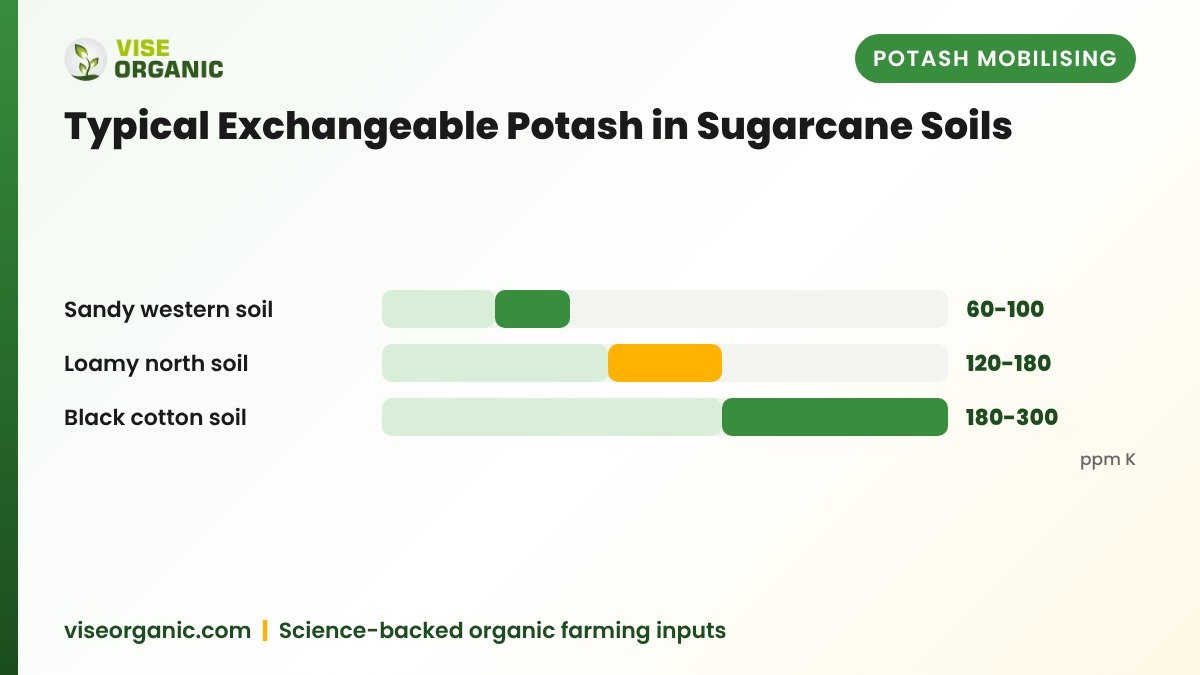
Deficiency shows up where the soil cannot release potassium fast enough, not only where the fertiliser dose was low. North Indian alluvial soils with low clay activity often test 120-180 ppm exchangeable K. Sandy soils in the western belt fall lower still, at 60-100 ppm. Black cotton soils may test high, 180-300 ppm, yet tie up applied potash between clay layers. A soil test tells you the available pool. It says nothing about the fixed pool, which is several times larger.
KMB bacteria release organic acids that weaken those mineral bonds and free potassium into the soil solution, where roots can absorb it. Field trials across cane-growing states have reported cane response to potash mobilisers, but the size of that response depends on your soil mineralogy, moisture and how much organic matter you already add. Treat KMB as a way to use the potash you already own, not as a substitute for a deficient dose.
What KMB Actually Does in the Root Zone
KMB is a bacterial culture, sold as liquid or carrier-based powder, that colonises the rhizosphere around cane roots. Its work is chemical and slow. Organic acids such as gluconic and citric acid lower the pH in a thin film around the bacterial cell and dissolve potassium out of feldspar and illite.
Three things follow from that, and they explain most of the results you will see.
- Released potassium feeds the whole season. The release is continuous while the bacteria are alive, so it fills the gaps between your MOP or SOP applications instead of replacing them in one go.
- Silicon and micronutrients loosen too. The same acids attack silicate minerals, which is why cane treated with potash mobilising microorganism often stands greener and firmer rather than simply taller.
- It works only where roots and moisture are. KMB does nothing in dry soil or in a furrow that stays waterlogged. Colony survival needs 60 to 70 per cent of available water holding capacity, which is roughly the moisture at every alternate irrigation in a rabi cane field.
Read How does eco green stimulate microbial activity in the soil if you want the microbial side in more detail.
Rabi Sugarcane Timing: Sets, Not Transplants
Rabi cane planted in October and November on irrigated land has a different nutrient calendar than the March-April (adsathi) crop. The sets germinate in cool soil, root initiation is slow, and the earthing-up that closes the furrows happens in December-January. Any KMB application must land before that earthing-up, because after it you cannot reach the set zone without damaging the stool.
Say you grow three acres of rabi cane near Muzaffarnagar on flood irrigation, planted in the last week of October. Your set treatment goes on at planting, a basal dose goes into the furrow at the first irrigation in the first week of November, and a banded dose goes at 45 to 50 days, just before the first earth-up. Three touches, all inside 50 days.
Set Treatment and Basal Dose
Set treatment is the cheapest place to put KMB in sugarcane because the inoculum starts within a centimetre of the new root initials. Make a slurry of the required dose in 15 to 20 litres of water, add a little jaggery or 1 kg of press mud per 100 sets if your label allows, and dip whole sets for 5 to 10 minutes. Do not leave sets in a bacterial slurry for hours.
For the basal route, dilute the full dose in 200 to 400 litres and run it with the first irrigation, or apply a carrier-based product blended with press mud and drop it in the furrow before the earth-up. The numbers below are typical published ranges for liquid KMB products. Your own product label governs.
| Application Route | KMB Dose (L/acre) | Water for Dilution (L/acre) | Note |
|---|---|---|---|
| Set treatment | 1-1.5 | 15-20 per 100 sets | Dip whole sets, 5-10 minutes |
| Nursing bed drench | 2 | 100-150 | One bed of 10 x 4 m |
| Basal furrow with irrigation | 5 | 200-400 | First irrigation after planting |
| Standing crop banding | 2-3 | 100-150 | At 45-50 days, before earth-up |
| Drip or fertigation | 5 | As per lateral capacity | Split into two passes |
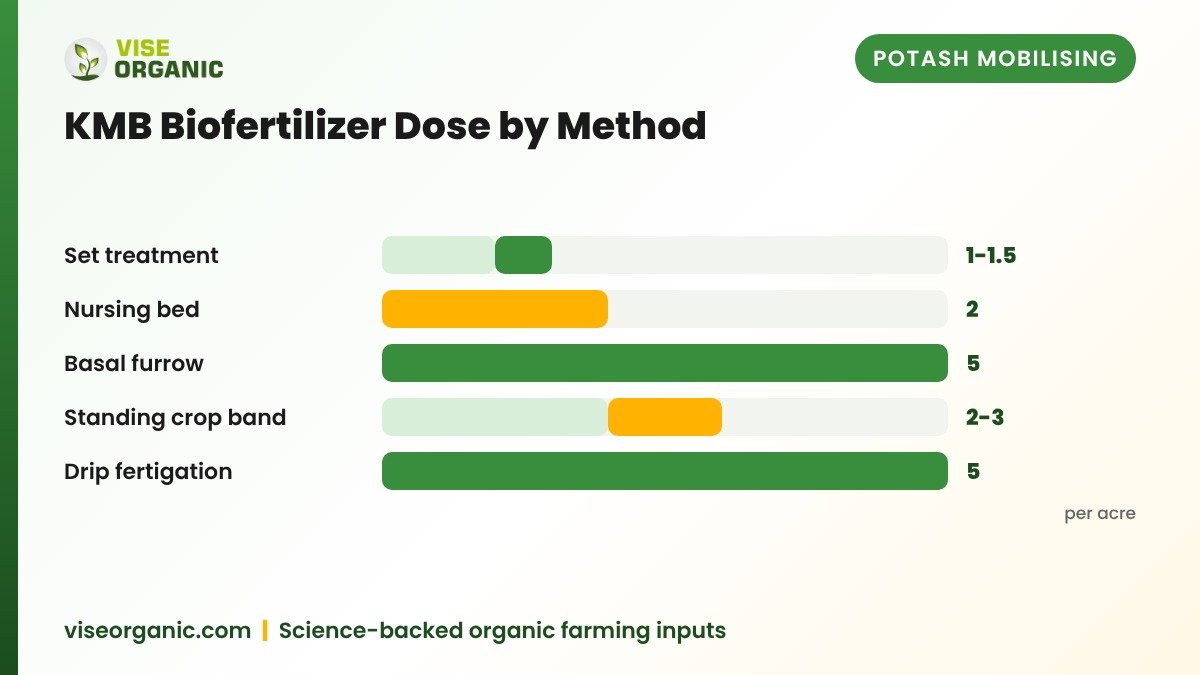
Set treatment uses the least product and gives the closest placement. Basal furrow application is what most rabi cane farmers actually manage, since dipping 6,000 to 8,000 sets per acre is labour. For the product side of this, see our Potash mobilizing microorganism and the KMB multiplier used to bulk up the culture before application.
Schedule From Planting to 90 Days
Timings matter more than doses in rabi cane, because cool soil in December slows bacterial multiplication. Warm the culture up by applying after the irrigation, never before it, and never in the hot middle of a clear afternoon.
| Stage | Days After Planting | What to Do |
|---|---|---|
| Set treatment | 0-3 | Dip sets in KMB slurry, plant same day |
| First irrigation with basal KMB | 15-25 | Run 5 L/acre through flood or drip |
| First earth-up plus banded KMB | 45-50 | Band 2-3 L/acre, irrigate within 2 days |
| Organic matter addition | 60-75 | Press mud or compost, keeps colonies fed |
| Second earth-up | 90-100 | Stop KMB at the root zone after this |
A Timeline of this kind is easier to follow than a single dose note, and the same discipline applies to cane: one input, one window, one irrigation to carry it in.
Pairing KMB With PSB, Humate and Seaweed
KMB on its own is a one-nutrient tool. In a cane field the pairing does more work than the dose. The logic is simple: one organism frees potassium, another frees phosphate, and the humate and seaweed fractions keep the colonies alive and the roots long enough to use both.
- KMB with PSB. Apply Phosphate solubilizing bacteria in the same slurry or the same irrigation pass. They occupy the same rhizosphere without competing for the same mineral.
- KMB with humic granules. A humate such as Eco granule at the recommended label rate adds the carbon food that bacterial colonies consume within weeks of application.
- KMB with seaweed. Seaweed extracts such as Seacure liquid at 2 to 3 ml per litre as a foliar at 60 and 90 days support root growth in cool weather, when root activity is the limiting factor.
- KMB with soil carbon. Where press mud is burnt or removed, add a soil carbon product like Soil carbone at 8 to 10 kg per acre with the organic matter. Microbial populations collapse in soil low in organic carbon.
Do not tank-mix KMB with chemical fungicides or bactericides. If a fungicide drench is unavoidable, leave a gap of 10 to 15 days and re-apply the biofertilizer after it.
What KMB Will Not Fix
Be honest with yourself about the limits, because this is where farmers lose money. KMB cannot create potassium that is not in your soil minerals, and it cannot correct a genuine deficiency in a soil that is already exhausted and low in clay.
- It will not replace a deficient potash dose in sandy soil testing below 80 ppm K. Build the base with graded MOP or SOP first, then use KMB to hold and recycle it.
- It will not rescue a waterlogged or saline root zone. In high-sodic soil with exchangeable sodium above 15, potassium is already plentiful and locked by sodium. Gypsum and drainage come before any microbial input.
- It will not work in dry furrows. A rabi cane field irrigated late, with soil cracking at the set zone, gets no benefit from any biofertilizer applied into that crack.
- It will not fix a nitrogen problem. Cane yellowing from nitrogen shortage looks a little like potash deficiency on older leaves. Confirm with a leaf test before you spend on potash routes.
Feed the colony before you increase the dose: KMB works only in moist soil with organic matter around the roots.
How to Check Whether It Is Working
You cannot see bacteria, so check the plant and the soil with cheap, repeatable measures. Take notes at the same spot in the field every time.
- Mark ten tagged canes. Choose ten plants in a line at the field centre and tie a plastic tag on each at planting.
- Measure girth, not height. Note the cane diameter at 1.5 m height at 60, 90 and 120 days; potash status shows in girth and firmness first.
- Score the lower leaves. Count leaves with yellow margins or scorch on the same ten canes at each visit and write the number down.
- Run a soil test at 90 days. Sample 0 to 30 cm from five spots and compare exchangeable K with your pre-plant test, same lab, same method.
- Compare a check strip. Leave one unfertilised row or one corner untreated with KMB and harvest it separately at crushing.
Expect the difference to show in girth, leaf scorch and juice quality rather than in a dramatic height jump. Cane response to potash mobilising bacteria in published trials is real but modest, and it depends on your soil, variety, water and how much organic matter you add.
Safety, Storage and Label Checks
Microbial products are alive, and they die from careless handling faster than from any disease in the field.
- Wear gloves and a mask when opening packs and mixing slurry; do not pipette culture by mouth.
- Mix in a shaded shed, apply in the evening or early morning, and never spray a microbial product in full midday sun.
- Store packs in a cool dark room between 15 and 30 degrees Celsius, off the concrete floor, away from the pesticide shelf.
- Keep opened liquid bottles capped and use within the label's opened-pack window; a swollen or foul-smelling bottle has gone off.
- Keep all packs away from children and animals, and never rinse mixing vessels into a pond, khad or well.
- Read the label for the exact crop dose, expiry and batch date before every application, and ask your local KVK or agronomist to confirm the rate for your soil test report.
Frequently Asked Questions
What is the KMB biofertilizer dose for sugarcane per acre?
For liquid KMB, common published ranges are 1 to 1.5 litres per acre for set treatment, 5 litres per acre as a basal through the first irrigation, and 2 to 3 litres per acre banded at 45 to 50 days. Confirm the exact figure on your product label and match it to your soil test.
Can KMB replace MOP or SOP in sugarcane?
No. KMB frees potassium that is already fixed in soil minerals such as illite and feldspar. In sandy soil testing below 80 ppm exchangeable K, that pool is small, so a balanced potash dose is still needed. Use KMB to stretch and recycle the potash you apply and already own.
When should KMB be applied in rabi sugarcane?
Before the first earthing-up. Dip sets at planting, run the basal dose with the first irrigation at 15 to 25 days, and band the last root-zone dose at 45 to 50 days. After the second earth-up at 90 to 100 days you cannot reach the set zone without harming the stool.
Can I mix KMB with PSB and Azotobacter in the same tank?
Yes, these bacterial cultures are usually applied together in one slurry or one irrigation pass, since they work on different minerals and different nutrients. Do not mix them with chemical fungicides or bactericides. Keep a 10 to 15 day gap and re-apply the biofertilizer.
Why is my sugarcane showing potash deficiency after I applied 60 kg of MOP?
Likely fixation or poor movement, not a missing dose. High-sodic and heavy clay soils lock applied potassium between clay layers, and dry furrows stop roots from reaching it. Check soil moisture at the set zone, add organic matter, and get an exchangeable K and ESP test done.
Does KMB work in cold December soil?
Bacterial activity slows in cool soil, which is why the rabi schedule places the heaviest dose at planting and the first irrigation, when soil is still warm. Applying after an irrigation, in the evening, and with humate or press mud nearby helps colonies survive the cool months.
How do I know if the KMB product is still good?
Check the batch and expiry date, store between 15 and 30 degrees Celsius away from sunlight, and reject bottles that are swollen, leaking or foul-smelling. A liquid culture that has been left in a hot shed over summer has lost most of its viable count even before expiry.
Conclusion
For rabi sugarcane, KMB biofertilizer for sugarcane earns its place in three narrow windows: the set dip at planting, the basal pass with the first irrigation, and a banded dose at 45 to 50 days before the first earth-up. Typical liquid doses run 1 to 1.5 L per acre for sets and 5 L per acre for the basal route, always with moisture and organic matter in the root zone, and always alongside your own soil test rather than instead of it. Pair it with PSB, a humate and a seaweed drench, and judge it on girth, leaf scorch and juice quality rather than on a single look across the field.
Start with one acre this season and keep the ten tagged canes. Browse Our products for the KMB and potash mobilising lines, or Contact Vise Organic to talk through your soil test with an agronomist. For crop-specific advice or bulk orders, Request a callback.
Disclaimer: This article is general agronomic information. Results vary with soil, crop, weather and practices. Always read and follow the product label and consult a local agronomist for advice specific to your field.
Article Topics & Tags:
Vise Agronomy Team
The in-house agronomy and field research team at Vise Organic Biotechnology, publishing applied research on bio-fertilizer protocols, crop protection, and sustainable cultivation practices.