
Why Zaid Flowering Is Different
You sow your okra in March, the first yellow flowers open by late April, and by mid-May the morning flowers are falling off before the pod ever swells. Anyone growing chilli or okra in the zaid window between March and June knows this sight, because the crop is asked to flower and hold fruit in the worst two months of the Indian summer.
This guide gives one practical zaid fruit set plan for chilli and okra: what to feed and when, how to handle water in 40 degree heat, which microbial inputs support root and flower development, and what records to keep if your lot is meant for an NPOP certified export consignment. Everything here is general agronomic guidance. Actual doses come from the product label, and results depend on your soil, variety, weather and how well you execute.
Read the Calendar Before the Input
Zaid in most of Gujarat, Rajasthan, Madhya Pradesh and Haryana means sowing in the last week of March or the first two weeks of April, first flowers 35-45 days after sowing, and the first harvest from 50-55 days in okra. The flowering peak lands exactly when temperatures cross 38 degrees Celsius and the dry wind starts.
Okra flowers open in the morning and must be pollinated the same day. The flower is gone by noon. Chilli sets fruit without pollination, but high night heat above 24 degrees still pushes flowers off. So the whole job in zaid is not forcing more flowers. It is keeping the flowers you already have.
Feed the Roots First
Nothing you spray on a leaf will help a plant whose roots sit in hot, dry, salt-loaded soil. Root establishment in the first 25 days decides how the plant behaves in week nine.
Seed and nursery treatment
- Soil mix the nursery. Mix well-rotted farmyard manure and a mature vermicompost into the raised beds two weeks before sowing so the media is cool and open.
- Treat the seed. Dip or seed-treat with a label-rate microbial formulation such as Phosphate Solubilizing Bacteria so early roots get access to locked phosphorus.
- Water the beds lightly. Small frequent doses keep nursery media temperature down; a heavy flooding watering bakes the root zone by afternoon.
Transplant at 20-25 days, not older. A stressed old seedling recovers slowly in summer and gives you two lost weeks of setting.
The Weekly Feeding Schedule
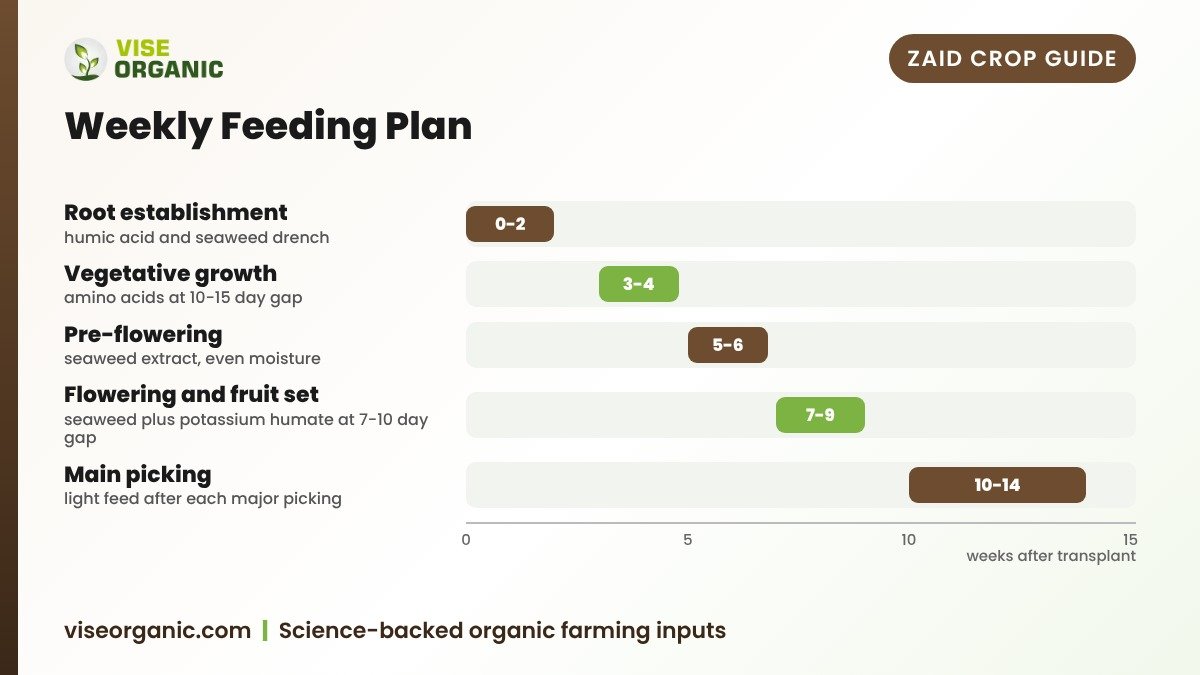
The plan below runs from transplant to the end of the main picking period. Foliar feeding in zaid is only useful before 8 am or after 6 pm, and every spray needs a spreader to sit on a waxy summer leaf rather than roll off it. Use a Spread adjuvant at label rate in every tank.
| Week after transplant | Stage | What to do | Main input type |
|---|---|---|---|
| 0-2 | Root establishment | Drench the root zone with a humic acid and seaweed combination | Humate, seaweed |
| 3-4 | Vegetative growth | Foliar amino acids at 10-15 day gap | Amino acids |
| 5-6 | Pre-flowering | Foliar seaweed extract, keep soil moisture even | Seaweed extract |
| 7-9 | Flowering and fruit set | Seaweed plus potassium humate, 7-10 day gap | Seaweed, humate |
| 10-14 | Main picking | Light foliar feed after each major picking | Seaweed, amino acids |
Doses for every input are the label rate for your crop, stated on the pack. Two points matter more than the number: never tank-mix a microbial product with a chemical fungicide or bactericide unless the label clearly allows it, and never spray a flowering crop in the heat of the day.
Flower Drop Signs and What Caused Them
Flower drop in zaid is a symptom, not a disease. Fixing the wrong cause costs you a whole week, and in summer a week is a picking round. Typical field observations from chilli and okra belts put reasonable flower-to-fruit conversion in the ranges below. Your own numbers vary with hybrid, shade and irrigation.
| Cause | Chilli (% flowers setting) | Okra (% flowers setting) | First thing to check |
|---|---|---|---|
| Healthy stand | 55-65 | 40-50 | Nothing, keep going |
| Weak root system | 25-35 | 15-25 | Root browning, bed temperature |
| Heat stress week | 15-25 | 10-20 | Afternoon shade, irrigation timing |
| Nutrition gap | 30-40 | 20-30 | Leaf colour, last feed date |
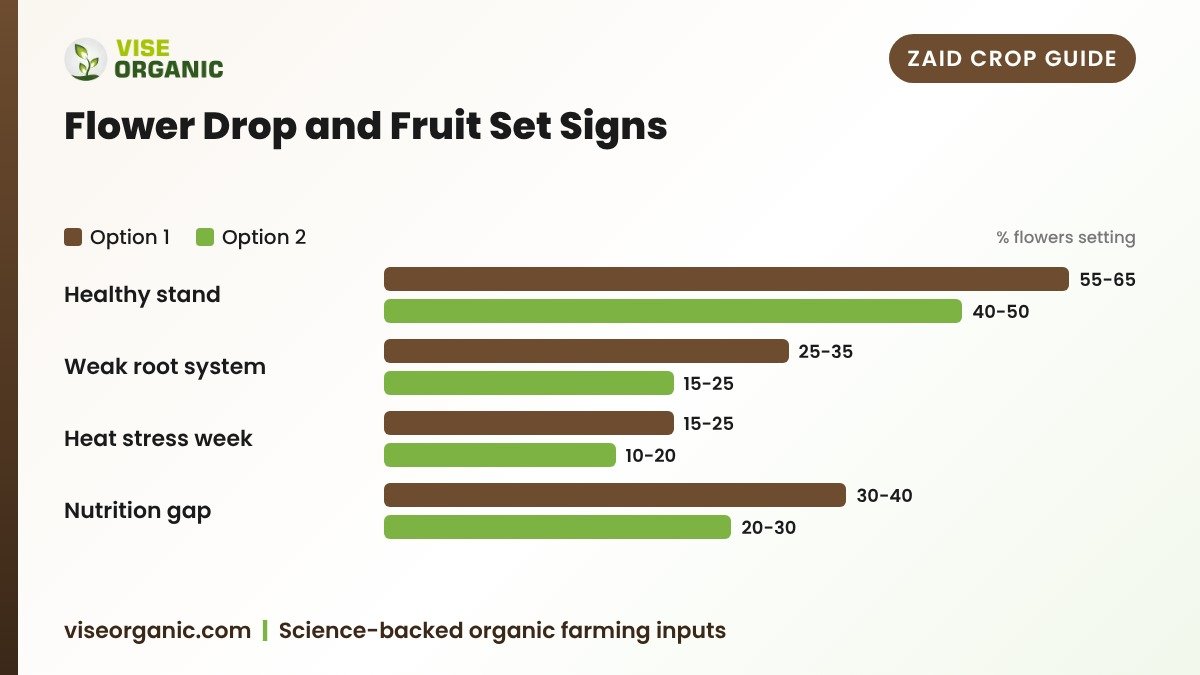
If the roots look brown and the bed is hot at 2 pm, no foliar feed will save the flowers. Cool the root zone first.
Water and Shade in 40 Degree Weeks
Summer irrigation is a timing tool, not just a water tool. A light irrigation at 5 pm cools the root zone overnight and the plant carries that coolness into the next morning's flowering hours.
- Irrigate at dusk, never at noon. A noon watering pushes root zone temperature up and the plant wilts harder by evening.
- Keep the frequency short. 4-6 liter per hour drippers for 30-45 minutes daily beats a flooding irrigation every four days.
- Mulch the beds. A 5-7 cm crop-residue or dry grass mulch holds bed temperature down and saves one watering a week.
- Use shade net at flowering. A 50% white shade net over chilli from the first flower stage reduces the midday heat load on the flowers.
- Do not let the soil go parched then flooded. A dry-to-saturated swing is the fastest way to lose a whole node of flowers.
Potassium and Silica at Setting Stage
Potassium moves sugars into the developing fruit and runs the stomatal guard cells that limit water loss. Potassium deficiency in a summer crop shows as a yellow, burnt margin on the older leaves while the young leaves stay green.
For a soil application route, a granular humic product such as Eco Granule worked into the beds at transplant improves moisture holding in sandy zaid soils. For a fast foliar route during setting, a water-soluble potassium humate like Eco Root at label rate is the usual choice between 8 am and 10 am.
Silicon is the other name you hear in export chilli. It strengthens the cell wall and the leaf stands heat better. A Potash mobilizing microorganism applied to the soil is the slower, cheaper route, and it fits the same plan as your other microbial inputs.
NPOP Records for an Export Lot
If your chilli or okra goes to an exporter who wants an NPOP certified lot, paperwork decides whether the consignment moves. The certifier and the NPOP rules of APEDA decide what inputs are allowed on a certified organic farm, so check the input list before you buy anything in bulk.
- Keep the input register. Write the product name, batch number, date, dose and field for every input you apply, including farmyard manure.
- Keep the batch tags. Do not throw away the pack label or batch tag of any input used on a certified plot.
- Map the plot. Keep a sketch or GPS point of each block, with the buffer zone marked where your neighbour sprays.
- Log the harvest and the packhouse. Weigh each picking by block and keep the cleaning and packing record.
- Ask for residue testing early. Send a representative sample to an approved lab before the consignment is committed, not after.
The NPOP compliance page explains how our documentation supports this. The Vise Organic Research and development page describes the lab behind the microbial formulations.
Safety and Label
Read the full label before the first use, including the compatibility note and the pre-harvest interval. Wear gloves and a mask while mixing and spraying, and wash your hands before handling harvested pods. Do not mix microbial products with chemical fungicides or bactericides in the same tank unless the label allows it. Store packs in a cool shaded shed away from direct sun and heat, and keep them away from children and away from wells, ponds and canals. Spray drift into a water body is not a small matter on a certified farm.
Related reads: Mustard rabi biofertilizer plan, Rabi wheat flowering grain fill organic plan, What is the mechanism of action of uphar in enhancing fruit size and weight
Frequently Asked Questions
When does the zaid season start for okra and chilli?
Sowing in most of north and west India runs from the last week of March to the second week of April. First flowers appear 35-45 days after sowing and the first okra picking starts around 50-55 days, so the flowering peak falls in the hottest weeks of May.
Why do okra flowers fall off in the afternoon?
Okra flowers open in the morning and must be pollinated the same day, and they close by noon. High morning heat, a dry root zone or a nitrogen-heavy leaf all shorten that window, so the flower is shed as a small dropped bloom with no pod behind it.
Is seaweed extract useful for chilli flower drop?
Seaweed extract is used as a foliar feed at setting stage because it supplies alginates, minerals and natural growth substances that support the plant through heat load. It will not hold fruit on a plant whose root zone is hot or whose irrigation keeps swinging, so fix the water first.
Can I mix biofertilizers with a fungicide in the same tank?
For microbial products, no, unless the label specifically allows that combination. Live formulations are affected by fungicides and bactericides. Apply them separately with a day or two between, and clean the tank before the microbial pass.
How often should I spray potassium humate during fruit set?
Most labels put a foliar humate feed at a 10-15 day gap, and many growers tighten it to 7-10 days during the peak setting weeks. Spray only before 8 am or after 6 pm with a spreader, because a summer leaf dries the droplet in minutes.
What records does an NPOP certified export lot need?
An input register with batch numbers and dates, pack labels or batch tags, a plot map with the buffer zone, harvest and packhouse logs by block, and a residue test report from an approved lab. The certifier decides the exact list, so confirm with them before the season starts.
Does shade net really help chilli in zaid?
A 50% white shade net lowers the midday heat load on open flowers and reduces how fast the bed dries out, which is why it is common in summer chilli near export belts. It is a cost decision, so it pays best on blocks already committed to a buyer.
Conclusion
A working zaid fruit set plan for chilli and okra is mostly timing: cool roots from week zero, even moisture through the flowering weeks, a light seaweed and humate feed at a 7-10 day gap in the cool hours, and clean records if the lot is meant for export. Nothing in this plan forces the crop. It removes the stresses that make a summer crop drop the flowers it already made.
Talk to our team about which inputs fit your block and your certification status, browse Our products and Contact Vise Organic, or Request a callback for crop advice from our agronomy desk.
Disclaimer: This article is general agronomic information. Results vary with soil, crop, weather and practices. Always read and follow the product label and consult a local agronomist for advice specific to your field.
Article Topics & Tags:
Vise Agronomy Team
The in-house agronomy and field research team at Vise Organic Biotechnology, publishing applied research on bio-fertilizer protocols, crop protection, and sustainable cultivation practices.