A February morning in Ludhiana, and the wheat is knee to shoulder high with the boot leaf just visible on the main tiller. The farmer walks the bund and counts heads, and the question on his mind is not about sowing anymore: it is whether this crop will fill the grain it has set. Rabi wheat flowering and grain fill is where a season of decisions either pays or quietly slips away, and it is also where most organic input advice gets vague. This article gives you a stage-wise plan for the crop from tillering to hard dough: what the plant is actually building at each stage, what a plant growth promoter can and cannot do, how to mix and spray in a real winter morning, and what paperwork an NPOP-certified or export-facing block needs to keep.
Key Takeaways
- Feeding stops at boot leaf and early milk: the flag leaf and the last 20 to 25 days carry the grain.
- Keep tillers green with balanced nitrogen and a carbon source, because a tiller that aborts takes its grain with it.
- Foliar amino acids and seaweed extract are used around boot leaf and early milk to support pollen and grain filling.
- Spray in cool morning hours in the North Indian winter, and never mix microbial products with chemical fungicides in the same tank.
- Keep a input register and bills from sowing: NPOP certification is decided by paperwork and your certifier's rules.
What the wheat plant is building between tillering and hard dough
Wheat does not store food and then spend it. It builds the grain out of what the leaves are making at that moment. That single fact explains most of the difference between two fields that look identical in January.
Tillering: the number of grain-bearing heads is decided
Between roughly 20 and 35 days after sowing, the plant puts out tillers. Many of them will abort later; the ones that survive are the ones with a strong root system and a leaf area that started early. Cold nights, a firm seedbed and steady moisture at the crown help tillers hold. This is the stage where a weak root system shows up three months later as thin grains on a field that looked bushy.
Boot leaf to anthesis: the head is assembled
The boot leaf stage is the last point at which you can influence the head itself. The flag leaf emerges here, and it will do more photosynthesis for the grain than any other leaf on the plant. Florets on the head open and pollinate over a few days. Pollen in wheat is short-lived, so anything that stresses the plant in those few days, heat, a dry soil profile, a sick flag leaf, reduces the number of florets that become grains.
Flower to hard dough: the grain is filled, not made later
After flowering the grain moves through water-white and milk stages to hard dough. Starch moves into the grain from sugars the flag leaf and upper leaves are producing right then, and from what the stem can remobilise. If the leaves are already fading at milk stage, the grain stops filling early and you get chaffy or shrivelled grain at threshing. There is no later spray that puts weight back into a grain that stopped filling.
Reading your field before you buy anything
Two fields, same variety, same sowing date, different result. Before choosing inputs, spend one evening in the field with a spade and a notebook.
- Tiller count and tiller size. Dig a few spots. White, branching roots with a brown crown ring mean the tiller base is sound. Brown, thin roots mean the base was never built.
- Leaf colour through the day. A field that goes blue-green by 11 am is telling you about water uptake, not about nitrogen alone.
- Flag leaf length and angle. An upright, long flag leaf shades the head less and works longer.
- Patchiness. Yellow patches in a line usually mean a sowing or irrigation problem, not a nutrition problem.
- Residue and soil surface. Heavy paddy stubble with poor decomposition holds nitrogen in the stubble and starves the young wheat crop in exactly the way Punjab and Haryana growers complain about every year.
Write down what you see per block. A dealer or an FPO field officer can only help you usefully when the note says "crown roots brown, tillers 3 to 4, patchy yellow on the high spot", not "crop is slow".
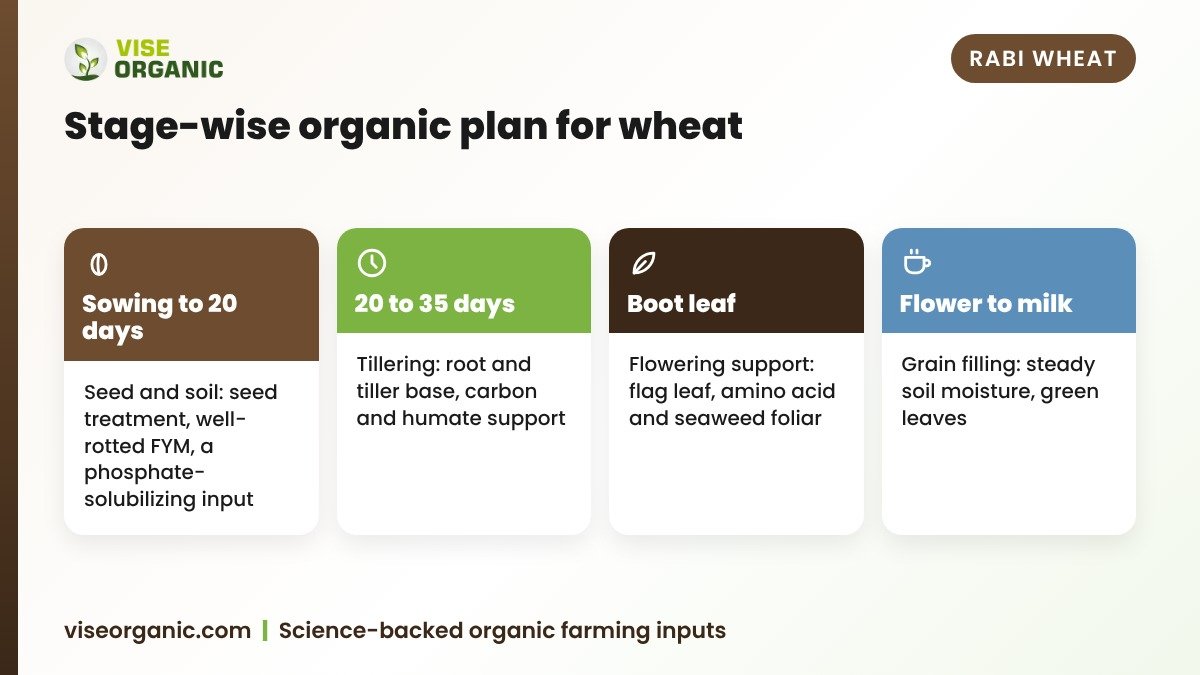
Stage-wise organic plan you can actually follow
The plan below follows the crop, not the shop catalogue. Use it to decide what your field needs, then confirm every rate on the product label.
| Stage | What the plant is doing | What you support it with |
|---|---|---|
| Sowing to 20 days | Root and first leaves; crown forming | Well-rotted FYM, seed treatment, a phosphate solubilizing bacteria input worked into the seedbed |
| 20 to 35 days, tillering | Tillers initiated; root mass expanding | Balanced nitrogen through the standing manure, a humic acid soil conditioner, one amino acid drench or spray |
| 35 to 55 days | Internodes; root still active | Steady moisture, no nitrogen excess, watch for aphids early |
| Boot leaf, roughly 60 to 75 days | Flag leaf out, head assembling | Foliar seaweed extract and amino acids at label rate, in the cool morning |
| Flower to milk | Grain filling; flag leaf carries the load | Keep leaves alive, steady soil moisture, no late nitrogen push |
| Milk to hard dough | Starch packing; stem reserves used | Nothing that forces green growth; water on schedule, harvest ready |
Crop-specific formulations exist for exactly this sequence. Nutri Wheat is Vise Organic's wheat-specific plant growth promoter in the Nutri Range, and results from any of these inputs depend on your soil, variety, weather and how you manage water, so treat the label as the instruction and not the shopkeeper's memory.
What a plant growth promoter does, and where it stops
A plant growth promoter is not fertiliser and it is not a pesticide. It changes how the plant uses what is already available.
Amino acids
Amino acids are the building blocks of protein. A foliar amino acid supply gives the plant ready-made nitrogen in an organic form, which matters in a cold month when root uptake slows down. It supports leaf and enzyme activity, and it is often used as the carrier in a foliar spray. It cannot substitute for the base nutrition you did not apply.
Seaweed extract
Seaweed extracts bring alginates, mannitol, minerals and trace levels of natural growth substances. Growers use them at sensitive stages because they support the plant through stress such as cold nights, wind or a dry spell, and they improve the wetting and uptake of a spray tank. Secure Power is the powder form of the same idea for those who prefer a granular or drench route.
Humates and potassium humate
Humic and fulvic acids work on the soil and the root rather than the leaf. They improve the way nutrients and micronutrients stay available in the rhizosphere, and a water-soluble potassium humate such as Eco Root is commonly used through drip or as a drench where root establishment is the issue. In a cold rabi soil with poor microbial activity, this is usually the input that makes the difference in the first 40 days.
Where the limits are
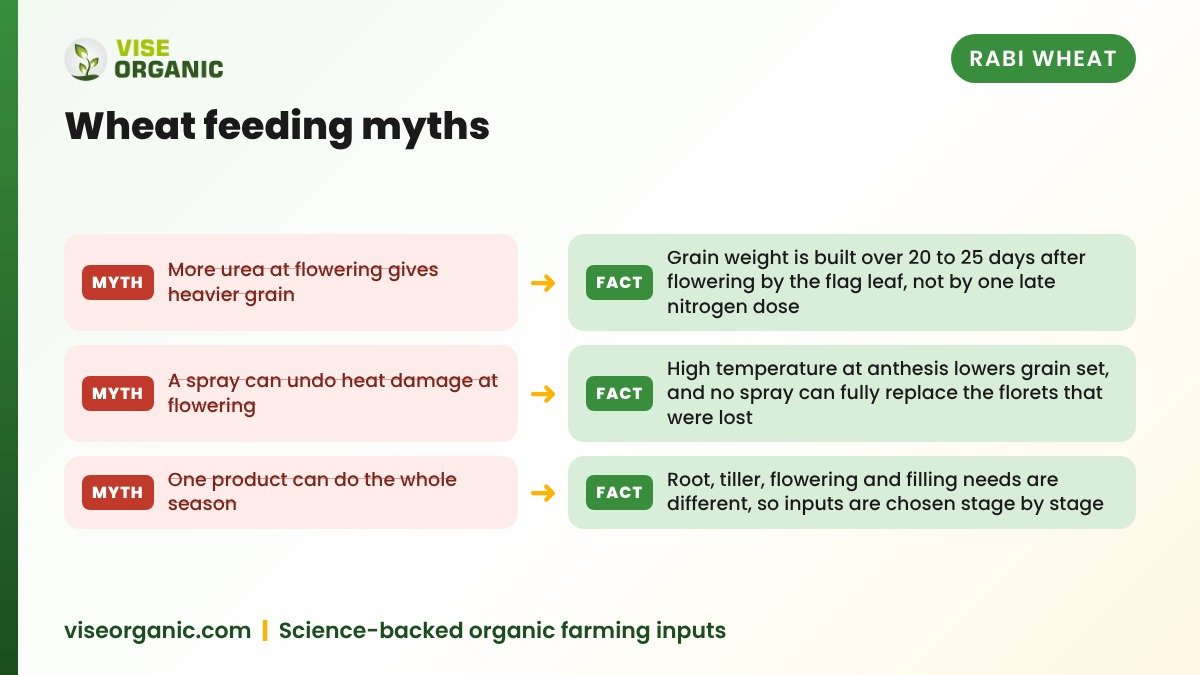
No promoter creates a floret that never set, pulls a tiller back after it aborted, or beats a 38 degree afternoon at anthesis. It supports the plant you have. That is why the plan above puts most of the effort before flowering.
Spray timing, water and mixing rules for an Indian winter
Most failures in a wheat foliar programme are spray failures, not product failures.
- Spray between 8 am and 11 am, after the dew is off the leaves but before the strongest sun. In December and January, an afternoon spray often dries before the leaf can take anything in.
- Use clean water from a source you trust, and fill the tank three-quarters before adding products.
- Do a jar test: mix the intended quantities in a clear jar of tank water, wait 15 minutes, and look for lumps, curdling or heat.
- Add products one at a time, dissolving each separately, and keep microbial inputs out of any tank that already has a chemical fungicide or bactericide unless the label allows it.
- Keep the nozzle clean and the pressure steady; wheat leaves are upright and waxy, so a fine, even cover matters more than volume.
- Wear gloves and a mask, do not eat or smoke near the tank, and wash the tank and yourself after spraying.
- Store every bottle away from sun and heat, out of children's reach, and never leave a mixed microbial tank standing overnight.
Adjuvants solve the waxy-leaf problem directly. A spreader-sticker such as Silk or a Plant Stick spreads the droplet over the leaf surface, which is worth more on a wheat crop than another 20 litres of water. A liquid NPK is used by some growers as a foliar carrier at label rate; confirm compatibility first.
Irrigation and the flag leaf: the two levers nobody bills for
Before you spend on inputs, close these two gaps, because they cost almost nothing and they out-perform most bottles.
- Critical irrigation windows. Crown root initiation, boot leaf, flowering and grain filling are the stages where wheat punishes a dry soil the hardest. Cutting water early "to ripen the crop" is a common reason for light grain at the mandi counter.
- Keep the flag leaf clean. Dust, aphid honeydew and leaf disease all shorten the working life of that one leaf. Manage pests on scouting, and use a botanical or Eco Safe type product where the label fits your situation.
- Residue matters. Where paddy stubble is left on the surface, young wheat often shows early yellowing because microbes are tying up nitrogen. Chopping and mixing the stubble, adding well-rotted FYM and a decomposition-support input at sowing reduces that drag.
NPOP, residue-free grain and the paperwork that decides it
If your wheat is going to an organic buyer, an exporter or an FPO premium group, the certification rules decide what you may use, not the shopkeeper. Under India's National Programme for Organic Production (NPOP), what is allowed on a certified farm is decided by the standards and by your certification body's approval of the specific input. A product being "organic" in ordinary speech does not mean it is approved for your certified block.
Practical steps that hold up in an inspection:
- Get every input approved by your certifier before the season, and keep the approval letter with the product label.
- Maintain a farm input register: date, field or block, input name, batch number, rate, who applied it, and the bill number.
- Keep conventional and certified blocks physically separated, with their own sprayer or a washed-out sprayer and a written cleaning record.
- Record compost and FYM making, including the source of the raw material.
- For residue-free export lots, keep spray records with pre-harvest intervals and follow the buyer's residue protocol and sampling plan.
- Ask for the NPOP organic compliance details on this page and keep product tags with every purchase.
Dealers and FPO field officers: the fastest way to lose a farmer's trust is to recommend an input that his certifier then rejects. Build a short approved-input list per cluster and hand it out with the bills.
Five mistakes that cost grain weight in February
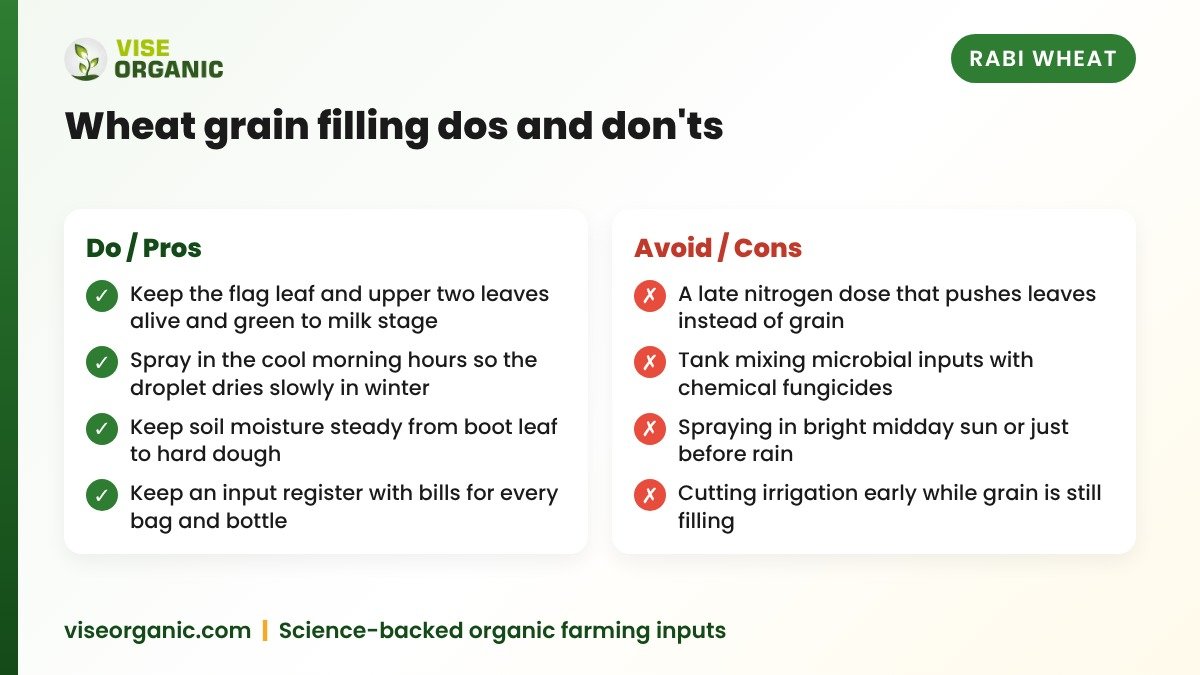
- Pushing nitrogen at boot leaf. A late nitrogen dose keeps leaves vegetative and can delay and uneven-rip the crop. Nitrogen decisions belong to the tillering stage.
- Ignoring the tiller base and chasing the head. A field with a poor root system at 30 days will not be fixed by a milk-stage spray.
- Spraying in bright sun or before rain. Winter afternoons and an incoming shower both waste the tank.
- One tank for everything. Microbial inputs and chemical fungicides in the same mix, in the same tank, with no jar test.
- No records. When a buyer asks what went on the crop between 1 December and 15 February, "we sprayed something" is not an answer.
Related reads: Rabi season mustard care guide, Biofertilizer seed treatment guide for rabi crops, How does nutri wheat contribute to improving wheat crop productivity
Frequently Asked Questions
When does wheat start flowering after sowing?
In most North Indian rabi conditions flowering begins roughly 60 to 75 days after sowing, around the boot leaf stage, and it shifts with variety and sowing date. Late sowing shortens the grain-filling window, so stage-based feeding matters more than the calendar date.
Which growth stage is most important for grain weight in wheat?
The 20 to 25 days after flowering, up to hard dough, decide grain weight more than anything you apply earlier. The flag leaf and the upper two leaves do most of the work in that window, so keeping them green and active is the goal.
Can I spray urea along with a plant growth promoter on wheat?
Many growers use a low concentration of urea as a foliar carrier, but do a jar test first and check the label of the product you are using. Avoid tank mixing a microbial biofertilizer with a chemical fungicide or bactericide in the same tank unless the label clearly allows it.
Is a plant growth promoter allowed in certified organic wheat?
It depends on the input and on your certifier's approval under NPOP rules. Keep the product tag, the label and the bill for every input, and get the input list approved before the crop season rather than at inspection.
My wheat has many tillers but thin grains. What usually causes this?
Common reasons are a nitrogen peak too early, water stress at flowering, a sick root system, or late-season leaf disease that shortens the grain-filling period. Correcting the tiller base at 20 to 30 days is more useful than trying to fix grain weight at milk stage.
What is the right dose of a seaweed extract spray on wheat?
Follow the dilution printed on the product label and keep the spray volume per acre consistent from one application to the next. Doses vary by formulation and crop, so confirm the rate with the label or with your local KVK or agronomist.
How do I stop grain shrivelling in the last week before harvest?
Avoid a dry spell at hard dough and avoid cutting off irrigation too early; a steady moisture profile in the soil supports normal grain filling. Heat and wind at milk stage are the usual cause of shrivelled grain, and no input can fully offset that.
Get a stage-wise plan for your block
The short version of this article: build the tillers and the roots by 35 days, protect the flag leaf at boot leaf, and keep the plant unstressed from flowering to hard dough. Feeding the head after it has already filled does nothing, and inputs that claim otherwise are selling you hope. Choose your inputs by stage, follow the label for every rate, and ask a local KVK or an agronomist about your own soil and variety before you change a programme mid-season.
Browse the wheat and cereal inputs in the Vise Organic shop, including Nutri Wheat, Uphar and Seacure Liquid, or write to support@viseorganic.com, call +91 84014 31440, or send your block details through our contact form or the callback request for crop advice, dealer tie-up or bulk orders for your FPO. Tell us your district, variety and sowing date, and we will talk through the stages with you.
Article Topics & Tags:
Vise Agronomy Team
The in-house agronomy and field research team at Vise Organic Biotechnology, publishing applied research on bio-fertilizer protocols, crop protection, and sustainable cultivation practices.