
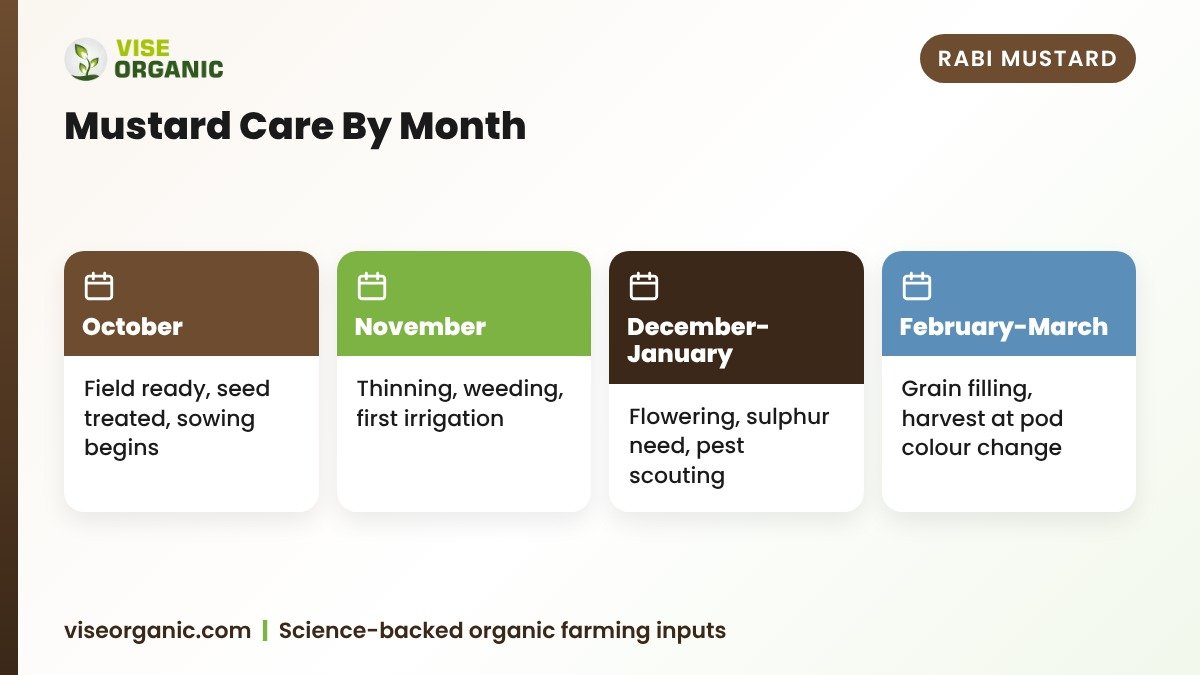
A field in Sikar district, second week of November. The tractor has finished the last furrow, the seed bag is open, and two farmers are arguing about whether to sow now or wait for one more rain. That one decision, plus what happens in the next four months, decides the oil in the drum. Good rabi season mustard care is not complicated, but it is stage-specific: what the crop needs in the first 30 days is different from what it wants at flowering. This guide walks through the whole season, sowing to harvest, with the nutrient, water and pest decisions you actually have to take, and where microbial inputs such as Azotobacter Multiplier fit into the plan.
Key Takeaways
- Sow mustard in the right window - late October to mid November in most of north India - and late sowing needs a wider row spacing.
- Treat seed with a recommended microbial biofertilizer such as Azotobacter and keep the treated seed in shade for 20-30 minutes before sowing.
- Split your nutrient plan by stage: basal phosphorus and potash, sulphur at flowering, and light nitrogen early.
- First irrigation at 25-30 days after sowing and again at pre-flowering matter more than frequent watering.
- Follow the product label for all doses and confirm the plan with your local KVK or agronomist.
Know the season window before you touch the seed
Mustard is a cool-season crop, and it responds sharply to when you put the seed in. Sowing in the right window gives you 20-30 days of vegetative growth before the cold slows the plant, which is what builds the branches that later carry pods.
In Rajasthan, Haryana, Punjab, Uttar Pradesh, Gujarat and Madhya Pradesh, the working window is roughly late October to mid November. In the hill foothills and colder pockets, sowing shifts earlier, into the first half of October. If your field was under paddy cotton or late sugarcane and you are sowing in December, choose a longer-duration variety and widen the spacing so each plant has room.
- Row spacing: 30-45 cm between rows, depending on how late you are sowing.
- Seed rate: about 750 g to 1 kg per acre for the common row method.
- Seed depth: 3-5 cm, on a firm seedbed, never into loose dust.
- Field ready: one deep plough, then two harrowings with a pulveriser so the top 5 cm is fine.
Moisture at sowing matters more than anything else on the seedbed. If the soil is dry at 5 cm depth, wait for moisture or give a light pre-sowing irrigation, because mustard seed has very little reserve to push a shoot out of dry soil.
Seed treatment: the cheapest stage in the whole season
Mustard seed is small and it carries the field's first 45 days on its own back. A microbial seed coating gives the young root zone a start on nitrogen and phosphorus availability at a cost measured in a few rupees per acre.
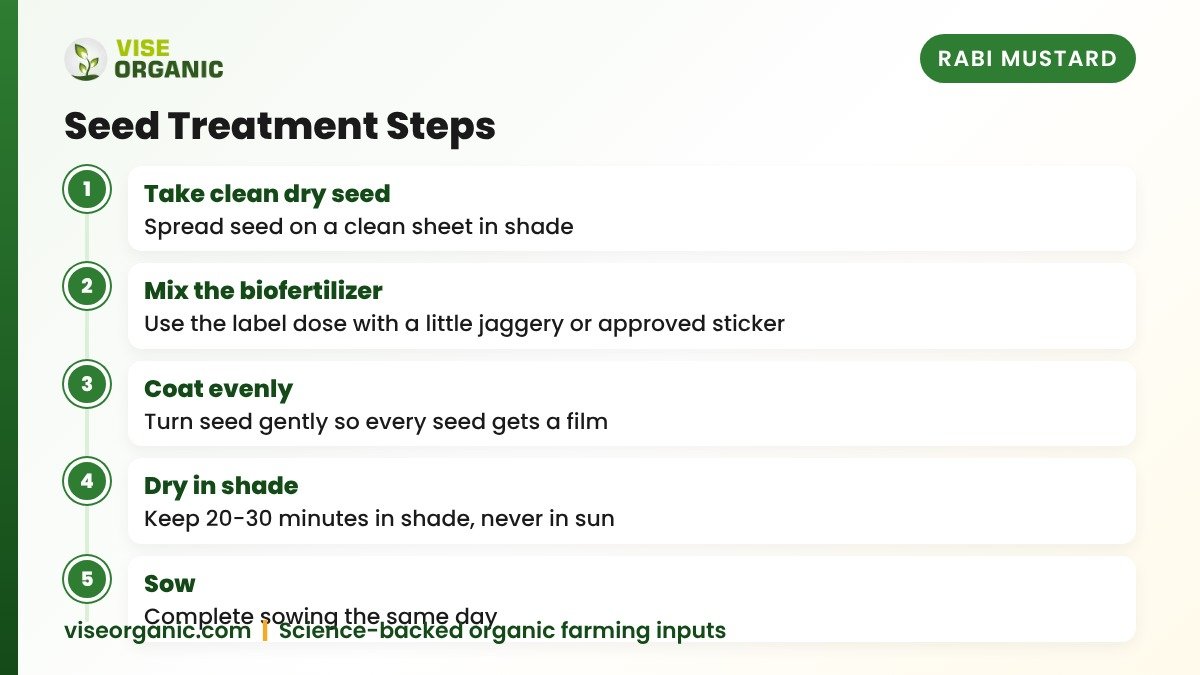
How to treat seed properly
- Take clean, dry, graded seed and spread it on a clean gunny sheet in shade.
- Take the recommended dose of a microbial product such as Azotobacter Multiplier as printed on the pack, mix with a sticker solution, and coat the seed evenly by turning it gently.
- Dry in shade for 20-30 minutes. Never dry treated seed in full sun; heat kills the microbes you just paid for.
- Sow the same day, in moist soil, and press the soil lightly after sowing.
For a certified organic field, check with your certifier before choosing any input, since NPOP or certifier rules decide what is allowed on your farm. For microbial products, do not mix them with chemical fungicides or bactericides in the same treatment unless the label clearly allows it. Wear a mask and gloves while handling seed, and keep the treated seed away from children and cattle.
Build the soil first, then feed the plant
Mustard is a shallow-rooted crop that punishes a hardpan quickly. A field with good organic matter holds the winter moisture longer and gives you fewer patches of yellowing in January.
Farmyard compost at 4-5 tonnes per acre, worked in at the last harrowing, is the base most successful growers stand on. On top of that, humic products and seaweed extracts are used to improve root growth and how efficiently the plant uses what is already in the soil. Eco Granule is a granular humic product commonly applied to the soil, and Seacure Liquid is a seaweed extract used as a drench or foliar spray as the label directs. Ask a local KVK or agronomist before you fix a dose for your field.
Soil testing once every two years is the single best money saved in mustard farming. It tells you the phosphorus, potash and sulphur status, and sulphur is the one most often missing in continuous wheat-mustard fields.
Nutrient need stage by stage
Mustard does not want a big nitrogen push. It wants a steady supply, enough phosphorus for roots, potash for the stem, and real attention to sulphur, which drives oil in the seed. Too much nitrogen gives you a leafy plant that lodges and drops flowers.
| Stage | What the crop is doing | What it needs from you |
|---|---|---|
| Sowing to 20 days | Root and branch initiation | Firm moist seedbed, basal phosphorus and potash, balanced nitrogen |
| 25 to 45 days | Branch and leaf building | First irrigation, weeding, no nitrogen excess |
| 45 to 75 days | Flower bud and flowering | Sulphur in the soil, steady moisture, pest scouting |
| 75 days to maturity | Pod fill and grain filling | Light water as needed, no handling damage, harvest on colour |
Sulphur is usually applied as a basal dose in the soil rather than sprayed. A liquid nutrient drench at flowering is one way growers cover micronutrient gaps; Liquid NPK is one such product, used strictly at the label rate. Results depend on your soil, variety, weather and how well the rest of the plan was followed.
Water and weed decisions that actually move the crop
Mustard is not a thirsty crop, but it is unforgiving at two points: 25-30 days after sowing, and just before flowering. Miss those and no later watering can recover the branches you lost.
Most fields do well with three to four irrigations through the season, timed at 25-30 days, pre-flowering, pod formation and grain filling. Sandy soils may need one extra light watering; heavy clay soils need fewer and longer gaps. Avoid irrigation with standing water in the field, and never irrigate in the middle of a hot afternoon at flowering.
Weeding in the first 40 days is as valuable as the first irrigation. Mustard seedlings are thin and slow, and a metaphit or grassy weed will take the light from them. Keep one hand weeding or one herbicide application as your local agricultural university recommends, done before the crop closes rows.
Flowering, pests and the problems you will meet in January
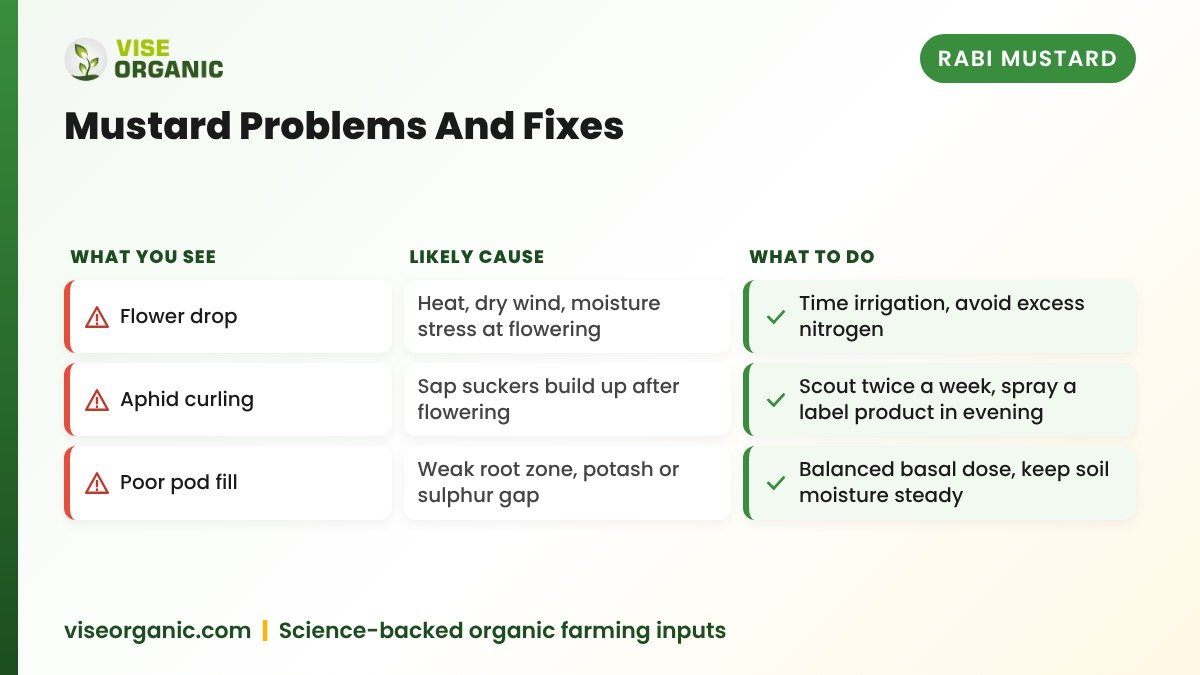
December to February is when a mustard field is most exposed. Aphids arrive after flowering, thrips and diamond moth caterpillars show up in warm spells, and Alternaria leaf spot appears in fields that stayed wet too long.
Flower drop
A few flowers falling is normal. Heavy drop usually means heat and dry wind at flowering, a moisture gap, or a heavy sucking-pest load. Time your irrigation, keep the field weed free, and do not push extra nitrogen to "force" flowering.
Sclerotinia and root issues in wet patches
White cottony growth near the base in low wet spots points to a fungal problem that thrives on prolonged moisture and buried old debris. Drain those patches, avoid overhead watering, and rotate away from canola, mustard and related crops for a season or two.
For sprays, wear gloves and a mask, spray in the evening, and do not tank-mix a microbial product with a chemical fungicide or bactericide unless the label allows. Store products away from sun and heat and keep them away from children. Eco Safe is one botanical option in the Vise Organic range; decide the need by scouting, not by the calendar. If you want to compare your plan with the standard seed-soil approach, the seed-stage steps in /biofertilizer-seed-treatment-guide-for-rabi-crops carry over directly to mustard.
Harvest, thresh and store without losing oil
Harvest when most pods have turned brown-yellow, the plant has shed most leaves, and a pod crushed in the hand gives a hard seed that dents rather than crushes. In the plains this is usually February to early March. Waiting too long costs you shattering in the plant, sometimes more than any pest did.
- Cut the crop at the base in the morning, when pods are slightly moist and less likely to shatter.
- Windrow in shade for 3-5 days, pods up, away from damp ground.
- Thresh with a light beat or a thresher set at low speed.
- Winnow and clean to under 8% moisture before bagging.
- Store in clean jute or in a dry, ventilated room off the floor, away from sunlight.
High moisture at storage is where mustard loses both weight and oil quality, so check the seed with a moisture meter or the salt test before bagging. For a broader look at how a rabi crop uses microbial inputs through the season, see /how-does-nutri-wheat-contribute-to-improving-wheat-crop-productivity, which follows the same field logic on wheat.
Frequently Asked Questions
What is the best sowing time for mustard in rabi?
In most of Rajasthan, Haryana, Punjab, Gujarat, Uttar Pradesh and Madhya Pradesh, sowing from late October to mid November works well. Late sowing in December needs a wider row spacing and a longer-duration variety.
Which biofertilizer is useful for mustard seed treatment?
Azotobacter and other nitrogen-fixing or phosphate-solubilizing products are commonly used for seed or soil application in mustard. Use the dose on the pack and ask a local agronomist for your field.
Why is sulphur important in mustard farming?
Mustard takes up more sulphur than most field crops, and sulphur supports oil formation in the seed. A soil-applied basal dose is the usual route, with any foliar use done only as the label directs.
How many irrigations does a rabi mustard crop usually need?
Most growers give three to four irrigations depending on rainfall and soil: around 25-30 days after sowing, at pre-flowering, at pod formation and at grain filling. Sandy soils may need one more light watering.
Can I mix a microbial biofertilizer with a chemical fungicide in the same treatment?
For microbial products, mixing with chemical fungicides or bactericides is generally not advised unless the label clearly allows it. Treat seed with the biofertilizer separately and keep treated seed in shade before sowing.
What causes flowers to drop in mustard and how do I handle it?
Hot dry winds, moisture stress at flowering and heavy aphid or thrips load all lead to flower drop. Keep the field free of weeds, avoid nitrogen excess, monitor the crop twice a week in December-January and spray a label-approved product in the evening.
When is the right time to harvest mustard?
Harvest when most pods turn brown-yellow and the plant leaves have fallen, usually February to early March. Late harvesting leads to shattering and pods splitting in the plant.
Make the next rabi easier than this one
Good rabi season mustard care comes down to five decisions: sow in the window, treat the seed in shade, keep the soil loaded with organic matter and enough sulphur, water at 25-30 days and at pre-flowering, and harvest on pod colour. Do those five and the crop has everything it needs to carry its own branches to maturity.
Browse the inputs at /shop, or write to /contact for product details and bulk or dealer enquiries. For crop-specific advice on your field and your soil, use /callback-request and our advisory team will get in touch, Monday to Saturday.
Article Topics & Tags:
Vise Agronomy Team
The in-house agronomy and field research team at Vise Organic Biotechnology, publishing applied research on bio-fertilizer protocols, crop protection, and sustainable cultivation practices.