You walk into a gram field in the second week of flowering and the buds look tired. A few flowers have pale silvery patches, some buds never opened, and a sticky film sits on the leaves below. That is usually Thrips feeding on the bud, and in pulses the bigger worry is what they carry:Bud necrosis and the Mung bean yellow mosaic virus complex that thrips spread from plant to plant. Getting Gram thrips control right is less about the strongest bottle you can find and more about scouting the right number of plants and spraying in the narrow hours when thrips are actually exposed.
This guide covers one crop and one pest: gram (chana) and field bean in zaid and kharif, from bud to pod set. You get scouting numbers, a spray calendar by days after sowing, how to use botanic and microbial sprays in the right order, and what to check before you buy a drum of botanic spray for your FPO or dealer shelf.
Why Thrips Hit Gram Hard in Zaid and Kharif
Thrips are tiny, slender, fringed insects about 1-2 mm long, and they live inside the bud where most sprays never reach them. They rasp the surface cells and drink the sap, which is why the damage looks like silver patches or streaks rather than holes. Warm dry weather suits them. Zaid gram sown in March-April in Rajasthan, Gujarat, western Madhya Pradesh and parts of Andhra Pradesh sits in exactly that weather, and kharif gram in central India faces the same flush after the rain spells end.
Two things make the pulse crop especially exposed. The flowering period is long and indeterminate, so there is always a fresh batch of buds for the population to move into. And the vector risk is real: thrips transmit thrips borne tospoviruses and, in the wider pulse belt, the Mung bean yellow mosaic virus complex that whiteflies and thrips worsen in the same field. A field that looks "just a little silvered" in week one can be a virus problem in week four. Population growth is temperature driven, as ICAR-Indian Institute of Horticultural Research notes in its vector work, so a warm March week can double numbers faster than your calendar expects.
How to Scout So You Spray Only When Needed
Scouting is the whole game. Most wasted sprays in pulses come from spraying on a fixed calendar date instead of on a count. Walk in a W or zig-zag pattern across the field, never just along the irrigated margin where numbers collect first.
- Count buds, not leaves. Open five to ten buds per plant at random on ten plants spread across the field and count the thrips inside them; adults hiding in leaf whorls tell you nothing useful.
- Check the silvering. Rub a bud and look at the inner surface; silvery patches on more than a few plants mean feeding has been going on for days, not hours.
- Look for the black specks. Fine dark faecal specks on buds and young pods confirm active feeding even when the insect has run off.
- Note the border first. Grassy and weedy margins, especially with Congress grass or ghul bar, hold the first build-up, so check two metres inside from the field edge.
- Repeat twice a week. Same time of day, same method, so your numbers are comparable; a count taken at noon when thrips hide deep in the flower under-reads the field.
For Gram thrips control in the bud to flowering stage, the number worth acting on is 8-10 thrips per bud averaged across your plants. Below that, a botanic spray and clean margins are usually enough. Above it, or when you see necrotic buds and virus symptoms appearing at the border, plan a spray within 24-48 hours.
Spray Calendar From Bud to Pod Set
Timing does most of the work. Thrips are exposed at dawn, they shelter deep in the bud and flower by mid-morning, and they come out again near evening. The table below maps the window and the action by days after sowing for zaid gram on light soil; shift the whole calendar by a week if your crop flowers later.
| Stage (days after sowing) | Thrips per bud (action level) | Action in the field |
|---|---|---|
| 30-40 (pre-flowering) | 0-2 | Clean weed margins, install sticky cards, no spray |
| 40-50 (first buds) | 4-6 | Botanic spray at dusk, focus on border and tips |
| 50-65 (flowering peak) | 8-10 | Botanic or microbial spray, 6:30-9:00 am |
| 65-80 (pod set) | 8-10 | Second spray, rotate the product group |
| 80-95 (pod fill) | 10-12 | Spot spray damaged blocks only, protect pollinators |
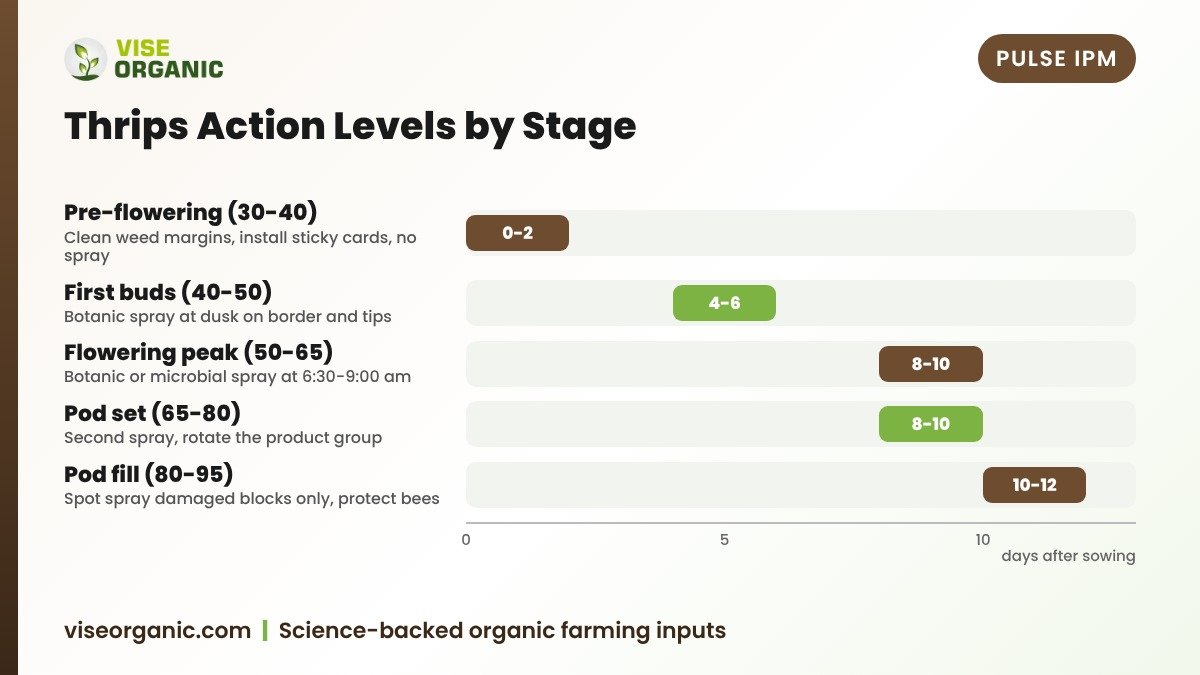
Read the middle column as an average across your ten plants, not the worst plant you found. The 40-50 day row is the one most farmers skip, and it is the cheapest spray of the season because the population is still on the exposed buds and tips rather than deep inside open flowers. Once the crop is at peak flowering with counts in the 8-10 band, one well-timed application beats three hurried ones. For a full season view of what to apply and when, our Guide to organic farming for mustard in rabi uses the same stage-by-stage logic for an adjacent rabi crop.
Botanic Sprays First, and Why Order Matters
Botanical sprays are the first tool in this program because they act fast on exposed thrips, break down quickly, and give you room to keep the field under a botanic regime for most of the season. Neem-based sprays work mainly as antifeedants and growth disruptors rather than quick knockdown, so expect the silvering to stop spreading rather than the insects to drop dead in an hour. That is normal.
- Neem oil or azadirachtin. Use at dawn or dusk at the label rate, cover the buds and growing tips with fine droplets, and treat it as a population regulator you apply on a 7-10 day cycle.
- Botanical mixtures. Read the label for the crop and the pest listed; a mixture registered for sucking pests in cotton is not automatically right for a pulse crop at flowering.
- Spray quality over dose. A 60-80 litre per acre volume with 80-100 mesh nozzles and a wetter covers buds far better than a concentrated pass with less water.
- Rotate the group. Alternate neem-based with a different mode of action between sprays so the population does not settle into one product.
Our Botanical and neem oil spray guide covers mixing and nozzle choice in detail. For the protection side of the plan, Eco Safe and Eco Cover are the label-check products to compare for your crop, and Virexx is the product line we position for fields where virus symptoms are already showing at the border. Always read the label for the registered crop, dose and pre-harvest interval, and ask your local KVK or agronomist before changing anything.
Microbial Biopesticides as the Backbone
Botanics knock the population down; microbial biopesticides keep it from rebuilding to the same peak between sprays. This is where a pulse program differs from a cotton program: you have a long flowering period to protect, so you want something living in the field rather than a fresh knockdown every week.
- Entomopathogenic fungi. Formulations based on Beauveria bassiana and Metarhizium anisopliae infect thrips and other soft-bodied pests in the humid microclimate inside the bud; apply in the evening with good coverage and no fungicide in the same tank.
- Nucleopolyhedrovirus. For the pod borers that arrive alongside thrips in kharif gram, a NPV product is block-specific and harmless to pollinators, which matters at flowering.
- Botanical plus microbial pairing. Use the botanic for the fast reduction and the microbial for the weeks between, so you are not spraying the same group twice in a row.
- Keep the microbes alive. Store packs in the shade below 35 degrees C, never in a hot cab, and mix into clean water without chemical fungicides or bactericides unless the label clearly allows it.
A grower's own multiplier keeps the microbial side affordable across a large area. PSB Multiplier and Azotobacter Multiplier are the multiplication products we sell for the nutrition side of the same field, and the same discipline of clean water, clean tank and shade applies to multiplying and storing any microbial input. For virus-stressed fields, our Viral disease management guide for organic farmers explains how to slow the secondary spread once symptoms appear.
Scout the bud, not the leaf: a thrips count taken at the wrong hour or from the wrong plant part is the reason pulse farmers spray twice and still lose buds.
What to Check Before Buying in Bulk
If you are stocking for an FPO, a dealer shelf or a 100-acre block, the buying check decides whether the season works. Ask for these before payment, not after delivery.
- Registered crop and pest. The label must list the crop and the pest you are buying for; a broad "sucking pest" claim without a crop list is a risk on food crops.
- Batch certificate and content. For botanicals, ask for the azadirachtin or active content of the batch, with the test report number. For microbial products, ask for the viable count per gram or millilitre and the date of the assay.
- Registration number. Match the CIB&RC registration number on the tag to the invoice, and check the expiry has at least six months of field season left.
- Packing and seal. Aluminium-lined or UV-stabilised packs for botanicals, intact seals, no bloated pouches on microbial packs (bloating means contamination or heat damage).
- Storage at your godown. Cool, dark, off the floor on pallets, away from diesel and fertiliser bags; heat kills microbial formulations long before the printed expiry.
For compliance questions on what your buyers can legally sell, see our NPOP organic compliance page. Bulk buyers should also run one small block first, on their own land, before committing a whole district's stock to one product.
Safety and Label
Pulse crops at flowering are being visited by bees and other pollinators, so spray discipline is part of the efficacy, not an extra.
- Spray at 6:30-9:00 am or after 5:30 pm when thrips are exposed and pollinators are less active.
- Wear gloves, a mask and a full-sleeve shirt while mixing, and wash hands before eating or smoking.
- Never mix a microbial biopesticide with a chemical fungicide or bactericide in the same tank unless the label explicitly allows it.
- Do not spray a pond, canal or field channel; keep a buffer along any water body.
- Store all packs locked away from children and animals, away from sun and heat, never in a drum of drinking water.
- Follow the label's pre-harvest interval on the pod crop; pod set is closer to harvest than most farmers think.
Frequently Asked Questions
How many thrips per bud mean I should spray gram?
Act when your average across ten plants reaches 8-10 thrips per bud at the bud to flowering stage, or sooner if you see necrotic buds and virus symptoms starting at the field border. Below 4-6 per bud, a botanic spray on the border and tips plus clean margins is usually enough.
What time of day is best for a thrips spray in pulses?
Early morning between 6:30 and 9:00 am is the best window because thrips come out to feed and pollinators are less active. Evening after 5:30 pm is the second choice, especially for microbial sprays. Avoid the hot midday hours when thrips hide deep inside the flower.
Does neem oil kill gram thrips immediately?
No. Neem-based sprays work mainly as antifeedants and growth disruptors, so you should see the silvering stop spreading over a few days rather than an instant knockdown. That is expected behaviour, and it is why you pair neem with a microbial spray for the weeks between applications.
Can I mix a microbial biopesticide with a fungicide?
Generally not in the same tank. Most microbial formulations, including Beauveria and Metarhizium based products, are harmed by chemical fungicides and bactericides. Check the label first, and if the label gives no mixing guidance, apply them on separate days with clean water in between.
Will spraying at flowering harm bees and pod set?
Spraying a flowering pulse crop does put pollinators at risk, which is why the early morning or late evening window matters, along with avoiding the peak bee activity hours. Use the least persistent option that keeps the count below threshold, and spot spray only the blocks that need it at pod fill.
How do I tell thrips damage from a nutrient problem?
Thrips damage shows as silvery patches or streaks with fine dark specks, worst in the buds and young leaves, and you can find the insects inside the bud. A nutrient deficiency usually shows as uniform yellowing or marginal scorch across older leaves, without silvering or insects in the bud.
Which fields need the closest watch in zaid gram?
Fields next to lucerne, cotton, onion or a previous pulse crop, fields with weedy grassy margins, and fields under stress from dry spells or intermittent irrigation. These build up first, so scout them twice a week from first bud rather than waiting for the whole block to show silvering.
Conclusion
Gram thrips control works when you scout the bud twice a week, act on 8-10 thrips per bud, and use a botanic spray for the fast reduction with a microbial biopesticide holding the population down between sprays. The 40-50 day first-bud spray is the cheapest pass of the season, and the clean border is the cheapest of all. Start with a clean tank, a 60-80 litre volume and a label that names your crop.
Browse Our products to compare what fits your block, and Contact Vise Organic or Request a callback for a spray calendar built around your sowing date and district.
Disclaimer: This article is general agronomic information. Results vary with soil, crop, weather and practices. Always read and follow the product label and consult a local agronomist for advice specific to your field.
Article Topics & Tags:
Vise Agronomy Team
The in-house agronomy and field research team at Vise Organic Biotechnology, publishing applied research on bio-fertilizer protocols, crop protection, and sustainable cultivation practices.