
Brinjal in the summer (zaid) crop is a different beast from the kharif field. Night temperatures stay high, the soil dries out between irrigations, and the plants carry fruit for three or four months instead of two. A brinjal biofertilizer schedule built for those conditions has to work with the moisture you actually have, not with a plan written for the rainy season.
This guide gives one complete schedule for a 1-acre brinjal crop transplanted in February or March, from the nursery bed to the fifth picking. It covers which microbial product goes at which stage, the typical doses per acre, and the mixing rules that decide whether the organisms survive long enough to do anything.
Why Summer Brinjal Needs a Different Plan
A zaid brinjal crop grows in soil that is already warm on the day you transplant, and the surface crusts over between light irrigations. Roots stay shallow, and the plant depends heavily on the top 15 cm for water and phosphorus. Microbial products placed in that layer get a short, hot working window, so timing matters more than dose.
Phosphorus and potash are the two nutrients that limit summer brinjal most, because both move to the roots through water and there is rarely enough water in the soil. That is exactly where Phosphate solubilizing bacteria and a KMB multiplier earn their place, along with humate to hold moisture around the root zone.
Choose Your Route: Seed, Nursery or Transplant
You only need one or two entry points, not all three. Pick based on how you raise seedlings.
- Seed treatment route. Treat the seed with Azotobacter or PSB before sowing in the nursery, so every seedling carries its own starter colony into the main field.
- Nursery drench route. Raise seedlings the normal way and drench the nursery bed two or three days before uprooting, which lets the microbes colonise before transplant shock.
- Transplant dip route. Make a slurry of water and biofertilizer in a bucket and dip the root ball of each seedling just before planting, the most reliable option in hot weather.
If you buy seedlings from a vendor, the dip route is the only one you control, so plan around it.
The Stage-Wise Schedule
The schedule below assumes 1 acre, roughly 5,500 to 6,000 plants on 1.2 m beds, and one fruit-bearing hybrid or F1 type. Doses are typical label ranges; always read the label of the pack you bought, since carrier-based and liquid products are measured differently.

In numbers per acre: seed treatment uses 3-5 g per kg of seed, the nursery drench takes 8-10 ml in 5 L of water for every 10 sq m of bed, and the root dip slurry is mixed at 5-8 ml per litre of water. The two stand drenches use 1500-2500 ml of liquid PSB or KMB diluted into the irrigation channel or a 200 L drum, and the foliar passes use 200-250 ml of seaweed or humic product in 150 L of water per acre.
How to apply biofertilizers for better crop results covers the same timing logic for field crops if you grow brinjal alongside other vegetables.
Week-by-Week Plan for a 1-Acre Crop
The chart below maps the same schedule on a day scale, which is easier to follow when you are standing in the field.
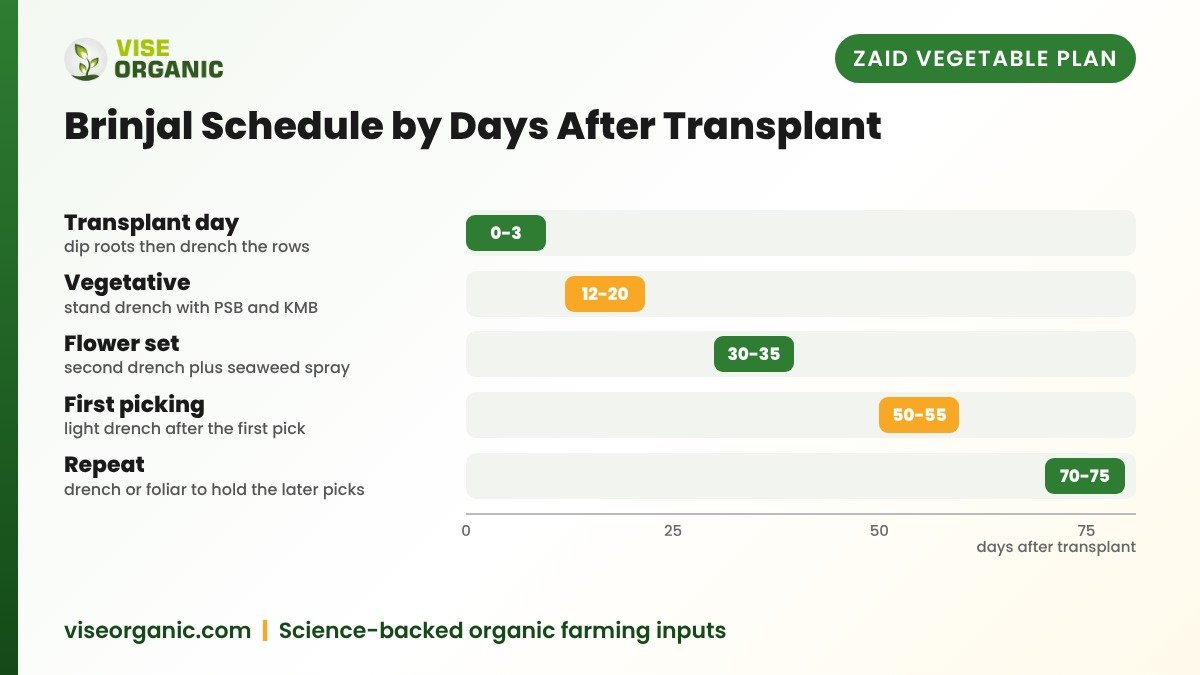
Say you grow 3 acres of brinjal near Bharatpur on flood irrigation and transplant on 20 February. Your first drench falls in the first week of March, the flower-set drench lands around the first week of April when the heat is already climbing, and the seaweed spray at 25-30 days is the pass that keeps the plant from shutting down flower drop in that heat.
How to Mix and Apply Without Killing the Microbes
Heat and bad mixing destroy more biofertilizer than a wrong dose ever will. Brinjal fields are the worst place to learn this, because everything is done in full sun.
- Mix in the shade. Prepare the slurry or drum before 9 am or after 4 pm, and never on a concrete slab in direct sun.
- Use plain water. Draw water that is free of chlorine and heavy turbidity; details are in Irrigation water quality and biofertilizers.
- Add the product last. Fill the drum with water first, then stir in the biofertilizer, then open the outlet.
- Finish the drum within two hours. A mixed drum sitting in the sun loses viability fast, so calculate the area you can cover.
- Water the bed before applying. A drench into dry crusted soil sits on the surface; moist soil pulls the organisms down to the roots.
- Never tank-mix with chemical fungicides or bactericides. Apply microbial products separately, with 3-4 days between the two passes unless the label says otherwise.
For root dips, add a handful of sieved compost or soil to the slurry so it clings to the roots instead of running off. Dip only the root ball, not the leaves.
Feeding the Soil Carbon Under the Crop
Microbes need food. In a three-month brinjal crop that removes a lot of biomass through repeated picking, the microbial population can run out of easy carbon between drenches, which is why the second and third drenches often look weaker than the first.
Well-rotted farmyard manure at 4-5 tonnes per acre in the last plough, plus a humate product at the label dose, keeps a carbon supply in the top soil. Eco Green is a granular humic product worked into the beds before transplanting, while Seacure Liquid is the foliar side of the same idea, given at 200-250 ml per 150 L. A seaweed spray on a hot afternoon does little; give it before 9 am or after 5 pm so the leaves actually absorb it.
If your beds look pale and crumbly by the third month, the problem is usually carbon and moisture, not a missing nutrient. Soil organic carbon in rabi wheat with compost and humate explains the same pattern in a field crop, and Compost maturity for soil health covers how to tell whether your manure is actually ready.
In brinjal, a drench into moist soil at the right stage beats a heavier dose thrown onto dry crust.
Nitrogen Products: Where They Fit and Where They Do Not
Azotobacter and Rhizobium are nitrogen fixers, and brinjal is a heavy nitrogen feeder with a long fruiting period. Free-living bacteria such as Azotobacter liquid contribute a modest, slow supply through the vegetative stage, which suits the early weeks. Rhizobium works only in association with legume roots, so it has no role in a brinjal field; save it for the bean or cowpea crop in your rotation.
The honest reading: no nitrogen biofertilizer replaces the nitrogen a fruiting brinjal crop pulls out over four months. Use these products to support the early growth and to reduce dependence on soluble urea in the first 40 days, and judge the rest from your own leaf colour and fruit set. How nitrogen biofertilizers fix nitrogen in soil explains what the bacteria actually contribute.
What to Check Before Buying in Bulk
Dealers and FPOs buying for a vegetable cluster should verify the pack before the field season, because summer stock moves fast and old stock moves faster.
- Check the batch certificate. Ask for the viable count per gram or ml and the date of the assay, not just the expiry date printed on the pack.
- Check the carrier and the count. Liquid products should be within their stated count and free of a foul smell or heavy sediment separation.
- Check the packing. Sealed, light-protected containers with an intact seal; a swollen or leaking can means heat damage.
- Check the storage history. Packs transported on an open truck in April or stored in a shop without shade lose count before they reach you.
- Check shelf life against your calendar. Buy only what you will use in the current season, and keep opened packs cool and closed.
Vise Organic's microbial formulations are DSIR-recognised and made at Manjusar in Gujarat; for cluster orders, dealership or a crop-specific plan, write to sales at +91 84014 31440 or use Request a callback for advisory help.
Safety and Label Reading
Read the full label before the first application, including the compatibility note, the storage note and the pre-harvest interval stated for any combined product. Wear gloves when handling concentrates and a mask when stirring dry carrier powder, and wash hands before eating. Store packs in a cool shaded shed, away from direct sun, fuel, pesticides and anything stored for children to reach, and never empty leftover mix into a well, pond or irrigation channel. Microbial products are living material, not a chemical, but they still deserve the same care in handling and storage. For a wider look at what fits an organic vegetable programme, see Organic farming practices for vegetables and browse Our products.
Frequently Asked Questions
When should I apply biofertilizer to brinjal in the summer crop?
The most useful points are the day of transplanting (root dip), 12-20 days after transplant, and again at 30-35 days when flowers set. A light drench after the first picking helps the next flush.
Can I mix PSB and KMB in the same drum?
Many liquid products are sold as combinations, so check the label first. If you are mixing two separate packs, dissolve them one after the other in a full drum of plain water and finish applying within two hours, away from direct sun.
Is Rhizobium useful in brinjal?
No. Rhizobium fixes nitrogen only inside the root nodules of legumes such as bean, cowpea or gram. For brinjal, a free-living product like Azotobacter is the relevant option, and even that supports only the early growth.
What dose of seaweed extract should I spray on brinjal?
A typical foliar use is 200-250 ml of liquid seaweed per 150 L of water per acre, given before 9 am or after 5 pm. Confirm the figure on your pack, since concentrations differ between manufacturers.
Why did my biofertilizer drench show no effect?
The usual reasons are applying on dry crusted soil, mixing in a drum left in the sun, using chlorinated or very turbid water, or tank-mixing with a chemical fungicide. Check these before assuming the product was weak.
Should I still use urea in a brinjal crop with biofertilizers?
Brinjal needs a steady nitrogen supply through a long fruiting period, so plan on your normal nutrition programme. Biofertilizers support early growth and root activity rather than replacing the whole nitrogen requirement.
How do I store leftover biofertilizer on a hot summer day?
Keep the pack closed in a cool shaded shed, off the floor and away from sun, heat and pesticides. Use opened liquid packs within a few weeks and do not carry them in an open vehicle all day.
Conclusion
A workable brinjal biofertilizer schedule for the summer crop comes down to one good entry point at transplant, two stand drenches at 12-20 and 30-35 days after transplant, and a carbon and moisture base under everything. Keep the mix cool, apply into moist soil, and never tank-mix the microbes with a chemical fungicide. Build the plan around your own field's heat and irrigation, and adjust the doses to the label of the pack in your hand.
Put the schedule on paper for this season, note what you applied and when, and compare two beds at the end of the fifth picking. For products or a plan for your crop, visit Our products, Contact Vise Organic, or Request a callback for crop advice from our agronomy team.
Disclaimer: This article is general agronomic information. Results vary with soil, crop, weather and practices. Always read and follow the product label and consult a local agronomist for advice specific to your field.
Article Topics & Tags:
Vise Agronomy Team
The in-house agronomy and field research team at Vise Organic Biotechnology, publishing applied research on bio-fertilizer protocols, crop protection, and sustainable cultivation practices.