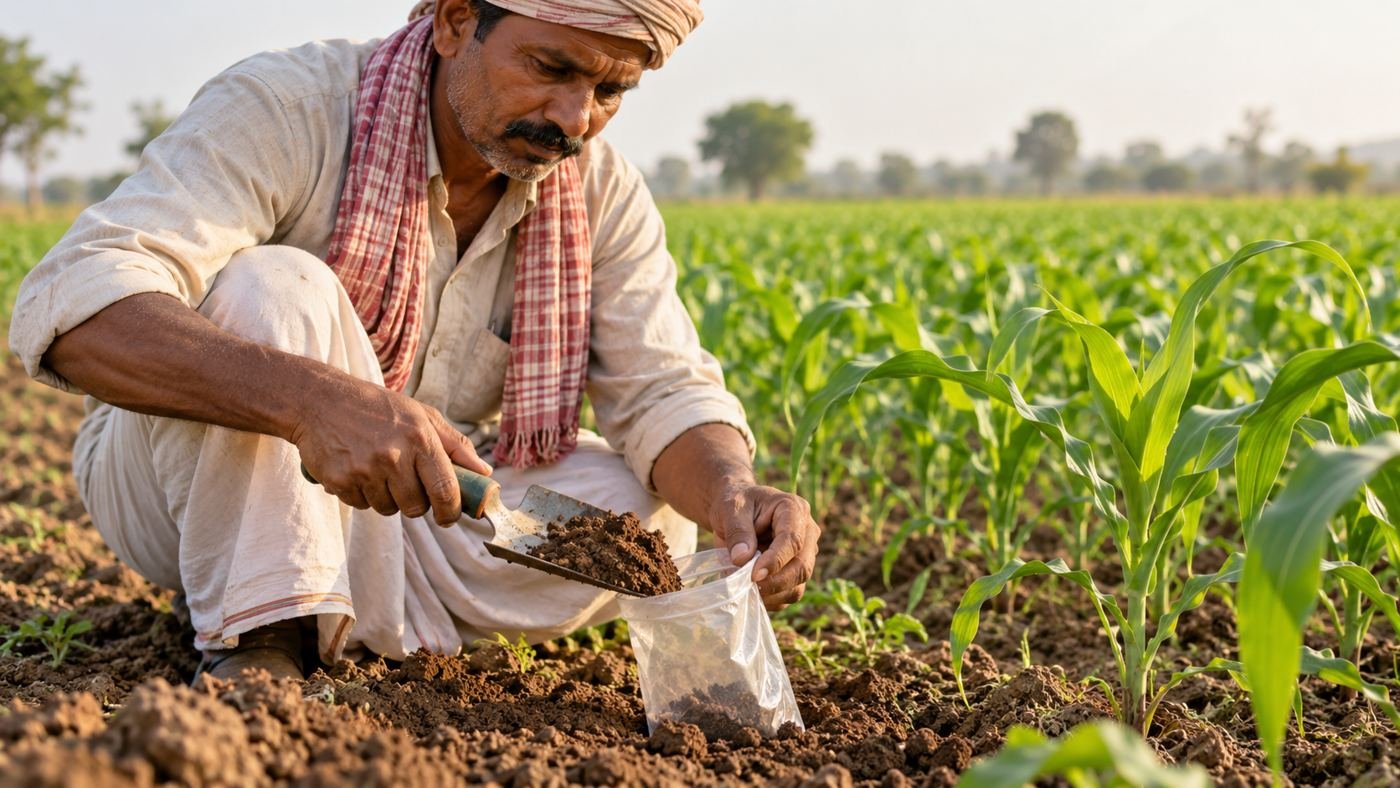
Soil testing before biofertilizers helps you make an informed buying decision instead of guessing which input your field needs. A soil report provides a starting point for nutrient planning; a biofertilizer label explains the microorganisms, suitable crops and application methods. Reading both together is more useful than choosing a product only because it promises healthier soil.
This guide explains what to prepare, which questions to ask and how to turn your report into a practical conversation with a local agronomist.
Why soil testing before biofertilizers matters
A field may have several constraints at once. Poor growth can involve nutrients, water, soil conditions, pests or establishment. A biological input should be selected for a defined role rather than treated as a cure for every symptom.
ICAR’s farmer education programmes connect regular soil testing with integrated nutrient management and microbial technologies. That supports a planning approach: understand the field first, then choose suitable inputs.
Prepare a representative sample
The laboratory’s sampling instructions should guide collection. A handful taken from an unusual patch may not represent the area you intend to manage.
Separate areas that differ
Discuss visibly different soil, crop history or management zones with the sample collector. Combining very different areas can hide problems that require separate recommendations.
Follow collection and labelling directions
Use the laboratory’s advice on depth, collection points, containers and timing. India’s Soil Health Card guidance describes collecting from several locations and mixing the sample. Confirm the procedure appropriate to your field rather than copying a depth from another crop.
Include field history
Record the previous crop, recent fertilizer and manure applications, irrigation source and the next planned crop. Keep the sample identity consistent with the field map or your notebook.
Read the report as a planning document
Ask for help interpreting the actual units, test methods and recommendations on your report. A number without its method or reference range is easy to misunderstand.
| Report detail | Question to ask | Planning use |
|---|---|---|
| Soil pH | Does the result need crop-specific attention? | Discuss soil conditions and any recommended correction. |
| Electrical conductivity | Does the laboratory identify a salinity concern? | Review irrigation and soil management with an adviser. |
| Organic carbon | How does it fit the field’s management history? | Plan appropriate organic-material management. |
| Nutrient results | What does the recommendation mean for the intended crop? | Choose nutrient sources and quantities. |
| Report date and field identity | Does this report represent the area now being planted? | Avoid applying an unrelated field’s recommendation. |
Match a biological input to a defined purpose
Biofertilizers contain beneficial microorganisms; they are different from a mineral fertilizer supplying a declared nutrient quantity. Ask which organism is present, what crop it suits and how the label directs application.
- Confirm the intended crop and application route.
- Check batch information, expiry and storage directions.
- Ask for written compatibility advice before mixing inputs.
- Keep the soil-test-based nutrient plan in place unless a qualified adviser recommends a change.
For a clearer comparison, read biofertilizer vs chemical fertilizer. A nutrient-solubilizing product does not make the laboratory’s nutrient recommendation irrelevant.
Create a simple pre-season checklist
Bring the report and a short field summary to your consultation. The aim is to leave with a clear plan rather than several products with overlapping claims.
- Identify the crop, field area and sowing or transplanting date.
- Review the report and flag anything requiring further diagnosis.
- List the recommended nutrient sources and organic materials.
- Confirm whether a specific biofertilizer has a useful role.
- Write down dose, timing, application method and compatibility instructions.
- Schedule observations and keep application records.
If seed treatment is suitable, our rabi seed-treatment guide can help you prepare questions. The current product label remains the application reference.
Frequently asked questions
Does a soil test identify every crop problem?
No. Symptoms may require crop inspection, water testing or other diagnosis. A soil report is one part of the investigation.
Can a soil test tell me the exact biofertilizer brand to buy?
Usually it informs nutrient and soil-management decisions. Product selection also needs crop compatibility, formulation information and label guidance.
Should I reduce fertilizer as soon as I add a biofertilizer?
No automatic reduction follows. Use a crop-specific, locally supported recommendation rather than a general percentage.
Can I use my neighbour’s soil report?
It does not establish the condition of your field. Arrange sampling that represents your own management area.
How often should I test?
Ask your laboratory or local adviser for a schedule suited to your crop rotation and management changes. Retest when recommended.
What should I send when asking Vise Organic for guidance?
Share the crop, acreage, location, soil report and intended application method. Include the product label if checking compatibility.
Conclusion: begin with the field
Soil testing before biofertilizers gives your nutrient programme a clearer starting point. Combine the report with crop requirements and verified label instructions, then keep records so the next season’s decisions are better informed.
Explore Vise Organic inputs or contact the team with your field information.
References: Soil Health Card sampling guidance; ICAR guidance on soil testing and microbial inputs.
Article Topics & Tags:
Dr. R. Sharma
Senior Agronomist at Vise Organic Research & Development Lab. Specialist in soil microbial ecology, mycorrhizal symbiotic inoculants, and organic carbon rejuvenation.