Leaving a field of cane trash burning on the bund is a sight most sugarcane belts in Uttar Pradesh, Maharashtra, Karnataka and Gujarat still show in November and December. That pile holds a good part of the potash you applied this season, along with carbon that your soil is short of. Composted properly and returned, it feeds the next rabi crop and the cane crop after that.
Sugarcane trash composting is the cheapest way to add organic matter to a cane field, because the material is already lying on the ground. This plan covers one heap at a time: the size that works, how much PSB, KMB and humate to use, the turning schedule, and how to tell when the compost is actually ready to spread.
Why Cane Trash Is Worth Composting
A 40-tonne cane crop leaves roughly 10-12 tonnes of leaves and tops behind for every acre. Burning it finishes that in a single evening on the bund. Composting it takes about 45 days and gives you a bulky, dark material that holds moisture and feeds the microbial life you are already buying in the form of biofertilizers.
Trash is mostly carbon and very little nitrogen, which is exactly why a plain pile of leaves sits unchanged for six months. The microbes that break down woody tissue need nitrogen to work with, and they need water. Give them both and the pile heats up in four or five days. Ignore the nitrogen and no amount of culture on the market will finish the job.
One more reason to compost instead of burn: the same microbes that open up cane residue also work on the soil they land in. Potash mobilizing microorganism releases bound potassium from the soil, and the organic matter from your heap is the food that keeps that population going.
Choosing the Spot and the Heap Size
Build the heap where you will actually see it, at the field inlet or along a watercourse, not on a plot you have already marked for the next crop. Level ground with a slight slope so that excess water drains away and does not drown the pile.
A heap of 3 m length, 2 m width and 1 m height is the practical size. Anything smaller dries out and never heats. Anything wider than 2.5 m goes sour in the middle because the turns never reach it properly. One heap of that size takes the trash from roughly one-fourth to one-third of an acre of harvested cane.
Chop the trash to 5-10 cm with a chopper or by running the rotavator over it once. Whole leaves mat into sheets, water runs off them, and the centre stays cold for months.
What to Layer in the Heap
Four layers is the standard build. Each trash layer goes down 20-25 cm deep, and every layer gets the culture solution and water. Between the trash layers, a thin layer of green dhaincha or senhai chopped to the same length brings the nitrogen down and gives the pile bulk.
- Chopped cane trash. The main body of the heap, 20-25 cm per layer, four layers in all.
- Green legume cuttings. A 5 cm layer of dhaincha or senhai between trash layers, if you have it.
- Well-rotted cow dung. One full can per layer, mixed into the wetting solution, mainly to add moisture and microbes.
- Biofertilizer culture. PSB and KMB suspended in water, poured over each layer as you build.
For the culture, use PSB Multiplier and KMB Multiplier to grow out the carrier culture in jaggery water a day before building, then dilute that into the watering can. If you would rather skip the multiplication step, the straight liquid works the same way; see the PSB bacteria product page for label use. The table below gives the quantities for one heap.
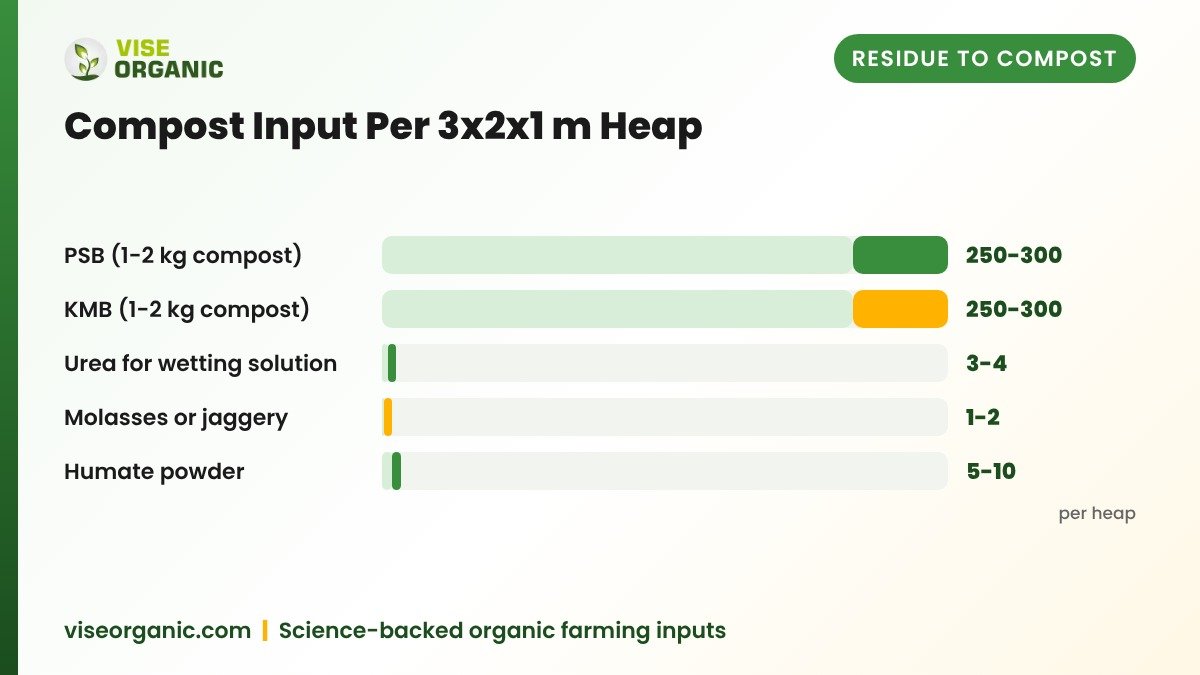
The urea figure is the one farmers argue about. Three to four kilograms for a heap of a tonne of trash is a starter dose for the fungi and actinomycetes, not a fertilizer dose. Sticking to it matters: beyond about 5 kg the pile goes ammonia-smelly and the actinomycetes that chew through lignin slow down.
If you want the full numbers on building a heap from dung and residue instead of trash, this Guide to on-farm compost covers that method.
Building the Heap in One Morning
- Chop and wet. Run the rotavator over the trash or chop it to 5-10 cm, then wet the cut material in a heap so it is damp through, not dripping.
- Mix the culture. Dissolve 1-2 kg jaggery in 50 L water, stir in the PSB and KMB, and leave the can in the shade for 12-24 hours before use.
- Lay the first layer. Spread 20-25 cm of trash over a 3 x 2 m base, sprinkle 1 kg urea, and pour the dung and culture solution over it until the layer is visibly wet.
- Repeat four times. Build four trash layers with a green-cutting layer between two of them, finishing with a trash layer on top.
- Cap with soil. A 5 cm soil cap on the finished heap holds moisture and keeps flies off the dung.
- Mark the date. Write the date on a stick at the head of the heap; the whole plan runs on that date.
The culture solution goes on the layers, never thrown on the finished heap. Microbes that sit on dry leaves on top of a pile do nothing.
Watering and Turning Schedule
Turn the heap on days 4-5, 12, 22 and 35. A turn does two things: it moves the cold outer material into the hot centre, and it lets fresh oxygen in, which is what the heating phase runs on. Water while you turn, so that dampness is even from edge to edge.
| Stage | Days after building | What to do |
|---|---|---|
| Heating | 0-2 | Build, wet well, cap with soil |
| First turn | 4-5 | Turn fully, squeeze test for dampness |
| Second turn | 12-14 | Turn, work 5-10 kg humate through the heap |
| Third turn | 22-24 | Turn, break any dry pockets at the edges |
| Curing | 35-50 | Stop turning, leave covered to finish |
At the second turn is where Eco Granule or humic acid powder earns its place. Worked into the middle of the heap it holds moisture against the coarse fibre and gives the humic coating that soil bacteria attach to. For a fuller read on how humate works in a heap and in the field, see How humic acid improves soil.
Squeeze test: take a handful from the middle of a turned heap and press. A drop or two at the knuckles means the moisture is right. Water running between your fingers means too wet, so turn it and leave the cap off for a day.
A heap that is cool at the centre on day 10 is a water and nitrogen problem, not a culture problem.
Reading the Heap: Heat, Smell and Colour
Steam and warmth tell you more than any lab report. On a cool December morning a working heap steams from the top for the first two weeks. Push a bamboo stick in, leave it ten minutes, pull it out and feel the wet end: warm means the pile is active.
- Sweet, earthy smell. Normal. The heap is breaking down evenly.
- Ammonia or urine smell. Too much urea or too wet. Turn it, skip urea at the next turn and add dry chopped trash.
- Sour, rotten smell. Waterlogged and short of air. Turn twice with a gap of three days and leave the cap open.
- Cold edges and a hot centre. Not enough water at the edges. Turn and water as you go.
If the whole heap is cold by day 12 and dry, water it heavily and turn the same day. A heap that dries out in the first fortnight simply pauses; rewetted, it picks up within a week.
Applying the Finished Compost
Compost from cane trash is ready at 40-50 days in the November to February weather, later in a cold spell in the northern belts. Spread it before the rabi planting or before the spring cane planting, and plough it into the top 10-15 cm.
One heap per quarter acre works out to roughly 3-4 tonnes per acre. If your heap yield is lower, spread what you have on the best strip and move the rest the following season. Do not wait for a "full field rate" of compost; a partial return beats a burn every time.
Where the manure or compost budget is thin, this Guide to using press mud in sugarcane covers the other residue from the same field. For the standing crop, a Sugarcane-specific plan works alongside the organic matter you are returning.
Safety and Label
- Read the label first. Carrier or liquid counts and the multiplication method differ by pack, so confirm the dose on the bottle or packet before you mix the can.
- Wear gloves and a mask. Dry chopped trash raises a lot of dust, and turning a heap puts that dust in your face.
- Do not mix with chemicals. Keep chemical fungicides and bactericides away from the culture can and the heap; they kill what you are trying to grow.
- Store culture in the shade. Multiplication cans and unused packs go in a cool dark place, out of sun and heat, and never near a water source or well.
- Keep it out of reach of children. Jaggery cans and culture packs look like something worth tasting.
Confirm the exact counts and storage life on your pack, and check with your local KVK or an agronomist about the trash and residue rules in your district before you decide what to burn and what to compost.
Related reads: Rabi potato psb kmb tuber stage plan, Kmb biofertilizer rabi sugarcane potash, Composting system
Frequently Asked Questions
How much PSB and KMB is needed for one sugarcane trash heap?
For a 3 x 2 x 1 m heap of about 800-1000 kg of chopped trash, 250-300 g of PSB and the same of KMB suspended in the wetting solution is the common rate when the carrier is 1-2 kg. Confirm the count on your pack and follow the label.
Do I have to use urea in a cane trash compost heap?
Trash is very high in carbon, so some nitrogen is needed to get the pile heating. Urea at 3-4 kg per heap, or the same nitrogen from dung and green legume cuttings, is enough. More than that slows the woody-tissue breakdown and starts smelling of ammonia.
How long does sugarcane trash compost take in winter?
Expect 40-50 days in the November to February weather of north and central India, and longer through a cold spell. The heap is ready when it is dark, crumbly, cool to the touch and smells earthy.
Can I compost whole sugarcane leaves without chopping them?
You can, but it is slow. Whole leaves mat into waterproof sheets and the pile stays cold. Chop to 5-10 cm with a chopper or a single rotavator pass before building.
Is the compost from cane trash good for rabi crops?
It is a soil-building material rather than a fertilizer substitute. Returned before planting and ploughed into the top 10-15 cm, it improves moisture holding and gives a food base for the soil microbes already present.
Should the heap be covered?
A 5 cm soil cap on the finished heap holds moisture and keeps flies off the dung. During a heavy rain spell, cover the heap with a tarp or dry trash so it does not waterlog.
What if my heap never heats up?
Check water first, then nitrogen. A dry centre and no urea or dung in the layers are the two usual causes. Water heavily, turn the same day, and add the urea in the wetting solution at that turn.
Conclusion
Sugarcane trash composting turns a burning liability into 3-4 tonnes of organic matter per acre, and the PSB and KMB you put in the heap go on working once that compost meets the soil. Build one heap this December, follow the four turns, and judge it by heat, smell and colour rather than by the calendar alone.
Start with a single heap at the field inlet and compare that strip against the rest of the field next kharif. Browse the culture and humate range at Our products or Contact Vise Organic for heap rates for your acreage; for crop-specific advice, Request a callback.
Disclaimer: This article is general agronomic information. Results vary with soil, crop, weather and practices. Always read and follow the product label and consult a local agronomist for advice specific to your field.
Article Topics & Tags:
Vise Agronomy Team
The in-house agronomy and field research team at Vise Organic Biotechnology, publishing applied research on bio-fertilizer protocols, crop protection, and sustainable cultivation practices.