Winter nights in Bhavnagar or Bharuch drag flower development down, and by the time the sun is up you are counting dropped caps on the soil around every plant. Growers usually blame the weather first. In most rabi chilli fields we walk through, the real gap is a micronutrient one: boron and molybdenum for fruit set are either missing from the spray tank or applied at a stage when the flower can no longer use them.
This guide gives one workable schedule for rabi chilli, from the first flower bud to the second pick. It covers rates, water volume, tank mix rules, the soil conditions that lock these two nutrients up, and what to keep in your records if the crop is meant for export or NPOP certified organic lots.
Why Flowers Drop in Rabi Chilli
Some drop is normal. Chilli sets its fruit after pollination, and a cool, cloudy January week always costs you a few flowers. What you need to separate is normal shedding from a nutrient gap that repeats in the same field every year.
- Uniform shedding. Flowers and small fruit fall across the whole plot after a cold or hot spell, and new flowers keep opening normally.
- Distorted new growth. Growing points and young leaves come out twisted, thick and brittle, with hollow or cracked stems.
- Flowers without fruit. Flowers open, look healthy, then fall while the fruit never swells past the button stage.
- Pale interveinal bands. Older leaves lighten between the veins while the veins stay green, often on sandy or strongly acidic ground.
Boron moves with water inside the plant and does not relocate from old leaves to new, so the flower and the fruit tip get starved first. Molybdenum sits mostly inside the leaf and is needed in grams per hectare, not kilograms. Both are needed in tiny amounts, and both are easy to over-apply.
Read the Soil Before You Spray
A tissue test tells you where the crop stands today. A soil test tells you why, and whether a foliar spray will even be taken up. Sandy, heavily leached soils in Saurashtra and light soils in parts of Rajasthan run low in both nutrients, while high pH soils lock molybdenum up and acidic soils lock boron up in forms the root cannot use.
Send a sample to your nearest state agricultural university laboratory before the crop starts flowering. Ask for pH, organic carbon, texture and available boron (hot water soluble, mg/kg). Molybdenum is rarely in the standard panel, so ask for it separately or judge it from the leaf symptoms.
The Spray Schedule
Apply these as foliar sprays on a calm morning, with the first open flowers visible. Rates below are typical published ranges for chilli; confirm them against the label of the product you buy and against your local KVK or agronomist advice.
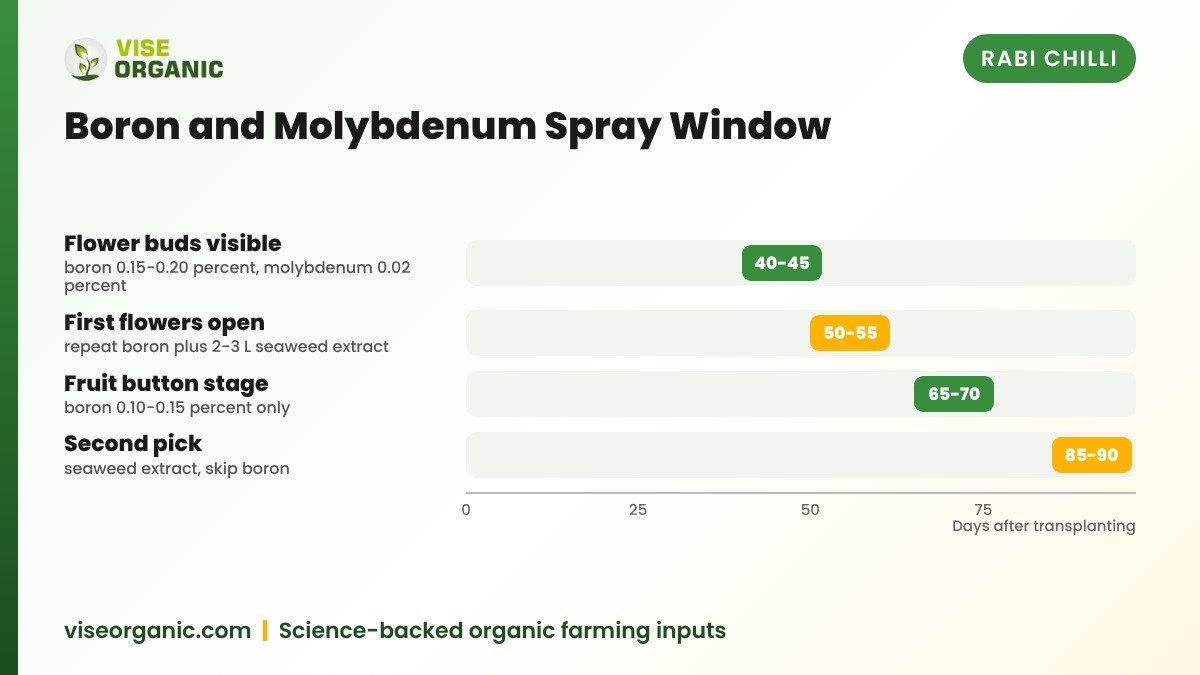
Two points matter more than the exact rate. First, the bud-to-50%-flowering window is where boron earns its cost; a spray after heavy fruit set cannot recover those flowers. Second, never exceed the label rate. Boron toxicity shows as yellowing and burning from the leaf tip inward, and in chilli it can stop new flowers altogether.
- Test first. Get soil pH and available boron before flowering, and note the field's history of micronutrient sprays.
- Treat the seed or drench the root zone. A boron soil application at 0.5-1.0 kg/acre of borax, or the equivalent product dose on the label, feeds the crop through the whole flowering phase.
- Spray at bud visible. Apply boron at 0.15-0.20% with molybdenum at 0.02% in 150-200 L of water per acre, covering the growing points.
- Repeat at first flowering. Spray again 10-12 days later, and add a Seaweed extract at the label dose for fruit retention support.
- Stop boron after fruit set. From the button stage onward, use calcium and a growth promoter instead of more boron.
- Record every spray. Date, product, lot number, rate, water volume, operator and weather go in the register the same day.
Spray boron when the bud is visible, not when the flower has already fallen.
Tissue Bands to Aim For
If you can get leaf analysis, these are the commonly quoted sufficiency ranges for the recently mature leaf of chilli during flowering. Read them with your lab, since methods differ between laboratories.
| Element | Sufficiency band (mg/kg dry weight) | Note |
|---|---|---|
| Boron | 20-60 | Below 20 deficiency, above 80-100 toxicity risk |
| Molybdenum | 5-20 | Below 5 shows pale interveinal bands |
| Calcium | 500-1,500 | Works with boron on cell walls |
| Nitrogen | 3,500-4,200 | High nitrogen delays flowering |
The gap between deficiency and toxicity for boron is narrow, which is why the soil test matters more than the spray. A field sitting at 30-40 mg/kg needs no foliar boron at all, and spraying there only wastes money and risks tip burn.
Tank Mix and Timing Rules
Micronutrient sprays fail more often from the tank than from the rate. Chilli leaves are waxy and the flower is delicate, so how you mix matters.
- Water first. Fill the tank half with clean water, add the dissolved product, then make up the volume.
-
Dissolve separately. Pre-dissolve boron in warm water in a bucket before pouring it into the tank; undissolved granules burn flower petals.
-
Spray low volume, fine drops. 150-200 L/acre with flat-fan or fine mist nozzles beats high volume running off the leaf.
- Time it right. Morning after the dew dries, before 10 am, or late afternoon; never above 35 degrees Celsius or when wind exceeds 10 km/h.
For microbial products, do not tank mix with chemical fungicides or bactericides unless the label specifically allows it. Apply a microbial biofertilizer such as PSB as a soil drench or seed treatment, on a different day from any copper or systemic fungicide spray. A Spread adjuvant at label rate helps on waxy chilli leaves and cuts runoff off the flower.
Pair Micronutrients With a Feeding Program
Boron and molybdenum fix one link in the chain. Flower number, pollen viability and fruit retention also depend on root growth, potassium movement and the amino acid supply the crop needs during heavy fruit fill. Amino acid and humate products sit well alongside a micronutrient program because they do not add salts that compete with micronutrient uptake.
-
Root and stalk first. A potassium humate such as Eco Root through irrigation at 500 g to 1 kg/acre supports the root mass that carries the fruit load.
-
Amino acids under stress. Amino acid products help the crop recover after cold nights or heat spikes that disturb pollination.
- Foliar support at flowering. A crop-specific plan for Flowering and fruit set shows how the same stages are handled in summer chilli and okra.
For the wider nutrition view, our guide on Nutrient management for organic vegetables covers the basal and top-dress side that these micronutrient sprays sit on top of.
NPOP Basics for a Chilli Grower
If your lot is going to a processor or an exporter, certification rules decide what you may use, not a shopkeeper's advice. Under NPOP (India's National Programme for Organic Production), an organic farm works with a recognised certifying agency, keeps a farm unit plan, and maintains input records and residue test reports for the produce it sells.
-
Check the input list. Whether an input is allowed on a certified organic farm is decided by NPOP or your certifier's rules and your certification scope, not by the word organic on a pack.
-
Ask for documents. Input purchase invoices, batch numbers and a spray diary form the audit trail an inspector will read.
-
Keep buffers. A physical buffer or drift barrier separates your certified plot from a neighbour's chemical spray.
-
Test for residues. Export lots are usually tested against the buyer's MRL list, so keep a lab report per lot.
Read the compliance details on our NPOP organic compliance page and, if you are converting a field, plan the conversion period with your certifier before you spend on inputs. Growers supplying exporters also find our Residue-free export vegetable guide useful for pre-harvest intervals and lot records.
Safety and Label
Wear gloves, a mask and full sleeves when mixing and spraying boron or molybdenum, and wash hands and face before eating. Never exceed the label rate: boron is a nutrient at low rates and a leaf burn at high rates, and molybdenum in excess can interfere with iron and copper uptake. Store packs closed, away from sun and heat, out of reach of children. Keep the mixing tank and any rinse water away from wells, ponds and canals, and never pour leftover spray into a water body. Calibrate the knapsack nozzle before the flowering spray, since most crop damage from micronutrients comes from a badly set nozzle and an uncalibrated tank.
Related reads: Guava rabi fruit drop spray schedule, Pomegranate flowering fruit set organic plan
Frequently Asked Questions
When should I spray boron on rabi chilli?
The main spray goes on when flower buds are first visible, roughly 40-45 days after transplanting, with a repeat 10-12 days later at first flowering. A spray after heavy flower drop recovers very little.
What is the safe boron spray rate for chilli?
Commonly published foliar rates are 0.15-0.20% for the flowering sprays and 0.10-0.15% later. Confirm the exact rate on your product label and do not exceed it, because chilli shows boron burn at the leaf tips.
How do I know if my chilli crop needs molybdenum?
Look for pale bands between the leaf veins on older leaves, often on acidic sandy soils. A leaf test showing under about 5 mg/kg confirms it, and 0.02% sodium molybdate in the tank is a typical corrective rate.
Can I mix boron with fungicide in the same tank?
Do it only if both labels allow it, and always pre-dissolve the boron in a bucket first. Never tank mix a microbial biofertilizer with a chemical fungicide or bactericide unless the label specifically permits it.
Is boron allowed in NPOP certified organic chilli?
What is permitted on a certified organic farm is decided by NPOP and your certifier's approved input list and your certification scope. Get written confirmation from your certifier before applying any mined or synthetic micronutrient.
Does foliar boron help fruit set in cold weather?
It supports pollen tube growth and cell wall formation, but it cannot override a week of cold nights or heavy rain during flowering. Keep the spray schedule and accept that weather losses happen in some years.
How much water should I use per acre for a micronutrient spray?
150-200 L per acre with fine drops covers chilli foliage well. More water at higher pressure mostly runs off the waxy leaves and the flower petals.
Conclusion
Getting boron and molybdenum for fruit set right in rabi chilli is a timing job more than a rate job: test the soil, spray at bud visible and again at first flowering, keep to the label dose, and stop boron once the fruit has set. Pair that with clean records so the lot clears a buyer's residue check. Talk to your KVK or a local agronomist about your own soil report before you change rates.
For a flowering program built around your crop and stage, look at Our products or Contact Vise Organic. For crop-specific advice on your field, Request a callback and our team will help you plan the schedule.
Disclaimer: This article is general agronomic information. Results vary with soil, crop, weather and practices. Always read and follow the product label and consult a local agronomist for advice specific to your field.
Article Topics & Tags:
Vise Agronomy Team
The in-house agronomy and field research team at Vise Organic Biotechnology, publishing applied research on bio-fertilizer protocols, crop protection, and sustainable cultivation practices.