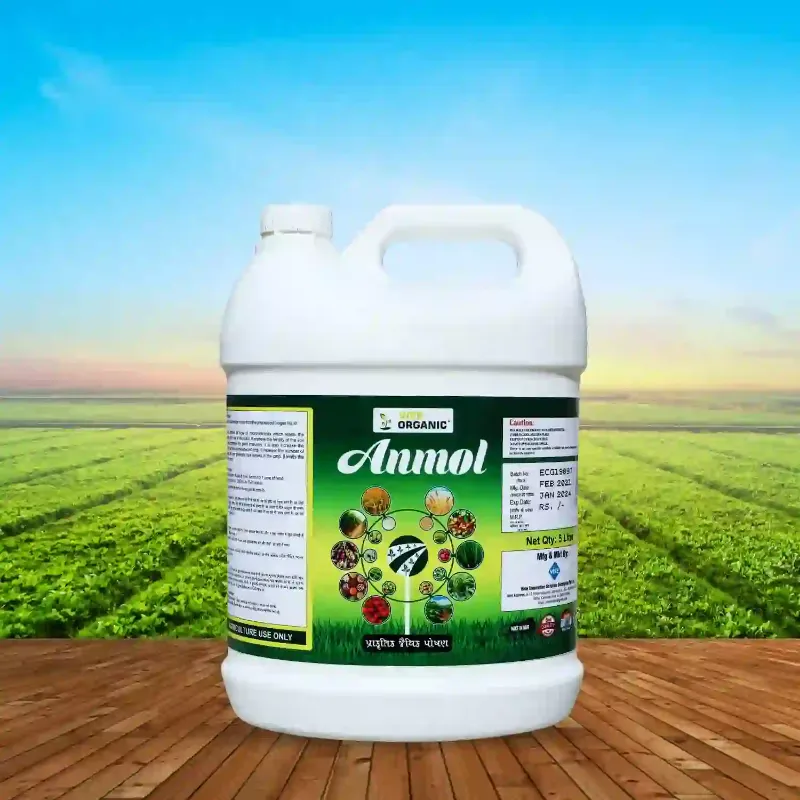
You bend down in an onion field in January, part two or three leaves, and see a fringe of tiny slender insects scurrying into the fold where the leaf meets the next one. The tops show pale silvery patches and the leaf tips are curling and drying. That is thrips damage, and by the time the silver is obvious across two acres the field is already well past the count that should have triggered a spray.
Getting onion thrips spray timing right means two things: a real count per leaf, and a sense of how fast the population moves as the weather warms. This guide covers scouting method, the numbers that tell you to spray, how to use day temperatures to predict the next generation, and how to place botanical and microbial sprays across a rabi onion crop from transplant to curing.
What Thrips Damage Actually Looks Like
Thrips do not chew. They pierce the leaf surface and suck out the contents of individual cells, and each damaged cell turns pale and air-filled. That is why the first sign is a speckled silver sheen rather than holes or chewed edges, which is what a chewer like a semilooper leaves behind.
Feeding starts deep in the leaf folds, so the damage appears first on young unfolding leaves near the growing point. As the leaf grows out, the streaks stretch and merge. In the same field you will usually see two patterns: broad silver streaks from thrips, and small white sunken spots with a grey mouldy centre from botrytis, which is a fungus and needs a different spray. Thrips wounds make entry easier for that fungus, so the two often arrive together in late January.
Leaf tip curling and drying is the third sign. Wind-blown sand and moisture loss finish off the tips that thrips have already damaged. Twisted, stunted young plants with poor bulbing usually mean thrips built up early and were never counted.
Count Before You Decide
Most spray decisions in onion are made by eye from a standing position. That is the weakest possible way to judge thrips, because the insects sit inside the leaf sheath where you cannot see them from above. Standing over a row and guessing usually under-reads a field by a wide margin.
Walk a W across the field, five to seven points, and at each point inspect five to seven whole leaves. Slide them apart rather than just looking at the upper surface. Count every live thrips you find, adults and the yellow and orange nymphs together. Nymphs do the bulk of the feeding and are the ones a contact spray has to hit, so a population of mostly nymphs is a more urgent situation than the same number of adults.
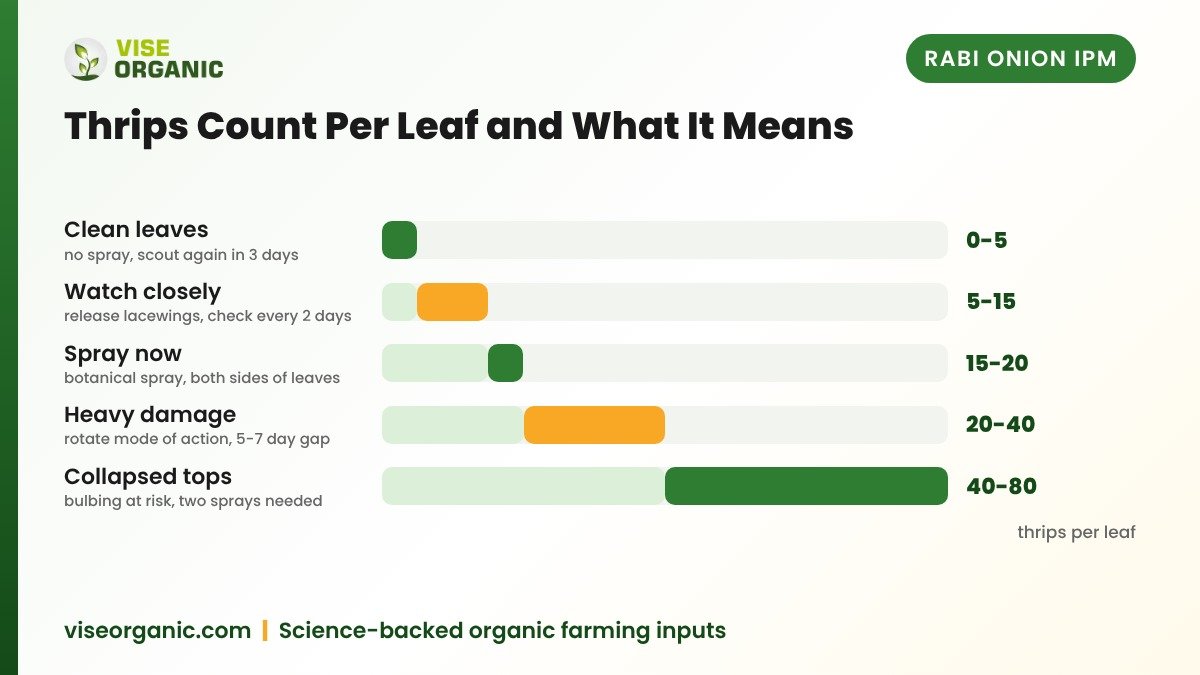
Those are published general ranges, not a rule for your particular field. A young crop with eight leaves tolerates far fewer thrips than a crop with the tops fully laid down, and a crop under drought stress shows damage at lower numbers. Read the label of whatever you buy and ask your local KVK or horticulture officer for the threshold recommended in your district.
Warm Nights Drive the Next Generation
Thrips activity tracks temperature more than anything else you can control. In north Gujarat and Rajasthan rabi weather, a generation from egg to egg commonly runs about 20-25 days in December and January, and shortens to roughly 12-15 days once night temperatures climb above 18-20 degrees Celsius in February. That is the reason February sprays seem to need repeating every week while December sprays hold for a fortnight.
A simple way to plan ahead is to add up day temperatures. Take the average of the daily maximum and minimum, subtract 10 degrees as the lower threshold, and add that number every day from transplant. Call it degree-days. At 25 degrees maximum and 12 degrees minimum, one day adds about 8.5. Around 150-200 degree-days, the first generation that started on the seedlings is maturing, which is when a clean field starts showing its first silver flecks. Around 400-500, the population that was sitting unnoticed in the leaf folds multiplies visibly.
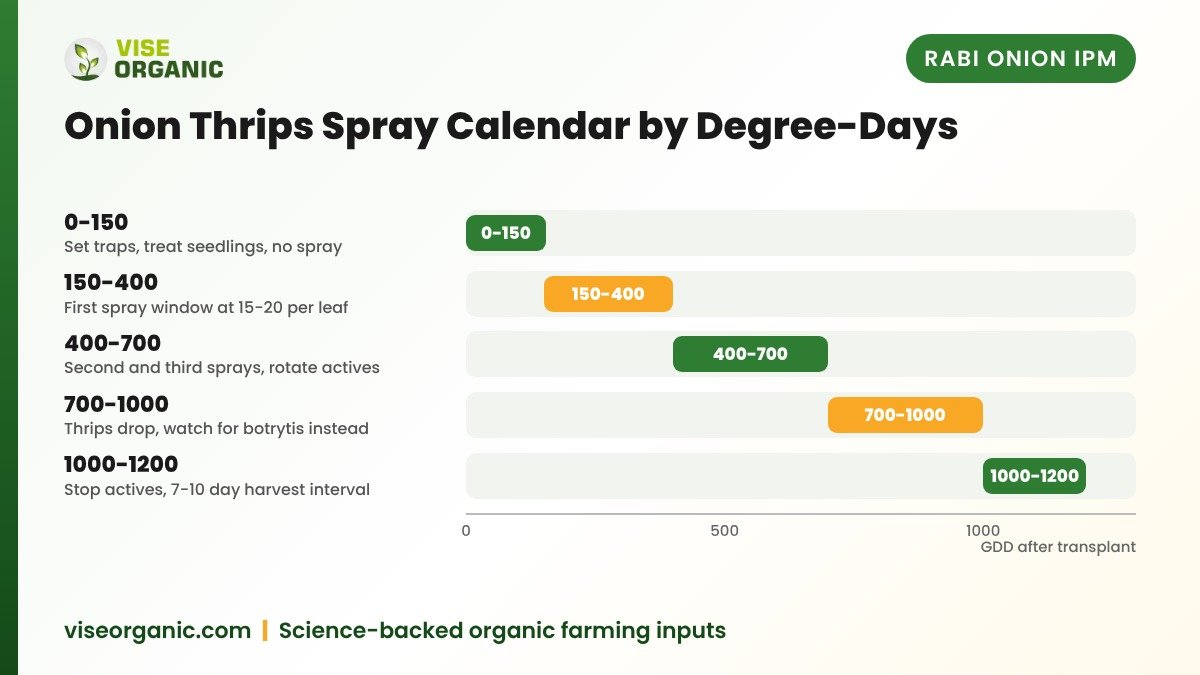
You do not need a weather station. A max-min thermometer hung in the shade at the field edge and a notebook give you the numbers, and the district agriculture office or a KVK can tell you the seasonal base to use locally. Treat this as a planning aid to decide when to walk the field, never as a substitute for the count.
Botanical Options and Where Each One Fits
Neem oil and azadirachtin are the workhorses of botanical onion protection, and they work differently from each other. Neem oil is largely a contact and smothering action on the insect cuticle, so it needs direct coverage. Azadirachtin is an antifeedant and growth disruptor: insects feed less and the nymphs fail to moult cleanly, which shows up as a drop three to five days after the spray rather than an immediate knockdown. Expect a slow curve, not a field full of dead insects the next morning.
- Neem oil. Contact action on nymphs sitting in the leaf folds, so volume and coverage matter more than dose. Spray low volume late evening with a fan nozzle at 15-20 bar.
- Azadirachtin. Antifeedant and moulting disruption, best against the nymph flush. Plan on 3-5 days to see the effect and do not re-spray early out of impatience.
- Beauveria bassiana. A fungal biopesticide that needs humid conditions to infect, so apply at evening with good leaf wetness and no chemical fungicide mixed in.
- Granular or systemic chemistry. Use only where the label allows and after scouting proves the threshold is crossed, and never as a calendar routine.
A realistic rabi sequence in a moderately infested field runs like this.
- Trap and record at transplant. Put blue or yellow sticky traps at canopy height on the field edge the week you transplant, and note the first catch date. That date starts your generation clock.
- Treat the planting material. Dip seedling roots in a Trichoderma or mycorrhiza slurry before transplanting to give a clean root start, and avoid nursery-side sprays that select resistant thrips before the crop even reaches the main field.
- Spray at the count, not the calendar. The first spray goes on when counts reach 15-20 per leaf on average, using neem oil or azadirachtin with a spreader so the spray reaches inside the leaf folds.
- Rotate the active ingredient. The second spray uses a different mode of action, azadirachtin if the first was oil, or a fungal biopesticide if nights are humid. Same active twice in a row is how fields stop responding.
- Back off as the tops fall. Thrips move off maturing bulbs to weedy margins. Cut spray frequency, keep the harvest interval, and shift attention to neck rot and botrytis.
For coverage, a Spread adjuvant makes more difference in onion than almost any tank mix decision, because the leaf carries a waxy bloom that sheds ordinary water droplets. See our page on How to use neem oil in organic farming for mixing order and nozzle choice.
A count taken on Tuesday is worth more than a spray date copied from your neighbour's diary.
Microbial Sprays and the Resistance Question
Thrips resistance to chemical insecticides is now a documented problem in onion belts across Maharashtra, Karnataka and Madhya Pradesh, which is the practical reason IPM programs lean on botanicals and microbial actives in the middle of the season. Resistance is not a mystery: a field sprayed on a fixed seven-day calendar with one active ingredient selects for survivors, and the next generation arrives already tolerant.
Microbial products such as Beauveria bassiana work through infection rather than a single nerve target, so they sit in a different slot in the rotation. They are slower and more weather-dependent. Spores need leaf wetness for several hours and moderate temperatures, which makes a humid February evening far better than a dry, hot, windy one. Do not tank-mix them with chemical fungicides or bactericides unless the label clearly allows it, and never apply them the same day as a strong alkaline spray.
Botanicals and microbials also fit well with what is already in your field. Lacewing larvae and the minute pirate bug eat thrips nymphs, and both survive botanical sprays far better than they survive broad-spectrum chemistry. Keeping a flowering margin of coriander or methi along one field boundary gives those predators somewhere to rebuild between sprays. Where you are managing a full rabi block, the crop-level sequence in our Onion IPM spray calendar style planning applies the same way: scout, threshold, rotate, rest.
What to Check Before Buying in Bulk
Dealers and FPOs buying botanical sprays for a season face a different problem from farmers: a batch that has lost potency is worse than no batch, because the field will look like the product failed.
- Registration and label. Confirm the CIB&RC registration number and the crop and pest listed match onion thrips, not just a generic mention.
- Batch certificate. Ask for the certificate of analysis for the specific batch, with the manufacturing date, not just the expiry.
- Content and shelf life. Neem oil is graded by azadirachtin content, and microbial products carry a viable count that falls with heat and age. Botanical concentrates typically hold 1-2 years, microbial formulations commonly 6-12 months.
- Packing and storage. Opaque, sealed containers stored below 40 degrees, out of sunlight, off the ground. A drum that stood in a godown courtyard through May is already degraded.
- Field trial first. Buy one drum, run two acres side by side against your normal practice, and count thrips on both before committing to a season order.
Our Eco Cover and Eco Safe pages list the current label details, and bulk, dealership and FPO enquiries can be routed through Our shop.
Safety and Label
Read the full label before mixing, including the pre-harvest interval, which decides your last safe spray date against your harvest date. Wear gloves, a mask and full sleeves for botanical and microbial sprays too; neem and azadirachtin are irritants to skin and eyes, and inhaling spore dust from microbial powders is not something to repeat. Mix in an open area, never near a water body or a well, and wash the tank and your hands after spraying. Spray in the early morning or late evening when thrips come out of the leaf folds and temperatures are lower. Store all containers away from children, food and direct sun, and never decant concentrates into drink bottles. For any microbial product, do not mix with chemical fungicides or bactericides unless the label says you may.
Frequently Asked Questions
How many thrips per leaf mean I should spray onion?
In published general guidance, 15-20 thrips per leaf on an average of several plants is the point where a spray is justified in a vegetative rabi crop. Below that, scouting more often and relying on predators usually holds the crop. Young plants and stressed crops need action at lower numbers, and the threshold for your district is best confirmed with your local KVK or horticulture officer.
How do I tell thrips damage from botrytis on onion leaves?
Thrips leave elongated pale silver streaks and patches, with silvery areas that follow the leaf, and the insects themselves are inside the leaf folds. Botrytis makes small round white sunken spots, often with a grey mouldy centre, and it can appear without many thrips present. If you see both, plan a botanical spray for thrips and a separate fungicide decision for the fungus, following the labels.
Can I spray neem oil and Beauveria bassiana together?
Do not mix them in the same tank unless both labels allow it. Neem oil can suppress fungal spore germination on the leaf surface, so the safer practice is to separate them by several days and use the fungal product on a humid evening when leaf wetness will last. Read both labels and do a small tank test first.
When should I stop spraying onion before harvest?
Stop actives once the tops are falling and the neck starts drying, and respect the pre-harvest interval stated on the label of every product you used, which is commonly 7-10 days for botanical sprays. Bulbs with wet necks stored straight after a late spray are the ones that rot in the store, so plan the last spray against your expected lifting date.
Why do thrips come back faster in February than in December?
Warmer nights shorten the thrips life cycle, so a generation that takes 20-25 days in December and January can finish in roughly 12-15 days by February. More generations in the same weather means the population rebuilds sooner after each spray. That is why scouting frequency should go up in February, not down.
Do sticky traps control onion thrips or only catch them?
Blue or yellow traps at canopy height are mainly a monitoring and early-warning tool, and they tell you when adults first landed. Mass trapping can reduce pressure a little in a small plot, but in a commercial field traps will not hold a population down on their own. Use them to time your first count, then rely on the count.
What spray volume and nozzle works best for thrips in onion?
Thrips live deep in the leaf folds, so coverage matters more than dose. A flat-fan or hollow-cone nozzle at moderate pressure, a spreader sticker to get past the waxy leaf bloom, and enough water to wet the leaf base and both surfaces do more than a concentrated low-volume pass. Spray in the evening when thrips move out of the folds.
Conclusion
Onion thrips spray timing comes down to three habits: count whole leaves instead of glancing at tops, use day temperatures to know when the next generation will arrive, and rotate botanical and microbial actives so nothing gets sprayed twice in a row. Do that through a rabi onion crop and your sprays land when they actually change the outcome, instead of burning money on a calendar.
If you want help building a spray plan for your onion block or district, talk to our agronomy team through Contact Vise Organic or Request a callback, and browse Our products for current label details.
Disclaimer: This article is general agronomic information. Results vary with soil, crop, weather and practices. Always read and follow the product label and consult a local agronomist for advice specific to your field.
Article Topics & Tags:
Vise Agronomy Team
The in-house agronomy and field research team at Vise Organic Biotechnology, publishing applied research on bio-fertilizer protocols, crop protection, and sustainable cultivation practices.