Your buyer in Europe has asked for organic basmati, and your exporter has asked you for a file. Most farmers in that moment discover that the certification is not won in the field alone. It is won on paper, in a register that shows every seed, every spray and every bag that touched the plot.
This guide covers NPOP certification for export crops from the field side: what the standards actually ask of you, which records an inspector reads first, how the conversion period works for a rabi plot, and where plant growth promoters, humates and seaweed products fit in the input list. It is written for farmers growing for export and for the FPO and dealer who collect their paperwork.
What NPOP Actually Means for Your Plot
The National Programme for Organic Production is the Indian government's production and certification standard, run by the Agricultural and Processed Food Products Export Development Authority (APEDA). It sets what may be used on a certified organic farm, how the farm must be managed and how it must be documented. APEDA's National Accreditation Body approves the certification bodies that actually inspect and certify you, so you deal with an accredited certification body (CB), not with APEDA directly.
Two things follow from that. First, your field is judged as a system, not as a single spray decision: seed, soil, water, inputs, buffer, harvest and storage all count. Second, a claim you cannot show in a record is treated as a claim you did not do. That is why the register matters more than any conversation with the inspector.
Note that NPOP is the standard used for most export shipments. India's home programme, the Participatory System for organic certification known as PGS-India, is a separate route and is generally accepted inside India rather than for export. If your buyer's contract names NPOP, your certification body must be an NPOP one.
Get the Field Ready Before You Register
Nothing in the office can fix a field that was sprayed late. Before you sign with a CB, walk your own plot with three questions.
- Chemical history. Write down every synthetic fertiliser, herbicide or fungicide used on the plot in the last three years, with the month and the product. The CB will ask for this and will cross-check it with your input bills.
- Conversion length. Synthetic residues decide how long your conversion runs. A plot that has followed a low-input routine converts faster than one on heavy urea and prophylactic spray.
- Buffer and contamination. A neighbour's sprayed field, a canal that carries spray runoff, or a shared sprayer can bring a prohibited substance into your plot. Identify each route now, not at inspection.
Say you grow 4 acres of basmati near Patiala on canal irrigation, and your neighbour sprays his wheat in February. That single fact changes your buffer plan, your water entry point and what you write in your internal system plan.
The Conversion Period and What It Costs You
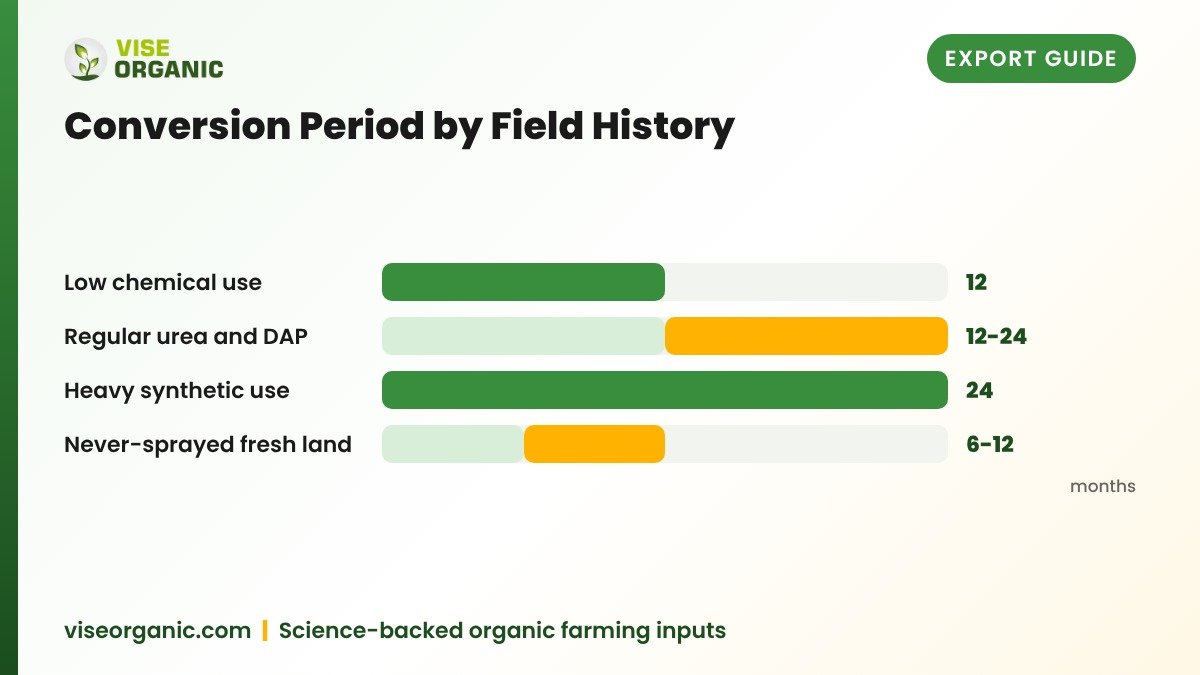
Conversion is the window in which you follow the organic production rules but your crop is still sold as "in conversion", not as certified organic. The length depends on what the plot carried before, and your CB sets it in writing at the start. Plan the calendar around it, because the market treats in-conversion and certified produce differently.
| Plot History | Typical Conversion (Months) | What the CB Looks For |
|---|---|---|
| Low chemical use, farmyard manure every season | 12 | Manure bills, old input bills, neighbour practice |
| Regular urea and DAP, occasional fungicide | 12-24 | Soil report, input records, soil organic carbon trend |
| Heavy synthetic use, prophylactic sprays | 24 | Two or more full crop records, residue test, buffer proof |
| Fresh land, never sprayed, good history | 6-12 | Revenue records, witness statements, water source check |
A rabi grower who starts in October 2026 on a low-input field can plan on selling certified grain by the 2028 season. Two full documented crops inside the conversion window is what turns a file into a certificate.
The Records an Inspector Reads First
The inspector has one working day per farmer group and dozens of plots. They go to the records before the field. Keep these in one file, in date order, for every season since conversion began.
- Input register. Every bag that entered the farm: product name, supplier, batch number, quantity, date, plot where it was used, and the bill stapled against the entry.
- Field diary. One page per plot per season: crop, sowing date, variety and seed source, each operation with its date, irrigation, and the labour and cost.
- Seed and planting material bills. Proof that your seed carried no chemical treatment. Treated seed is a common certification failure that no amount of later care can undo.
- Harvest and storage record. Cut date, yield from each plot, the bag count, storage location, and how organic bags were kept apart from conventional bags.
- Sales and traceability. What left the farm, to whom, in what quantity. The numbers in, the numbers stored and the numbers sold must agree.
The arithmetic is the part that fails. If your register says 40 bags harvested and 38 sold, the missing 2 need a line in the file. An unexplained gap is read as a traceability break.
Where Plant Growth Promoters Fit
This is the question Vise Organic gets most often from export growers: do humic acid, seaweed extract, amino acids and microbial products fit inside an organic plan? Broadly, microbial biofertilizers, mined humates, seaweed and plant-derived amino acids are the categories organic standards are built to accommodate, while synthetic plant growth substances are not. But the deciding rule is simple and it is not a manufacturer's claim.
In organic certification, the label and the certifier's approval decide what enters the field, not what a leaflet promises.
Three checks before any input goes into an NPOP plot.
- Read the label for the claim. A product registered as a biochemical or microbial input sits in a different place from one carrying a synthetic growth substance registration.
- Ask your CB in writing. Send the product name, the composition and the manufacturer's details, and keep the reply in your file. An input your CB has not approved must stay out of the plot, even if it is sold freely in the market.
- Keep the batch certificate. A certificate of analysis for the batch you used ties your field record to a real, tested lot.
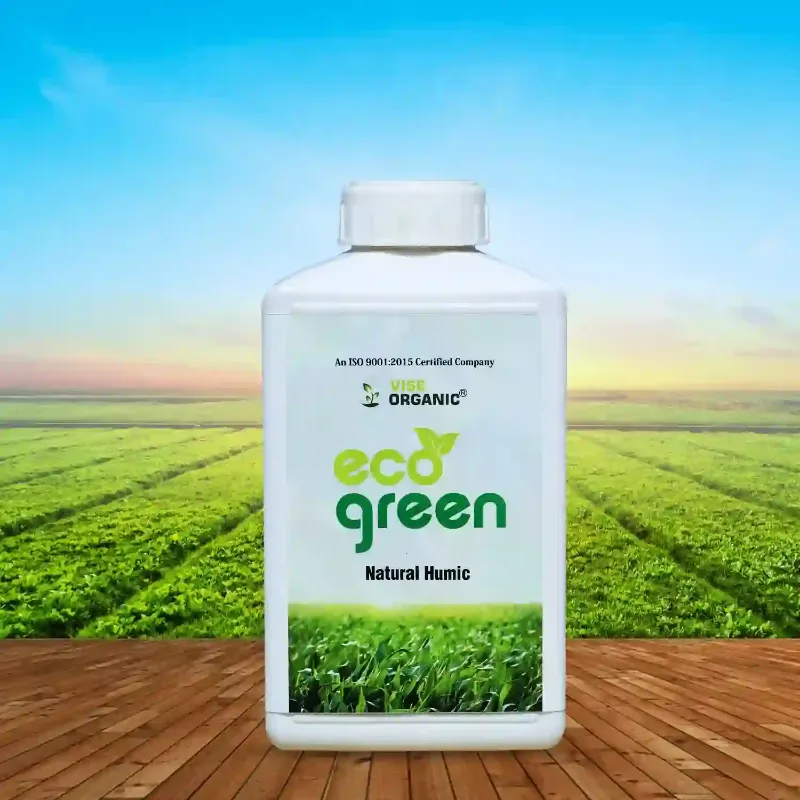
For growers on this route, products such as Seacure Liquid seaweed extract, Eco Green humic acid and Uphar amino acid are the sort of inputs that appear in organic programmes, subject to your CB's written approval. Ask for the composition sheet before you buy, and never accept a verbal assurance from a shopkeeper.
Building a Residue-Free Crop Plan
Certification gets you through the door; the residue report decides whether the container moves. Buyers test for pesticide residues against their own market's limits, and those limits are far stricter than what most field programmes are designed around. A residue-free plan is built by removing the reasons to spray, not by hoping the test clears.
| Stage | What You Do | Why It Lowers Residue Risk |
|---|---|---|
| Pre-sowing | Healthy seed, seed treatment with a microbial culture, correct spacing | Even establishment and a fast canopy hide early pest damage |
| Vegetative | Nitrogen from microbial and organic sources, no late urea flush | Soft, sappy growth attracts sucking pests and forces sprays |
| Flowering and fruit set | Monitoring twice a week, need-based nutrition, adjuvant for coverage | Damage is caught below the threshold, so one targeted job replaces three calendar sprays |
| Late crop | Stop all input use before the label's waiting period, keep the record clean and empty | No detectable residue at harvest |
The flowering window is where export crops are usually lost. A fruit set spray done on a calendar date instead of on a threshold is the single most common cause of a failed residue report. Coverage matters more than volume here: a Spread adjuvant such as Silk lets a small, well-timed application do the work, and the record shows one entry instead of four.
Read the flowering and grain-fill sequence in our Rabi wheat flowering and grain fill organic plan for how the same stage-by-stage logic looks on a cereal.
How an FPO Should Organise the File
A single farmer with 3 acres fails on paperwork. A 300-member FPO fails on the same paperwork multiplied by 300. The internal control system (ICS) is the structure that makes group certification possible, and it is the FPO's real product.
- One written procedure. A manual covering input purchase, field records, internal inspection, traceability and the corrective action loop.
- A trained internal inspector. Someone who visits every member's plot at least once a season, on a written checklist, and files the report.
- Central input procurement. Buying in bulk from one supplier gives you one composition sheet, one batch certificate and one CB approval instead of three hundred.
- Mass balance. Group-wide reconciliation of input bought, area cropped, yield harvested and quantity sold, done before the external audit, not during it.
- A complaints and recall drill. One written trial of tracing a lot back to the plot, dated and signed.
Our page on NPOP organic compliance covers what Vise Organic supplies to programmes like this. For the soil side of the same programme, see the guide on Building soil fertility for organic farming, and for input selection, our note on Choosing a liquid biofertilizer supplier.
Safety, Storage and Label Discipline
Records are not only about what you applied; they are about how it was handled. An inspector notices a rusted chemical drum stored beside organic grain bags.
- Read the full label before use, including the crop, the dose, the waiting period and the storage line.
- Wear gloves and a mask while mixing and spraying, and wash hands before handling harvested produce.
- Do not mix microbial products with chemical fungicides or bactericides unless the label specifically allows it, and never use a sprayer that carried those chemicals without a full rinse.
- Store all inputs away from direct sun and heat, in original labelled packs, with the batch number visible.
- Keep every pack out of reach of children and away from wells, canals and ponds.
What to Check Before Buying in Bulk
An FPO or dealer buying a season's input for a certified programme should close the file on these points before payment.
- Composition and grade. Get the full declared composition in writing, matched to the label you will actually receive.
- Batch documentation. A certificate of analysis and, for microbial products, the viable count and carrier details for the lot supplied.
- Registration status. The product registration category, since that is what your CB will read.
- Packing and seal. Sealed, labelled packs with batch and manufacturing and expiry dates printed, not stuck on.
- Shelf life and storage. Enough remaining shelf life for the season, plus a cool, covered storage point at the FPO godown.
- Traceability at the godown. A register that links each batch received to the members who drew it.
Ask for these documents up front from Our shop or through Contact Vise Organic; a supplier who cannot produce them is a risk to your certificate, not just to your crop.
Related reads: How does organic certification influence consumer trust and choices
Frequently Asked Questions
Is NPOP certification needed to export organic produce from India?
Most organic buyers and importers require certification under a recognised standard. NPOP, administered with APEDA's accreditation of certification bodies, is the Indian standard built for export shipments, so check what your buyer's contract names before you register.
How long does conversion take for a field that used chemical fertilisers?
Your certification body sets it in writing at the start, based on the field's input history and a soil report. Fields on regular urea and DAP generally need a longer window than fields already running on farmyard manure and low external input.
Can I use plant growth promoters on a certified organic plot?
Microbial inputs, mined humates, seaweed extracts and amino acid products are the categories organic programmes usually work with, but only your certification body can approve a specific product. Send them the composition sheet and keep their written reply in your file.
What raises residue risk the most in an export consignment?
Calendar sprays rather than threshold-based sprays, especially around flowering and fruit set. A well-timed, well-covered small application leaves far less risk than repeated scheduled sprays, and a late-season spray inside the waiting period often shows up in the report.
What is an internal control system in group certification?
It is the FPO's documented system for managing its members: a written manual, a trained internal inspector who visits every plot each season, central input purchase, mass balance of inputs and sales, and a dated traceability drill.
Does PGS-India certification work for export?
PGS-India is a domestic peer-review route and is generally accepted within India. For export, buyers normally require NPOP certification through an accredited certification body.
What happens if my records do not add up at inspection?
The certification body raises it as a non-compliance and asks for a corrective action with a deadline. An unexplained gap between harvested and sold quantity is read as a traceability break, so reconcile your numbers before the audit and document any loss.
Conclusion
NPOP certification for export crops is a records exercise carried out on a field. Fix the field history, respect the conversion period, keep an input register that adds up, and get written approval from your certification body for every input, including plant growth promoters and biostimulants, before it enters the plot. Do that and the residue report and the inspection become routine rather than frightening.
Start with one season's file: pick your plot, list its chemical history, and put a dated diary in the hands of the person who works the field. For inputs, batch documents and a composition sheet for your certifier, browse Our products or Request a callback for crop-specific advice.
Disclaimer: This article is general agronomic information. Results vary with soil, crop, weather and practices. Always read and follow the product label and consult a local agronomist for advice specific to your field.
Article Topics & Tags:
Vise Agronomy Team
The in-house agronomy and field research team at Vise Organic Biotechnology, publishing applied research on bio-fertilizer protocols, crop protection, and sustainable cultivation practices.