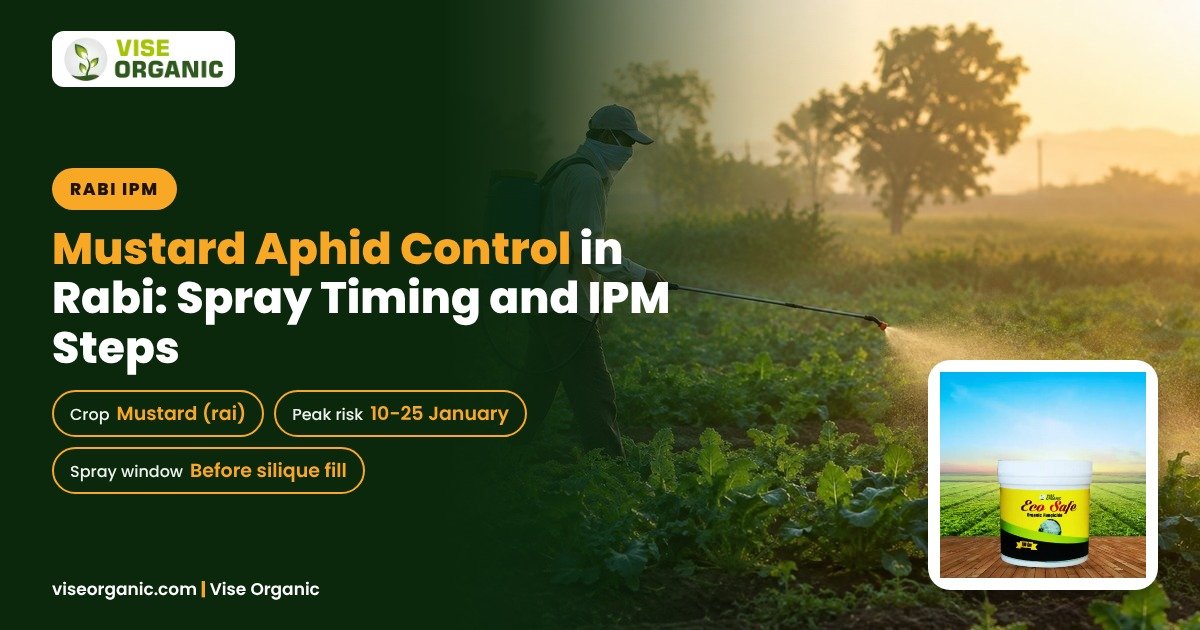
You walk into a mustard field in the last week of January and the plants look healthy from the road. Bend down and take a look at the young stem just below the flower head. That is where the aphids sit, packed tight, with ants running up and down after the honeydew they shed. By the time the leaves curl and the field looks sticky, the crop has already paid for the delay.
This guide covers mustard aphid control in rabi for the real calendar of north and central India, from Bharatpur and Bharuch to Ganganagar and Muzaffarnagar. It covers how to scout, the thresholds that tell you when to act, what neem and other botanical sprays do, where a microbial biopesticide fits, and how to time the spray so the silique fill is not lost.
Why Late January Is the Danger Window
Mustard aphid (Lipaphis erysimi) builds up as the weather cools and the crop turns from vegetative growth to flowering. Cool nights above 8 degrees Celsius with low rain and thick canopies from excess urea are the classic combination. Aphids suck sap from the young stem, petiole and flower buds, and the plant pays in two ways: the flower buds drop and the siliques that do form come out short and thin.
The crop stage matters more than the insect count. A heavy aphid crowd on a crop that is still making leaves is a manageable problem. The same crowd during flowering and early silique formation hits the part of the plant that cannot be regrown. That is why mustard aphid control is a calendar exercise as much as a spray exercise.
Read the Field Before You Read the Catalogue
Scout twice a week from flowering onward, walking a W pattern across the field so you do not only check the border rows. Aphids always start in patches, usually on the field edge next to a bund with mustard, toria or a weedy brassica.
- Check the growing tip. Open five to ten plants at ten spots and look at the young stem and the underside of the top leaves where the colonies sit in rows.
- Look for ants and shine. Ants farming aphids and a glossy sticky film on lower leaves tell you the colony is established, not just a few arrivals.
- Count beneficial insects. Ladybird beetles, lacewing larvae and small aphid midges often keep a patch below the threshold on their own if you leave them alone.
- Note the plant stage. Record whether the field is at flowering, pod set or silique fill, because the same aphid number means different damage at each stage.
A quick hand lens and a notebook beat memory at this stage. Fields scouted on a fixed day each week get sprayed at the right time far more often than fields visited when someone has a free afternoon.
The Threshold That Decides Your Spray Day
Thresholds are not rules written to annoy farmers. They exist because a calendar spray in December wastes money and can knock down the natural enemies that do most of the work in a well-managed field. The numbers below are the published ones used by KVKs and ICAR-National Research Centre on Oilseed Crops guidance.
| Field observation | Aphids per 10 cm of stem | Action |
|---|---|---|
| Building colony, predators active | 10-15 | Scout again in 3 days, no spray |
| Economic threshold crossed | 25-30 | Spray a botanical within 24 hours |
| Honeydew shine on top leaves | 30-40 | Spray now, do not wait for the neighbour |
| Silique filling with a heavy colony | 40-plus | Spray plus nutrient support, recovery will be patchy |
The 25-30 aphids per 10 cm of stem figure is the number to memorise for mustard aphid control. Below it, the crop tolerates the pest and predators are usually catching up. Above it, the colony doubles in days, not weeks, and the spray you postponed becomes two sprays.
A Step-by-Step IPM Sequence for the Season
Work through these in order. Each step is cheaper than the next, and skipping straight to the spray is the most common mistake.
- Sow early and avoid excess nitrogen. Timely sowing in October and a balanced nitrogen dose keep the growth firm instead of the soft, leafy flush that aphids prefer.
- Grow a border of a trap crop. Rows of toria or a mustard border sown a little earlier pull alighting aphids onto a smaller area you can treat, which is far cheaper than a whole-field spray.
- Conserve the predators. Before you decide on any spray, check whether ladybird larvae or lacewings are present in the patch. One larva in a colony of fifty aphids will clean that spot in days.
- Spray neem at the threshold. Use neem oil or an azadirachtin product at the label rate in 80-120 litres of water per acre, aimed at the growing tip and the underside of the top leaves, in the evening.
- Use a microbial biopesticide for the next generation. Where the crop is dense and coverage is poor, a fungal biopesticide such as Beauveria bassiana works slowly through the colony over 5-7 days and suits cooler humid weather.
- Re-scout four days later. Count again at the same spots. If the colonies are still rising, alternate to a different mode of action rather than repeating the same spray.
Spray when the count crosses the threshold, not when the neighbour sprays; a week's delay in flowering costs siliques you cannot get back.
What Neem and Botanical Sprays Actually Do
Neem is not a quick knockdown. Azadirachtin works as an antifeedant and a growth disruptor, so aphids stop feeding within hours of a good covering spray and the population collapses over three to five days. That is exactly what you want in a rabi crop, because the damage you are preventing is the feeding damage of the next few days.
Three things decide whether a neem spray pays for itself: coverage, timing and water volume. Azadirachtin breaks down in strong sunlight, so an evening spray and thorough wetting of the underside of the upper leaves matter more than pushing the dose higher. Add a spreader or a mild adjuvant at the label rate so the droplets sit on the waxy mustard leaf instead of rolling off.
- Neem oil. A contact and antifeedant action with the shortest residual, best at the first threshold crossing on an open canopy.
- Azadirachtin formulations. More standardised content, easier to repeat across acres, useful for growers running larger plots.
- Other botanicals. Products based on plant-derived actives give a different mode of action to rotate with neem so the same chemistry is not used back to back.
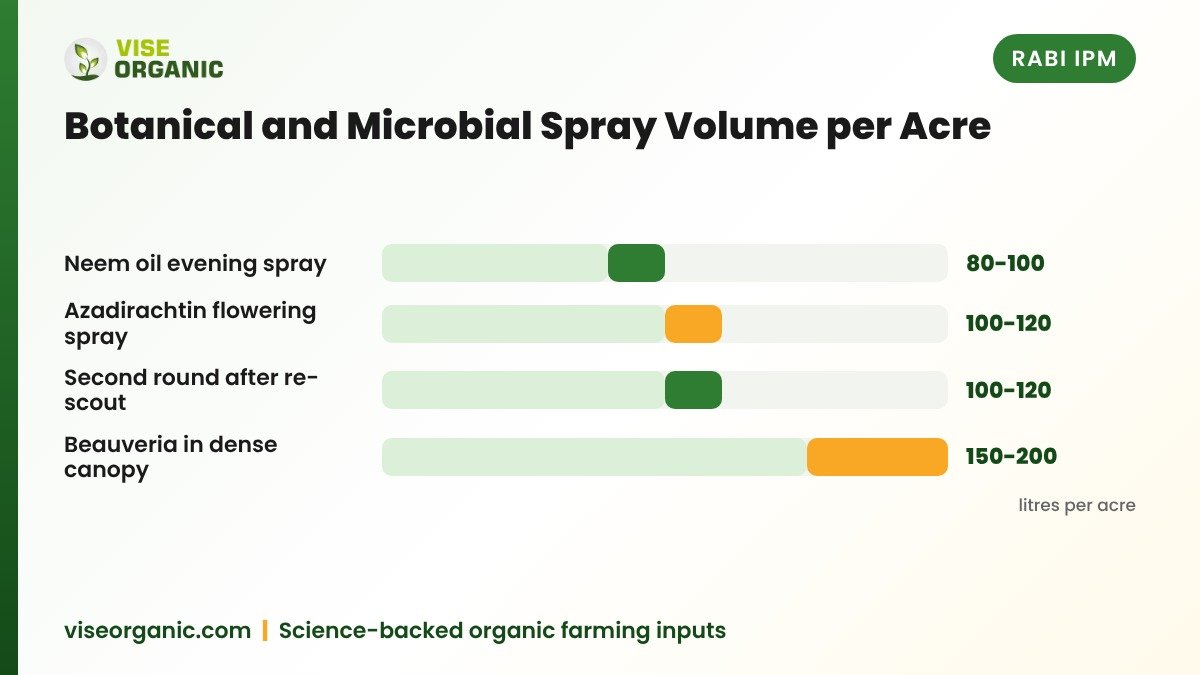
For a full field of standing crop, a realistic spray volume is 80-120 litres per acre with a knapsack, and 150-200 litres per acre with a boom sprayer. Under that, the growing tip where the aphids sit never gets wet and the count will not drop.
Microbial Biopesticides in the Same Programme
Microbial products are not a substitute for a botanical spray on a hot colony; they are the slower, longer arm of the programme. Entomopathogenic fungi such as Beauveria bassiana need humidity and time, so they perform best in the cool, moist part of the day inside a dense canopy, and poorly in a dry, windy noon.
Apply them on a clean tank. Do not mix a microbial biopesticide with a chemical fungicide or bactericide unless the label explicitly allows it, because the product is live. Spraying a fungal biopesticide right after a copper or sulphur spray usually wastes the money. Vise Organic's Eco Safe and Eco Cover sit in this part of the shelf for pest and disease management, and Virexx is used where viral symptoms are showing up in the field. Read the label for the crop, dose and waiting period, and ask your local KVK what is registered for brassica in your state.
Spray Timing Rules That Hold in a Real Field
The same product gives a 20% difference in result depending on when in the day and at what stage it is applied. These are the rules that cost nothing to follow.
| Condition | Best practice | Spray volume (litres per acre) |
|---|---|---|
| Neem oil, evening, open canopy | Grower knapsack, flat fan nozzle | 80-100 |
| Azadirachtin, flowering stage | Knapsack with spreader | 100-120 |
| Beauveria in a dense canopy | Boom or knapsack, high volume | 150-200 |
| Second round after re-scout | Same volume, different mode of action | 100-120 |
Time of day and weather matter as much as the volume. Spray in the evening between 4 pm and sunset, or early morning after the dew has dried, with no rain for 4-6 hours and wind under 10 km/h. Keep the nozzle 40-50 cm above the canopy at the label pressure. A spray on a frosty morning does not spread well and the plants stay wet too long, so wait for the frost to lift and spray in the evening as planned.
What the Timing Does to Your Siliques
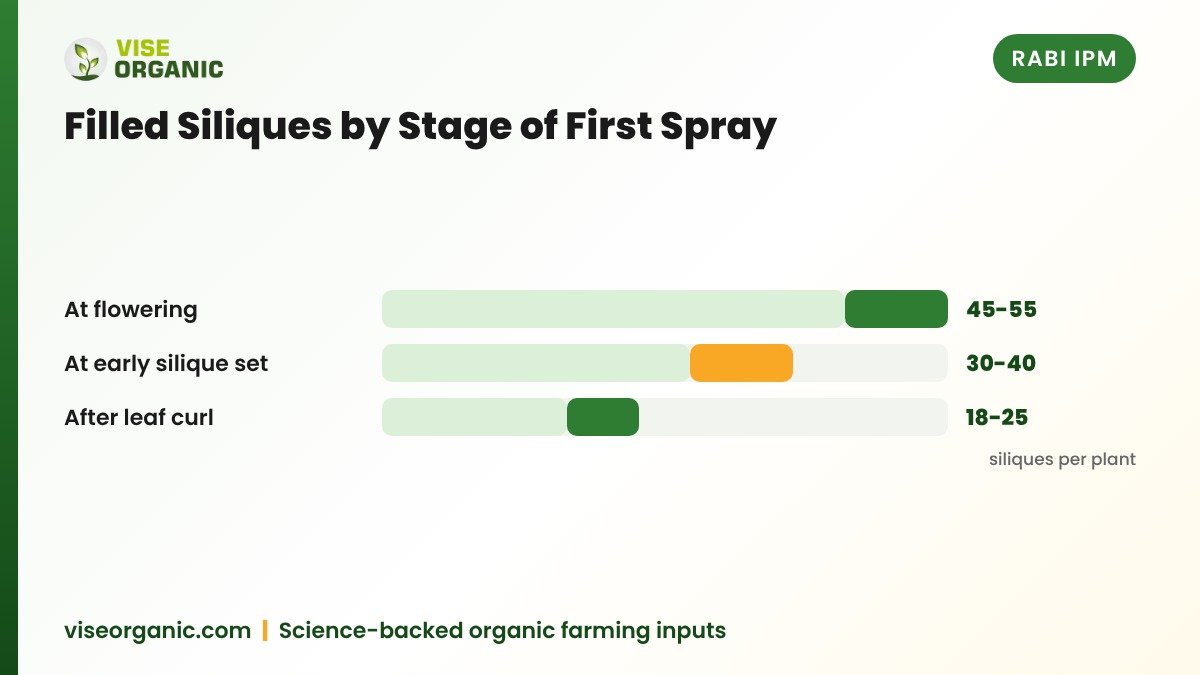
The reason all this scouting matters comes down to a handful of siliques per plant. In a well-grown crop, plants that get their first effective spray at flowering carry the highest number of filled siliques; plants treated after the leaves have curled and the honeydew is visible come in lowest, and that difference cannot be bought back with a later spray or extra fertiliser.
| First effective spray stage | Siliques per plant (typical range) | Note |
|---|---|---|
| At flowering, threshold crossed | 45-55 | Best recovery, natural enemies preserved |
| At early silique set | 30-40 | Flower bud drop already happened in patches |
| After leaf curl and honeydew | 18-25 | Damage locked in; spray only limits spread |
Treat these as indicative ranges from field observation, not a promise of any particular harvest. Soil, irrigation, variety and weather all move the numbers, which is why the honest advice is to spray on the threshold and not on a hope.
Safety and Label
Read the label on every bottle before mixing, for the crop, the dose, the water volume and the pre-harvest interval, and keep the batch certificate with the pack. Wear gloves and a mask when mixing and spraying, wash after, and never eat or smoke near the tank. Store packs away from direct sun and heat, and keep them locked away from children. Do not rinse or mix spray in a pond, well, canal or any water body, and wash the sprayer on a grass strip, not on the field bund next to a water source. Because mustard is pollinated by bees and other insects, spray in the evening when bee activity is low and avoid flowering-stage applications on the trap crop rows during the day.
Frequently Asked Questions
What is the aphid threshold for spraying mustard?
The commonly used economic threshold is 25-30 aphids per 10 cm of stem at the growing tip. Below that, scout again in three days and let predators work. Above it, spray a botanical within a day.
Which month does mustard aphid attack start?
In the plains of north and central India the build-up usually starts in late December and peaks between 10 and 25 January, coinciding with flowering and early silique formation. Coastal and warmer zones can run two to three weeks later.
Is neem oil enough for mustard aphid control?
Neem or azadirachtin at the label rate works well when applied at the threshold with good coverage and 80-120 litres of water per acre. It is not a quick knockdown, so expect the population to fall over three to five days, and rotate the mode of action if a second spray is needed.
Can I mix neem with a microbial biopesticide in the same tank?
Do not mix live microbial products with chemical fungicides or bactericides unless the label allows it. Tank mix only what the label of both products explicitly permits, and always do a jar test first.
How many sprays does a rabi mustard crop usually need?
Many well-scouted fields need one to two targeted sprays, one at the threshold and one four to ten days later if the count rises again. Fields sprayed on a fixed calendar often end up with more sprays and poorer control.
Will spraying after the leaves curl still save the yield?
A late spray limits spread to the rest of the field but cannot rebuild siliques that were lost to flower bud drop. That is why the stage of the crop matters as much as the insect count.
Are biopesticides safe for bees in a flowering mustard field?
Mustard depends heavily on pollinators, so spray in the evening when bee activity is low, avoid the trap crop rows during the day, and follow the label. Check with your local KVK for what is registered for brassica in your state.
Conclusion
Mustard aphid control in rabi comes down to three habits: scout twice a week from flowering, act at 25-30 aphids per 10 cm of stem, and spray in the evening with enough water to wet the growing tip. Neem and botanical sprays do the fast work, a microbial biopesticide does the slow work, and the natural enemies do a lot of the rest if you leave them something to work with. If you are planning a full rabi programme, the Mustard rabi biofertilizer plan and the Rabi season mustard care guide cover the nutrition side, and you can see how the general principles fit in What strategies do organic farmers use for effective pest management and How does eco safe contribute to effective pest and disease management in organic farming. For the products in this programme, browse Our products, including Eco Safe and Eco Cover, or Contact Vise Organic and Request a callback for crop advice on your field.
Disclaimer: This article is general agronomic information. Results vary with soil, crop, weather and practices. Always read and follow the product label and consult a local agronomist for advice specific to your field.
Article Topics & Tags:
Vise Agronomy Team
The in-house agronomy and field research team at Vise Organic Biotechnology, publishing applied research on bio-fertilizer protocols, crop protection, and sustainable cultivation practices.