
Fifty days after sowing, your mustard stands at knee height with the first yellow flowers opening, and the cold has just started to bite at night. That is exactly when the number of pods per plant is decided, and a mustard flowering spray schedule built around this window does more for you than another bag of urea. Poor pollination, flowers dropping before they set and hollow pods at harvest all trace back to what the crop gets (or does not get) between first flower and pod fill.
This guide walks through the stage-by-stage sprays for rabi mustard in north and central India: boron for pollen, 1-MCP to hold the flowers that already opened, seaweed extract to carry the crop through a cold spell, and the tank mix rules that keep those inputs from cancelling each other out. It covers the timings, the doses stated as typical label ranges, and what to skip when the weather turns.
Why Flowering Is the Deciding Window
Mustard does not flower once. It keeps putting out racemes over four to five weeks, so flowers, open blooms and small pods all sit on the same plant at the same time. Boron moves poorly inside the plant, so every new raceme depends on the spray you gave just before it opened. Pollen germination and pollen tube growth both fall short when boron is low, and the plant answers by dropping the flower and setting nothing.
Say you grow three acres of RH-0749 near Bharatpur on flood irrigation and the soil tests below 0.5 ppm available boron. You will usually see the symptom at harvest rather than in the field: flowers look normal, pods set, but a few pods on each raceme come out empty or with only one seed. That is a boron and pollination problem, not a disease.
Cold does the rest. When night temperature stays below about 5 degrees Celsius for a few nights, the flower opens but the anther does not shed properly. A plant growth promoter based on seaweed helps the crop handle that stress; it does not make the crop ignore the cold. Read the stage-by-stage plan for the crop in our Rabi wheat and mustard flowering care guide before you fix your own calendar.
Stage Map: First Flower to Pod Fill
The table below is the backbone of the schedule. Days after sowing (DAS) vary by ten to fifteen days between Gurdaspur and Bhilwara, so match the plant stage, not the calendar date.
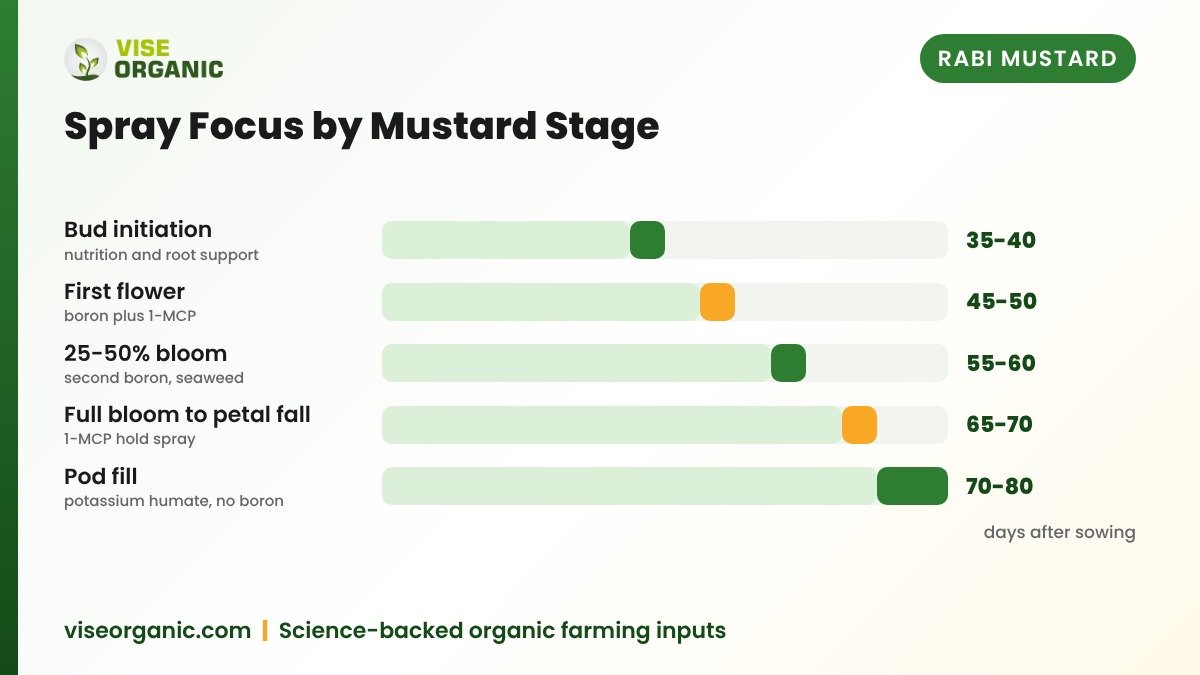
If you can only make two sprays in the whole season, make them at first flower and at 25 to 50 percent bloom. Those two cover the racemes that carry most of your yield.
Boron: The One Input You Cannot Skip
Boron is the cheapest yield protection in mustard, and the easiest to waste. Typical label use is 0.3 to 0.5 kg of borax or 0.15 to 0.2 kg of boron acid per acre in 100 to 150 litres of water, applied as a foliar spray. Some products carry boron as a stabilized salt at a much lower dose, so read the label and use the number printed on your pack, not your neighbour's.
- Spray at open flowers. Boron has to land on the stigma and the young bud; a spray at 25 percent bloom reaches the racemes that are about to open.
- Spray twice, not thrice. Two sprays at 45 to 50 and 55 to 60 DAS cover the flushes. A third adds cost and raises the tip-burn risk.
- Dissolve fully in warm water. Borax powder in cold tank water leaves granules that block nozzles and burn leaves. Dissolve it in a bucket of warm water first, then pour into the tank.
- Do not exceed the label dose. Boron moves from leaf margin inward when over-applied, and the scorch you see on the oldest leaves costs more than the extra gramme was worth.
Our Nutri Wheat special PGR is the rabi cereal version of this logic; for mustard, follow the boron plus promoter combination described in our Mustard flowering boron and 1-MCP spray guide.
1-MCP: Holding Flowers That Would Drop Anyway
1-MCP (1-methylcyclopropene) blocks ethylene, the hormone that tells a stressed flower to shed. In mustard it is used at very low doses, commonly 50 to 200 ppb equivalent as stated on the product label, which for most wettable powders works out to a few grammes per acre. The dose is so small that measuring it wrong is the main failure.
- Weigh it, never eyeball it. Use a 0.1 gramme digital scale. A pinch more than the label can lock the crop's own senescence signals and delay normal pod maturity.
- Activate in clean water first. Most 1-MCP powders need a short activation period in water before going into the tank; follow the time printed on your pack.
- Spray at first flower and again at 25 to 50 percent bloom. That matches the two drop peaks in mustard.
- Never mix 1-MCP in the same tank as boron, seaweed or an insecticide. Use a separate small knapsack tank. Trace metals and alkaline water inactivate it fast.
1-MCP is a plant growth regulator, not a nutrient. It holds flowers that are already healthy. If the flowers are dropping because of boron shortage or an aphid attack, no amount of 1-MCP will fix the cause. Check the pest side against our Mustard aphid control and spray timing guide.
Seaweed and Amino Acids Through Cold Spells
This is where a plant growth promoter earns its cost. A cold, hazy January week in Rajasthan stops pollen shed for four or five days, and the flowers that open in that weather mostly abort. Seaweed extract (Ascophyllum or similar, typically 1 to 2 ml per litre, so 400 to 800 ml per acre in a full tank) supports the crop's own stress response and keeps the next raceme healthier.
- Spray before the cold, not after. A promoter applied two days ahead of a cold wave does far more than one applied a week later, when the flowers are already gone.
- Pair it with boron in the same tank. Seaweed extract at a slightly acidic pH carries boron well; that combination is the standard rabi mix for most products.
- Use amino acids for recovery, not prevention. After a heat or cold spell, an amino acid product at the label dose helps the plant rebuild leaf area. See our Amino acid Uphar product page for the label pattern.
- Add a spreader on waxy leaves. Mustard leaves and petals are waxy. A silicone or organosilicone spreader at 0.5 to 1 ml per litre, or a Plant Stick spread adjuvant, pays for itself in coverage.
- Keep the pH at 5.5 to 6.5. Hard, alkaline canal water knocks the activity out of both seaweed and boron.
For a granular soil side, potassium humate at pod fill supports the fill stage; our Eco Root water soluble potassium humate is used in that pattern. For the soil and nutrition base of the crop, see Biofertilizer seed treatment guide for rabi crops.
The Spray Calendar Most Fields Need
Three sprays carry a normal rabi mustard crop from bud to pod. Adjust to your field, your water pH and your label doses.
- At 35 to 40 DAS, build the base. Spray seaweed extract at the label dose with a spreader if the crop looks pale after the last irrigation. This is a nutrition spray, not a flowering spray.
- At 45 to 50 DAS, spray boron plus 1-MCP. Boron in the main tank, 1-MCP in a separate tank right after. Target the open flowers with coarse droplets at low pressure.
- At 55 to 60 DAS, repeat boron with seaweed. Same tank is fine. This covers the second and third racemes, which often carry a third of your pods.
- At 65 to 70 DAS, hold the set with 1-MCP only. If nights have been below 5 degrees Celsius, this is the spray that saves the late flush.
- At 70 to 80 DAS, feed the fill. Potassium humate as a drench or fertigation. Stop foliar boron here; late boron marks the pod wall.
- Log every spray. Crop stage, product, dose, water pH, tank mix, weather and time of day. This log is your evidence if a buyer or certifier asks.
In mustard, two well-timed boron sprays at flowering beat five late ones at pod fill.
Tank Mix Rules and What to Skip
Most spray failures in mustard are mixing failures, not product failures.
- Do not mix microbial biopesticides with 1-MCP or alkaline water. Products based on live organisms need their own tank and a pH near neutral; check the label before any mix.
- Never tank-mix boron with gypsum or hard canal water without a water conditioner. Calcium ties up boron and you spray salt instead of nutrition.
- Skip a flowering spray when bees are working. Spray after 4:30 pm or before 8 am in February, when bee activity is low. Flowering stage sprays that kill pollinators cost you set, not just compliance.
- Skip boron if your field already gets a boron-rich micronutrient mix. Two sources at full dose in one season is how leaf scorch starts.
- Do not chase a flowering spray into a hot, dry wind above 35 degrees Celsius. Droplets evaporate before the leaf takes anything in; wait for a calmer evening.
- Do not use a flowering promoter to push past the label dose hoping for more pods. Beyond the label rate, promoters flatten out or turn sour on the crop.
For a field-level view of the whole season, including the pest sprays that must fit between these nutrition sprays, use our Mustard IPM spray calendar.
Safety and Label Reading
- Read the full label before mixing. Dose, water volume, pre-harvest interval and the compatibility note are on the label, not in WhatsApp forwards.
- Wear gloves and a mask, and cover your nose while mixing. 1-MCP powders are concentrated; breathe them and you will regret it.
- Mix in an open space, never in a closed room. Prepare the tank at the field bund, away from the house.
- Never wash the sprayer in a pond, well or canal. Empty the leftover spray into a marked bund strip and rinse the machine on dry ground.
- Store packs away from sun, heat and children. Locked shed, off the floor, original packing.
- Keep a buffer from the field edge near water bodies. Even organic inputs are contaminants in standing water.
Frequently Asked Questions
When should I spray boron on mustard for more pods?
Two sprays work best: the first at first flower, usually 45 to 50 days after sowing, and the second at 25 to 50 percent bloom, around 55 to 60 days. Match the plant stage rather than the calendar, since sowing dates and districts shift the timings by ten to fifteen days.
How much boron per acre for mustard flowering?
Typical published foliar use is 0.3 to 0.5 kg of borax or 0.15 to 0.2 kg of boron acid per acre in 100 to 150 litres of water, but stabilized boron products carry a much lower dose. Use the number printed on your own pack and never exceed it, because excess boron scorches leaf margins.
What is 1-MCP and is it safe for mustard flowers?
1-MCP is a plant growth regulator that blocks ethylene, the signal that makes stressed flowers drop. It is used at very low doses, commonly 50 to 200 ppb equivalent as per the label. Weigh it on a 0.1 gramme scale, activate it in clean water, and spray it in a separate tank rather than mixing it with boron or seaweed.
Can I mix seaweed extract and boron in the same tank?
Yes, in most cases. Seaweed extract at a slightly acidic tank pH of 5.5 to 6.5 carries foliar boron well. Do not add 1-MCP, alkaline water conditioners or a chemical bactericide to that mix, and always check the compatibility note on the label first.
My mustard flowers are dropping in January cold. What helps?
Cold nights below about 5 degrees Celsius disturb pollen shed, so flowers abort. A seaweed-based promoter sprayed two days before an announced cold wave, plus a 1-MCP hold spray at 65 to 70 days, reduces the loss. It supports the crop through the stress; it does not make the crop ignore the cold.
Should I spray at flowering if aphids are present?
Handle both. Aphid honeydew sooty mould and direct sap loss both cause flower drop, so control the aphids on the timings in our mustard aphid control guide, then keep your boron spray. Spray in the early morning or after 4:30 pm so you do not hit foraging bees.
Is a flowering promoter allowed in certified organic mustard?
It depends on the input and the certifier. Seaweed extracts and many plant-based promoters are commonly accepted, but what is allowed on your certified block is decided by NPOP rules and your certifier's approval list. Keep product tags, invoices and your spray log for the inspection and check before you buy.
Conclusion
A workable mustard flowering spray schedule is short and boring: boron at first flower, boron again at 25 to 50 percent bloom, 1-MCP in a separate tank at the two drop peaks, seaweed ahead of the cold nights, and potassium humate at pod fill. Match the plant stage rather than the calendar, keep the pH right, and never exceed a label dose in the hope of more pods.
Talk to our agronomy team about the promoter and micronutrient combination for your district and crop stage, and browse Our products or Contact Vise Organic for dealer and FPO quantities. For field-specific advice on flowering sprays, Request a callback.
Disclaimer: This article is general agronomic information. Results vary with soil, crop, weather and practices. Always read and follow the product label and consult a local agronomist for advice specific to your field.
Article Topics & Tags:
Vise Agronomy Team
The in-house agronomy and field research team at Vise Organic Biotechnology, publishing applied research on bio-fertilizer protocols, crop protection, and sustainable cultivation practices.