In a Nashik vineyard in January, the difference between a clean bunch and a shatter-prone one is usually decided in a ten-day window, somewhere between buckshot stage and first colour. That window is where grape flower induction and fruit set planning earns its keep, and where a growth regulator spray either pays for itself or costs you the export lot.
This guide covers one narrow job: how to run grape flower induction with GA3 and CPPU in a block that is being maintained for organic and residue-free export, what to spray at buckshot, at shatter and at nut stage, and how to keep the input records clean enough for an NPOP inspection. It is written for grape growers in Maharashtra, Karnataka and Andhra with table grape blocks, and for the FPO and dealer teams who advise them.
Why Grape Blocks Lose the Set Even With Good Flowering
A vine can carry a full panicle and still drop most of it. Bunch shatter in table grape usually comes from a mix of things that all show up in the same two weeks.
- Weak pollen and poor pollination. Cool nights during flowering slow pollen germination, so berries that never get pollinated fall off in the first shatter.
- Carbohydrate shortage at fruit set. If the leaf area is thin or the cane was loaded with too many buds, the young berries have no sugar to hold onto.
- Hormone imbalance in the bunch. Natural gibberellin and cytokinin levels in the berry decide whether a fruit keeps growing or is aborted.
- Canopy crowding. Shaded panicles inside a thick canopy set poorly, and the berries that do hold stay small and uneven.
A growth regulator addresses the third of these. It cannot fix a weak canopy or an overloaded vine, which is why the schedule below puts canopy and load work first.
What GA3 and CPPU Actually Do in the Bunch
GA3 (gibberellic acid) and CPPU (forchlorfenuron, a cytokinin) work on different systems inside the berry, and that is why they are often used together at low rates.
- GA3 pushes cell elongation. It signals the berry and the bunch stem to lengthen, which is what opens a tight panicle and keeps the rachis green right up to harvest.
- CPPU pushes cell division. It works early, when the berry is still dividing cells, so it supports fruit retention and berry size at the stage where shatter happens.
- They cover different windows. GA3 is used from flowering through berry enlargement; CPPU is used once, early, when division is still running.
- Rates are additive in effect. A full dose of both in the same tank usually gives bunches with rough, uneven berries and cracked shoulders, so programs split the dose across stages.
Read them as signals to the vine, not as plant food. A vine that is short of potassium or seaweed-derived minerals will not hold berries just because the hormone was applied on time.
Typical Growth Regulator Schedule for Table Grape
Every block is different, so treat these as published ranges and confirm against your own product label and your local KVK or vineyard extension officer. Sharad Seedless and Thompson Seedless behave differently, and a rate that suits one hot Nashik week can be too strong in a cooler Dindoli block.
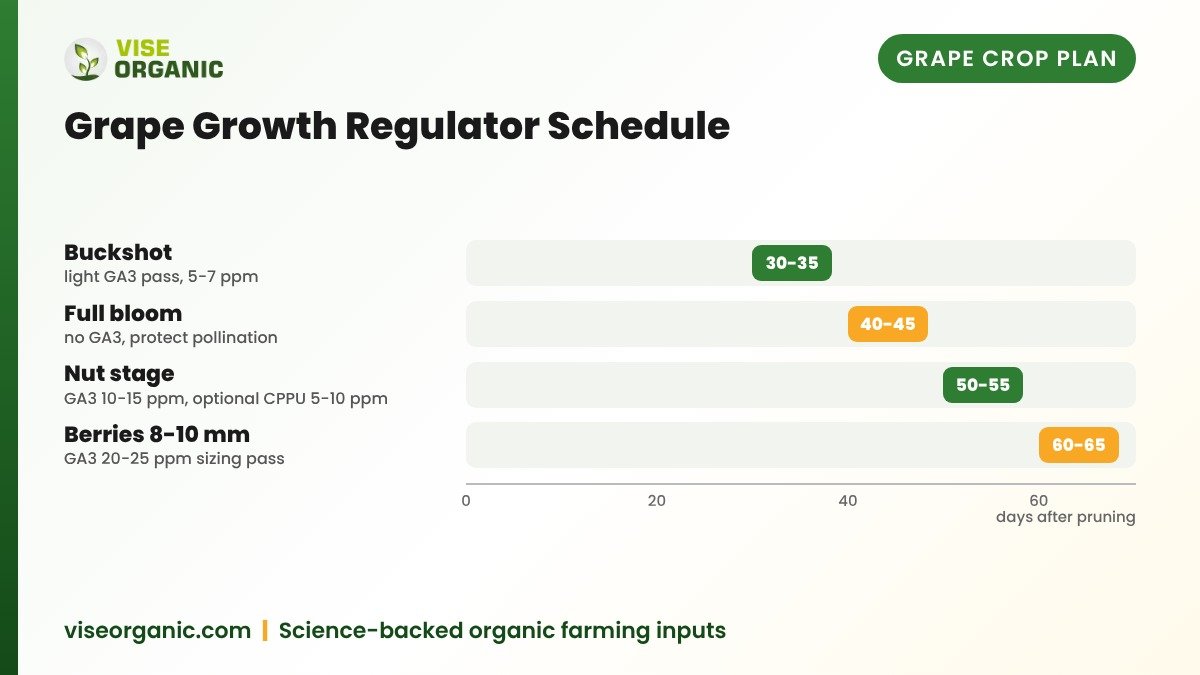
CPPU is generally added once at the nut stage at 5-10 ppm, and only if berry set is already even. The important number is not the ppm alone but the total gibberellin the bunch receives across the cycle. Skip the full-bloom spray entirely: applying GA3 into open flowers interferes with pollination and increases the second shatter.
Two practical points on the tank. GA3 needs a fully dissolved, slightly acidic solution, so mix it in a small bucket of clean water before it goes into the main tank. Add the adjuvant last, not first, so the spread on the waxy berry surface is even.
Thinning and Girdling Before Any Hormone Touches the Vine
The sprays only organise what the vine can already feed. Two vineyard jobs decide more of your pack-out than the tank mix does.
- Balance the buds at pruning. Count the buds you leave per vine against your target cane length; an overloaded vine drops berries later no matter what you spray.
- Thin the panicle at 15-20 cm. Cut the shoulder and the tip so the remaining laterals carry even berries, and remove any panicle that is small or crooked.
- Open the canopy before flowering. Remove laterals shading the fruiting wire so light and spray both reach the panicle.
- Shatter and size the bunch at nut stage. Remove loose, shot berries and any bunch that is too tight, then decide the number of bunches per vine from the leaf area you actually have.
- De-shoot after fruit set. Keep 12 to 15 functional leaves per vine for ripening, and stop heavy nitrogen once colour break starts.
A well thinned bunch with a light spray does more than a heavy spray on an unthinned bunch.
Feeding the Set: The Organic Side of the Program
Growth regulators spend the vine's reserves. The nutrient side of the program is what refills them, and this is where an organic block earns its residue-free record.
- Seaweed extract before flowering. A foliar seaweed feed at buckshot supports pollen tube growth and gives the young berries a potassium and cytokinin base; see our Seaweed extract for crops.
- Amino acids at fruit set. An amino acid feed at nut stage helps the vine carry the stress of the second shatter; our Amino acid product Uphar is used in this slot by many vineyard programs.
- Potassium humate through the drip. Humate improves root growth and potassium uptake during berry enlargement; see Water soluble potassium humate.
- A special PGR for the sizing stage. Blocks that want even berry size in the 8-10 mm window often use a crop-specific promoter such as Nutri Sure alongside the mineral program.
- A spreader on every bunch spray. A waxy berry and a hard panicle need a proper spreader; see Plant Stick spread adjuvant.
If you are building the full cycle, the Pomegranate flowering and fruit set organic plan follows the same logic of feeding the set before pushing it, and the Zaid flowering and fruit set plan for chilli and okra covers the same stage in vegetables.
Keeping the Block Residue-Free and NPOP-Defensible
An export lot is held up on a residue report, not on a yield figure. That is the reason a lot of growers are moving the bunch spray program onto a documented input list.
- Only inputs on your approved list. Under NPOP, what you spray has to be on the permitted input list your certifier works from; the rules of the certifier and NPOP decide what is allowed on a certified block, not a catalogue claim.
- Growth regulators need a clear status check. GA3 and CPPU are used widely in conventional table grape. Before you count on them in a certified block, get written confirmation from your certifier on whether the exact product is permitted, and keep that letter in the file.
- Records per block, not per farm. Every spray in every block needs a date, a product name, the batch number, the dose in ppm or ml per litre, and the operator. The NPOP input checklist for FPO export crops lists the documents an inspector asks for.
- Pre-harvest interval and residue testing. Plan the last bunch spray against your buyer's MRL and the declared PHI, and keep the lab report with the lot. The NPOP certification records for export crops shows how to file these so an audit does not stall a container.
- Buffer and drift. Keep a record of what is sprayed on neighbouring conventional blocks; drift from a neighbour's tank is the most common way a clean block loses its status.
For the wider residue logic in a grape block, the Residue-free grape export plan covers the pest management side that this guide leaves out.
Safety, Mixing and Storage
- Read the label first. The product label is the legal document for dose, stage and PHI; ppm rates on the label override any schedule written on the internet, including this one.
- Wear gloves and a mask. Concentrated GA3 irritates skin and eyes, and CPPU powders are harmful if inhaled. Mix in an open, airy place.
- Dissolve properly. Wet the powder with a little water into a paste, then top up and stir before adding it to a half-full tank of clean water.
- Do not mix with alkaline products. Do not tank mix growth regulators with copper, bactericides or strongly alkaline sprays unless the label clearly allows it; microbial biofertilizer sprays are best kept on a separate day.
- Store cool and dark. Keep the container closed, away from sun, heat and moisture, and lock it away from children and animals. Never rinse anything into a well, pond or canal.
What FPOs and Dealers Should Check Before Selling a Program
A bunch-spray program is a document as much as a product. Before an FPO recommends one to its member vineyards, or a dealer stocks a growth regulator for grape, run these checks.
- Registration and content. Ask for the CIB&RC registration number of the growth regulator and the stated assay, and match it to what the bag actually says.
- Batch certificate. Take the certificate of analysis for the batch you buy, with the manufacturing and expiry dates, and keep it against the batch number in your records.
- Packing integrity. Foil-sealed, unopened packs with legible printing only. Damaged or re-packed sachets are a common source of weak solutions that fail in the field.
- Shelf life and storage. GA3 breaks down in heat and light. Check the storage conditions at the dealer's godown, and note the remaining shelf life at the time of purchase.
- Label and literature. The label language, the crop list and the PHI must match the state where you sell it. Ask for a copy of the certifier's permitted input note if the block is certified organic.
Frequently Asked Questions
When should GA3 be sprayed for grape flower induction?
The first low-rate pass is normally at buckshot stage, around 30 to 35 days after pruning, with further sizing sprays at nut stage and when berries reach 8 to 10 mm. Do not spray GA3 into open flowers, as it can disturb pollination and increase shatter. Confirm the stage and rate on your product label.
What is the difference between GA3 and CPPU in a grape spray?
GA3 is a gibberellin that makes cells elongate, so it lengthens the panicle and keeps the rachis green. CPPU is a cytokinin-type material that supports cell division, so it acts early on fruit retention and berry size. Because they work on different systems, programs split low rates across stages rather than applying full doses of both at once.
Can GA3 and CPPU be used in a certified organic grape block?
That depends on NPOP and your certification body's permitted input list, not on a general claim. Get written confirmation from your certifier for the exact product before using it in a certified block, and file that letter with your spray records. Many export grape programs are built entirely on permitted organic inputs for this reason.
How much bunch shatter is normal in table grape?
Some drop is natural. Grapes normally shed a large share of the flowers and berries through two natural shatter periods, one at full bloom and one after fruit set, so a vine with a full panicle at buckshot does not automatically carry a full bunch at harvest. Thinning, canopy light and balanced crop load reduce how much of that loss you suffer.
Do I still need to thin bunches if I spray growth regulators?
Yes. A growth regulator organises the berries the vine can already feed. Panicle thinning at 15 to 20 cm, bunch sizing at nut stage and a realistic number of bunches per vine do more for pack-out than any tank mix, and they also reduce the tight bunches that crack later.
Why do my grape berries come out rough and uneven after a GA3 spray?
Rough, uneven berries and cracked shoulders usually mean too much gibberellin in the cycle, a rate too high for the stage, or a tank mix of full doses of GA3 and CPPU together. Heat at the time of spraying and poor dissolution of the powder can produce the same result. Split the dose across stages and mix in a bucket first.
What records does an FPO need for a residue-free grape lot?
A spray register per block with dates, product names, batch numbers, doses and operators, batch certificates of analysis, the declared pre-harvest interval, the residue lab report for the lot, and a note of anything sprayed on neighbouring blocks. The NPOP inspector works from these documents, so the lot moves only when the file is complete.
Conclusion
Grape flower induction with GA3 and CPPU works when the vine is prepared first and the hormones are used lightly, at the right stages: nothing at full bloom, a low rate at buckshot, and a single sizing pass at nut stage and at 8 to 10 mm berries. Thin the panicle, balance the crop load and feed the set with seaweed, amino acids and humate, and the sprays have something to hold on to. In a block being run for export, every tank must also be on paper, with the certifier's written status on the growth regulator sitting next to the spray register.
Talk to our team about the nutrient side of your grape program and the products named above on Our shop page, or Request a callback for vineyard-specific advice from an agronomist.
Disclaimer: This article is general agronomic information. Results vary with soil, crop, weather and practices. Always read and follow the product label and consult a local agronomist for advice specific to your field.
Article Topics & Tags:
Vise Agronomy Team
The in-house agronomy and field research team at Vise Organic Biotechnology, publishing applied research on bio-fertilizer protocols, crop protection, and sustainable cultivation practices.