Bitter gourd is the crop where fruit fly damage is noticed last and paid for first. You keep picking, the vines look healthy, and then one load at the mandi comes back full of yellow, split fruits with maggots inside. By that stage the flies have been laying eggs in your young fruit for three or four weeks, and no spray on a grown fruit will undo it.
This guide covers bitter gourd fruit fly control with botanical sprays and microbial products: how to tell the two fly species apart by the damage, a scouting route that gives you a real count instead of a guess, the spray window that actually lands on the flies, and how to fit all of it into a zaid or late kharif schedule. It is written for growers in the plains who run one to five acres on trellis or field planting.
Why Timing Beats the Spray Itself
The female fly sits on an open flower or a fruit younger than five days, cuts a small pocket and puts in eggs. Those punctures heal over within a day or two, and the fruit keeps swelling. What you see later, the yellowing, the soft rot and the maggots, is the harvest of matings that happened weeks before.
That is why a grower who sprays on a fixed calendar date every ten days often loses more than one who sprays only four times, aimed at the fly's morning feeding and mating hours. Bitter gourd flower opening, fly activity and fruit susceptibility all line up in the same narrow part of the morning, so a well-timed botanical spray does work a poorly timed chemical one cannot.
Say you grow three acres of karela near Bharatpur on sprinkler irrigation, sown in the second week of February. Your first flowers open around the 40th day, peak fly pressure usually lands in the third and fourth week after that, and that one window decides most of your marketable grade.
Know the Two Flies by the Damage
Two pests do almost all the damage, and they leave different evidence. Reading the evidence tells you which one you are chasing and where to aim.
- Fruit fly (Bactrocera species). Small punctures with a dark pinprick near the blossom end, stinging marks on young green fruit, and white maggots inside a fruit that still looks sound from outside.
- Cucurbit fruit fly (Melanoneura species). Fresh gum-like exudation and a small hole on the fruit, and the same kind of hole with gum on the stem, where the larvae bore into the vine.
- Damage on mature fruit. Yellowing, sunken and water-soaked patches and a soft collapse, which is old egg-laying plus secondary bacteria, not a fresh attack you can still stop.
The distinction matters practically. Bactrocera attacks the fruit and needs fruit-cover sprays from flowering on. Melanoneura bores into stems too, so you also inspect the main vine near the base and remove the damaged portion rather than only spraying the canopy.
The Scouting Route That Gives a Real Number
Walking the field diagonally once is not scouting. Fruit flies gather at the field edge first, especially the side near a bund, an old vegetable plot or a tree line, so your count must sample edge and centre separately.
Walk the crop in a W pattern across the plot and stop at five fixed points: two on the windward edge, one in the middle and two on the far side. At each point check ten open flowers, ten fruits under five days old and five older fruits, and write the punctured ones in a notebook or on your phone.
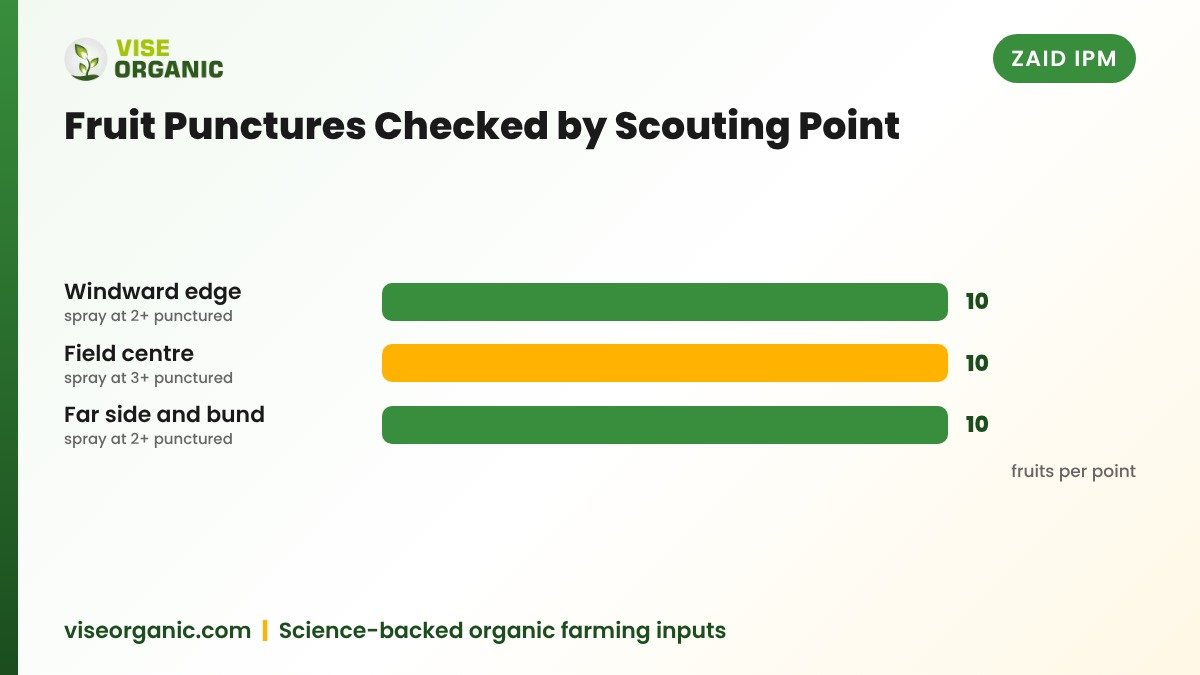
Edge rows carry the highest count in most plots, so do not average them away with the centre. If edge and centre both show punctures, the population is established and a single spray will not hold it.
Botanical Sprays and What They Do
Botanical and microbial products are contact and deterrent treatments. They disturb feeding, mating and egg-laying while the fly is on the plant. They do not kill the larva already inside a fruit, which is why sanitation carries half the load.
- Neem oil. Acts as a repellent and antifeedant and interferes with larval development. Use it at the label rate with a proper emulsifier, on the youngest fruit and the flower cluster.
- Pungent botanical extracts. Chilli, garlic and karanj-based sprays push flies off the flowering canopy for a few days; they wash off fast, so cover matters more than strength.
- Entomopathogenic fungi. A Beauveria-type product applied as a contact spray infects the adult resting on wet foliage, so the best fungal spray goes at the same evening hours when flies are on the canopy.
- Entomopathogenic bacteria. A Bacillus thuringiensis spray targets the young larva as it feeds, useful where stem borer holes from cucurbit fly also show on the vines.
- Spray adjuvants. Waxy cucurbit leaves shed plain sprays. A spreader-sticker from the Plant Stick page improves coverage on the flower and fruit surface.
Vise Organic Eco Safe and Eco Cover sit in this contact-and-deterrent group in our range, and Virexx is used where the flies have carried virus symptoms into the crop. Follow the label dose on the pack you hold. Our Shop page lists the full range.
In karela, the spray that lands between 7 and 10 in the morning on the flower cluster does more than any dose sprayed at noon on the leaves.
A Week-by-Week Spray Calendar
The table below is a typical zaid schedule for a February sowing on trellis. Shift every line by the days your crop actually reaches each stage, and confirm the product dose on the label.
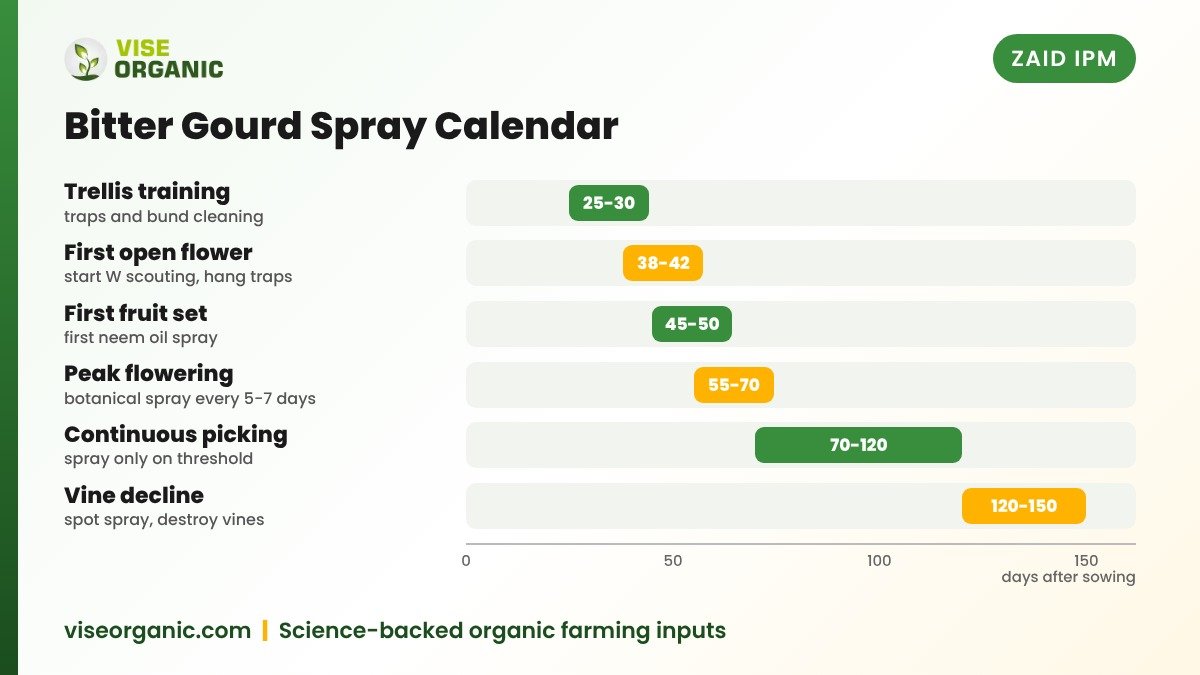
Two rules make this calendar work. First, alternate the botanical group you use, neem one round and a microbial product the next, so you are not relying on one mode of action. Second, once picking has started, a spray goes on only when your scouting crosses the threshold, not because the week arrived.
The Morning Window and Nozzle Work
Adult flies are least active and easiest to contact in the cool early hours, roughly 7 to 10 in the morning, and again for a short spell late in the evening. Midday spraying on a 38 degree day wastes most of the tank in evaporation and pushes the flies to a shaded neighbour's field.
- Scout before you mix. Do the W route, count punctures and decide whether today is a spray day.
- Cut the canopy target first. Aim at open flowers, fruit under five days and the leaf underside, not the top of mature leaves.
- Mix with a sticker. Fill half with water, add the emulsified botanical, the adjuvant, then make up the volume; do not pour concentrate into a full tank.
- Spray 07:00 to 10:00. Cover the edge rows on the windward side before moving inward, since that is where the flies land first.
- Finish with sanitation. Collect every fallen and punctured fruit in a bucket and cover it with soil or bag it in the sun, never dump it on the bund.
- Log the day. Write the date, stage, product and count; the next spray date comes from that note, not from memory.
Use a fine droplet at low pressure for flowers. A heavy jet blows petals off and reduces the very fruit set you are protecting.
Traps, Sanitation and the Field Edge
Sprays are the smaller half of bitter gourd fruit fly control. The fly population in your plot is set by what you remove and where the flies came from.
- Male traps. Methyl-eugenol traps at the label count per acre, hung on the windward boundary at canopy height, drawn the males out of the mating population.
- Yellow sticky traps. Placed just above the trellis to track whitefly and aphid pressure, which ride into the crop at the same time as the flies.
- Protein bait spots. Small bait stations on the bund pull adults off the fruit; put them away from the flowering canopy so you do not draw more flies into the rows.
- Fruit sanitation. Pick up punctured and fallen fruit twice a week and destroy them by deep burial or solarisation in a sealed bag, not by leaving them on the field margin.
- Stem care. Cut the affected stem portion below the gum hole on cucurbit fly attacks and burn or bury the cut piece.
- Harvest tight. Do not leave overripe fruit on the vine as a larva nursery between picks.
Neighbour coordination pays here. On a two-acre plot with a fallow or late vegetable plot next door, most reinfestation walks in from that side, so trap the boundary you share.
Reading the Damage Along With Other Pests
Fruit fly entry wounds let secondary rot organisms in, and that rot is what turns one punctured fruit into a whole basket of rejects. Where dieback, fruit rot or viral mottle symptoms follow the fly damage, work on both at once rather than treating the fly alone. Our guides on Eco-safe pest and disease management and Virexx for sustainable pest management cover that second half.
Sap feeders complicate the count too. Where whitefly and aphids are also present, read Natural pest and disease management and What strategies organic farmers use for pest management before you stack products in one tank. Never mix a microbial spray with a chemical fungicide or bactericide unless the label clearly allows it.
Safety and Label
Read the full label before every tank mix, including the re-entry interval and the pre-harvest interval, which matters most on a crop you pick every two or three days. Wear gloves, a mask and full sleeves; wash the mask separately from household cloth and keep it for spray use only.
Store packs in a cool, dry, shaded place away from direct sun, and never near the kitchen or drinking water. Keep all containers closed and out of children's reach, and do not wash the sprayer or your hands in a pond, well or canal. Calibrate the nozzle before the season, not in the middle of a spray round.
If you are buying botanical or microbial products in bulk for your shop or FPO, ask for the batch certificate and the active content, check the packing seals and the manufacturing and expiry dates, and confirm the storage conditions you can actually offer your customers. Products for certified organic farms must satisfy your certifier's approved list under NPOP rules; ask the supplier for the paperwork rather than relying on a claim.
Frequently Asked Questions
When should I start spraying my bitter gourd for fruit fly?
Begin scouting when the first flowers open, around 38 to 42 days after sowing, and put the first botanical spray on at first fruit set, roughly 45 to 50 days. After that, spray on your puncture count and not on a fixed date.
What time of day is best for a botanical spray on karela?
Between 7 and 10 in the morning, while adult flies are on the flowers and young fruit and evaporation is low. A short late-evening round also works in very hot weeks. Avoid the middle of the day.
How do I tell fruit fly damage from a stem borer attack?
Fruit fly leaves pinprick punctures near the blossom end of a young fruit with maggots inside. Cucurbit fruit fly and borers also leave gum-like exudation and a hole on the stem itself, so check the main vine base as well as the fruit.
Do neem oil sprays actually work against bitter gourd fruit fly?
Neem oil works as a repellent and antifeedant on the flies while they are feeding and laying on the plant, and it disrupts larval development. It will not kill a larva already inside a fruit, so pair it with picking up and destroying punctured fruit.
How many traps per acre do I need?
Use the trap count stated on the methyl-eugenol pack you buy, placed on the windward boundary at canopy height. Add yellow sticky traps just above the trellis to track whitefly and aphids. Traps support sprays, they do not replace them.
Can I mix neem oil with a microbial biopesticide in one tank?
Do not combine them unless both labels clearly allow it, since botanical sprays can reduce the viability of a microbial product. Alternate them across rounds instead, and always do a small jar test first.
Is this plan acceptable on a certified organic farm?
What is allowed on certified land is decided by your certifier and the NPOP approved list, not by a product label claim. Ask the supplier for the documentation and confirm with your certifier before using anything.
Conclusion
Bitter gourd fruit fly control comes down to three habits: scout in a W pattern with a real count, spray the flowering canopy and young fruit in the cool morning window, and remove punctured fruit twice a week so the population does not build behind your sprays. Botanical and microbial products do their best work inside that routine, on the right days and at the label dose.
Start with your own field edge this week, note the puncture count, and build the spray calendar from what you see rather than from a fixed date. Browse Our products for the full range, or Contact Vise Organic and Request a callback for crop-specific advice on your plot.
Disclaimer: This article is general agronomic information. Results vary with soil, crop, weather and practices. Always read and follow the product label and consult a local agronomist for advice specific to your field.
Article Topics & Tags:
Vise Agronomy Team
The in-house agronomy and field research team at Vise Organic Biotechnology, publishing applied research on bio-fertilizer protocols, crop protection, and sustainable cultivation practices.